Research Peptides, Bioregulators & Laboratory Compounds
Browse research compounds by mechanism and study area, including GLP-1 receptor pharmacology, growth-hormone signalling, tissue biology and cellular metabolism. View available vial strengths and product-specific analytical documentation before ordering. For laboratory research only.
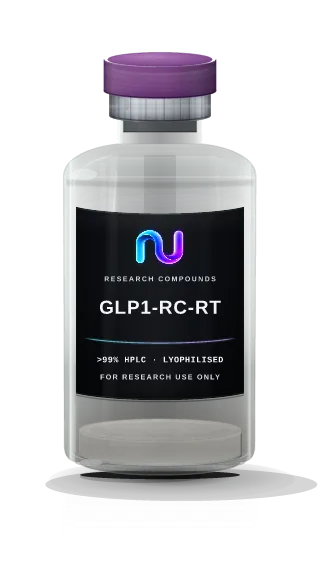
Retatrutide is an investigational triple receptor agonist targeting GLP-1, GIP and glucagon receptors. Studied in receptor-pharmacology and metabolic research, with GLP1-RC-RT supplied as laboratory research material.
GHK-Cu is the copper(II) complex of glycyl-histidyl-lysine, a naturally occurring tripeptide. Studied in fibroblast cultures for collagen synthesis, extracellular-matrix signalling and dermal tissue biology.
MOTS-c is a 16-amino-acid peptide encoded by mitochondrial DNA. Investigated in preclinical models of AMPK signalling, cellular energy balance and glucose metabolism.
Tirzepatide is a dual agonist of GIP and GLP-1 receptors. GLP1-RC-TZ research material is listed for comparative incretin-receptor pharmacology, insulin-signalling and metabolic-pathway studies.
Tesamorelin is a stabilised growth-hormone-releasing hormone analogue based on GHRH(1-44). Relevant research examines GHRH-receptor activation, pituitary growth-hormone release and GH/IGF-1 endocrine signalling.
KLOW combines four research compounds in one lyophilised vial: copper peptide GHK-Cu, KPV, BPC-157 and New-U's full-length thymosin beta-4 (TB-500). The components are studied individually; blend-specific findings are not established.
Bacteriostatic water contains sterile water with 0.9% benzyl alcohol as a preservative. A laboratory diluent for compatible materials; select bottle volume and verify protocol-specific compatibility before use.
BPC-157 is a synthetic 15-amino-acid peptide derived from a gastric-protein sequence. Studied mainly in cell and animal models of gastrointestinal integrity, tendon biology and vascular signalling.
Semax is a synthetic ACTH(4-10)-derived heptapeptide. Studied in neurological research models for neurotrophin-related signalling, including BDNF-associated pathways and stress-response biology.
SS-31, also known as elamipretide, is a mitochondria-targeted tetrapeptide associated with cardiolipin interactions at the inner mitochondrial membrane. Studied for mitochondrial membrane function and cellular bioenergetics.
Cerebrolysin is the name associated with a porcine brain-derived peptide preparation studied in neurobiology. Confirm the supplied material's exact composition and formulation before comparing it with published Cerebrolysin studies.
New-U's TB-500 is full-length, 43-residue thymosin beta-4, not a short TB-4 fragment. An actin-binding peptide studied in cell migration, cytoskeletal dynamics and tissue models.
Ipamorelin is a five-amino-acid growth-hormone secretagogue that acts at the ghrelin receptor GHS-R1a. Investigated for pituitary GH-release signalling and receptor selectivity in endocrine research.
Selank is a synthetic tuftsin-derived heptapeptide. Investigated in preclinical models of stress-related neurochemistry, GABA-associated signalling and neuroimmune interactions.
PT-141, also known as bremelanotide, is a melanocortin receptor agonist. Studied in receptor-pharmacology and central melanocortin-signalling research; New-U material is for laboratory use only.
CJC-1295 without DAC is a modified GRF(1-29) analogue lacking the albumin-binding drug affinity complex. Studied for GHRH-receptor activity and short-duration growth-hormone-axis signalling.
NAD+ is a cellular redox coenzyme, not a peptide. Studied in metabolism, mitochondrial biochemistry and NAD+-dependent enzyme systems, including sirtuins, PARPs and CD38.
A two-component lyophilised blend of BPC-157 and New-U's full-length thymosin beta-4 (TB-500). Intended for laboratory investigation of complementary gastric-pentadecapeptide and actin-associated cell biology; blend-specific results are not established.
CJC-1295 with DAC is a modified GHRH analogue containing an albumin-binding drug affinity complex. Research compares prolonged GHRH-receptor signalling with shorter-acting GRF analogues.
Epitalon is the synthetic tetrapeptide Ala-Glu-Asp-Gly (AEDG). Investigated in cell and animal studies involving telomerase-associated pathways, pineal biology and cellular ageing models.
Cagrilintide is a long-acting amylin analogue investigated for amylin- and calcitonin-receptor signalling. Its research includes food-intake neuroendocrine signalling in preclinical models and interaction with incretin signalling.
Kisspeptin-10 is a C-terminal fragment of the KISS1 peptide family and an agonist of KISS1R/GPR54. Studied for hypothalamic GnRH signalling and reproductive-endocrine regulation.
IGF-1 LR3 is a modified insulin-like growth factor-1 analogue with an extended N-terminal sequence and Arg3 substitution. Investigated for IGF-1 receptor signalling and IGF-binding-protein interactions.
Human chorionic gonadotropin (hCG) is a glycoprotein hormone that activates the luteinising hormone/chorionic gonadotropin receptor. Used in reproductive-endocrine and steroidogenesis research models.
A laboratory blend combining a short-acting GHRH analogue (CJC-1295 without DAC) with the ghrelin-receptor agonist ipamorelin. Designed for research comparing two distinct growth-hormone-axis signalling pathways.
Prostamax is the Lys-Glu-Asp-Pro tetrapeptide from the Khavinson bioregulator family. Its limited experimental literature covers tissue-explant growth and chromatin-related assays.
Melanotan II is a cyclic alpha-MSH analogue with activity at multiple melanocortin receptors. Laboratory research examines receptor selectivity, melanogenesis and broader melanocortin signalling.
KPV (Lys-Pro-Val) is the C-terminal tripeptide of alpha-melanocyte-stimulating hormone. Studied in preclinical intestinal, skin and immune-cell models for inflammatory signalling and epithelial responses.
GLOW combines GHK-Cu, BPC-157 and New-U's full-length thymosin beta-4 (TB-500) in a single research vial. The components are individually studied in collagen, cytoskeletal and cell-migration models; blend-specific results are not established.
Sermorelin is the N-terminal 29-amino-acid fragment of growth-hormone-releasing hormone. Used in endocrine research examining GHRH-receptor activation and pulsatile pituitary GH signalling.
AHK-Cu is the copper complex of the Ala-His-Lys tripeptide. Research examines dermal papilla cells, hair-follicle biology and VEGF-associated signalling in preclinical models.
Thymosin alpha-1 is a 28-amino-acid peptide investigated in immune-system research. Published studies examine T-cell signalling, innate immune responses and cytokine regulation.
Reduced glutathione (GSH) is a naturally occurring tripeptide central to intracellular redox chemistry. Research uses include glutathione-peroxidase pathways, oxidative-stress assays and cellular antioxidant systems.
Melanotan I, also called afamelanotide, is a linear alpha-MSH analogue with strong MC1R activity. Studied in melanocortin-receptor pharmacology and pigment-cell biology.
Pinealon is the Glu-Asp-Arg (EDR) tripeptide from the Khavinson bioregulator family. Studied in cellular models of neuronal stress, oxidative injury and gene-expression responses.
DSIP is a synthetic nonapeptide investigated in experimental sleep, stress-axis and neuroendocrine research. Its biological activity and mechanisms remain incompletely established.
Bronchogen is the Ala-Glu-Asp-Leu tetrapeptide from the Khavinson short-peptide family, studied in bronchial epithelial cell cultures and limited rat models. No human outcomes are established.
5-Amino-1MQ is a synthetic small molecule, not a peptide. It inhibits nicotinamide N-methyltransferase (NNMT) and is studied in preclinical NAD+ metabolism and adipocyte biology.
PEG-MGF is a PEGylated analogue of mechano growth factor, an IGF-1-related peptide. Studied in muscle-cell models for IGF signalling, satellite-cell biology and the effects of PEGylation.
Semaglutide is a long-acting GLP-1 receptor agonist analogue with a lipid side chain that supports albumin binding. GLP1-RC-SM is supplied for laboratory incretin-receptor and metabolic-pathway research.
FOXO4-DRI is a D-retro-inverso peptide designed to interfere with FOXO4-p53 interactions. Explored in cell and animal models of senescent-cell survival and apoptosis signalling.
SNAP-8 is an acetylated octapeptide used in cosmetic-ingredient research. Investigated in models of SNARE-complex interactions and neurotransmitter-release mechanisms.
Adamax is an adamantane-modified peptide built around the Semax/ACTH(4-10) scaffold. Research interest concerns peptide stability, structural modification and neurological signalling models; published evidence is limited.
AOD-9604 is a modified C-terminal fragment of human growth hormone. Studied in adipose-cell and preclinical metabolic models for lipid-handling pathways, distinct from full-length GH signalling.
Hexarelin is a synthetic growth-hormone-releasing hexapeptide and ghrelin-receptor agonist. Investigated in endocrine studies of GH release and receptor interactions, including GHS-R1a and CD36.
A pre-mixed blend of tesamorelin, a GHRH-receptor agonist, and ipamorelin, a GHS-R1a agonist. For laboratory study of complementary endocrine receptor pathways; choose the actual per-component strength.
A two-peptide research blend combining Semax and Selank. Each is investigated separately in neurochemical and stress-response models; combined-formulation outcomes have not been established.
GHRP-2 (pralmorelin) is a synthetic hexapeptide agonist of the ghrelin receptor. Studied in endocrine research for growth-hormone secretagogue activity and related hypothalamic-pituitary pathways.
GHRP-6 is a synthetic growth-hormone-releasing hexapeptide that activates the ghrelin receptor. Investigated in GH-secretion and ghrelin-receptor signalling models.
Oxytocin acetate is the salt form of the nine-amino-acid peptide hormone oxytocin. Used in receptor and neuroendocrine research involving OXTR signalling, social-behaviour models and smooth-muscle biology.
Cartalax is the Ala-Glu-Asp tripeptide from the Khavinson short-peptide family. Investigated in preclinical cartilage, connective-tissue and gene-expression models.
Testagen is the Lys-Glu-Asp-Gly tetrapeptide. Research focuses on short-peptide interactions with chromatin and endocrine or thymic tissue models; the evidence is primarily preclinical.
Cardiogen is the Ala-Glu-Asp-Arg tetrapeptide in the Khavinson short-peptide family. Studied in cardiac tissue explants and cytoskeletal protein-expression models.
Cortagen is the Ala-Glu-Asp-Pro tetrapeptide. Investigated in preclinical cerebral-cortex and neural tissue models within the Khavinson peptide research programme.
Vitamin B12 (cobalamin) is a cobalt-containing cofactor involved in methionine synthase and methylmalonyl-CoA mutase activity. Supplied as research material for biochemical and metabolic assays; not a peptide.
Liraglutide is an acylated GLP-1 analogue with a C16 fatty-acid modification supporting albumin binding. Studied in GLP-1 receptor pharmacology and metabolic-signalling research.
PNC-27 is a synthetic chimeric peptide incorporating a p53-derived sequence and membrane-targeting segment. Investigated in cell-line and membrane-interaction studies; evidence is early-stage.
Vilon is the Lys-Glu (KE) dipeptide from the Khavinson bioregulator family. Investigated in cell and animal models of immune and gene-regulatory signalling.
Eloralintide (LY3841136) is an investigational selective amylin-receptor agonist. Studied for amylin-pathway pharmacology and neuroendocrine energy-balance signalling.
IGF-DES is an IGF-1 analogue lacking its first three N-terminal amino acids. Studied for IGF receptor activity and altered interactions with IGF-binding proteins in cell models.
LL-37 is the 37-residue human cathelicidin antimicrobial peptide. Investigated in microbiology, innate-immune signalling and epithelial barrier models.
Follistatin 344 is a follistatin precursor isoform studied in the activin/myostatin signalling system. Research focuses on ligand sequestration, muscle-regulatory pathways and isoform biology.
Follow New-U in GoogleAdd New-U as a preferred source for future research updates and articles.
New-U Research Compounds supplies research-grade compounds. Independent laboratories (Janoshik Analytical, Freedom Diagnostics and Lingda Laboratory) analyse submitted samples, and each report published at /coa states what was measured in the sample tested, including purity. Certificates of Analysis are published for the compounds that have a report.
Catalog
Metabolic Research: incretin and amylin receptor agonists, and mitochondrial and cellular-ageing research compounds.
GH-Axis Research: GHRH analogues and ghrelin-receptor (GHS-R1a) agonists.
Compounds are supplied as lyophilised powder, in 10-vial packs or as single vials. Qualifying orders include complimentary bacteriostatic water, calculated from the vials in the order; the cart shows the quantity before checkout.
Shipping & payments
We ship direct from the source. That takes a little longer to reach you, but your research is worth the short wait.
US researchers: see the USA research peptides hub for USD pricing, published COAs and tracked US delivery.
We accept cards and crypto — BTC and selected stablecoin and network-asset payments across Ethereum, Solana, TRON, Polygon, Base, BNB Chain and Linea.
Not for human or veterinary use - for laboratory research only.