
Tanning & skin pigment
Research explores how it tells the skin to build its own dark pigment without needing sun exposure to trigger the response.
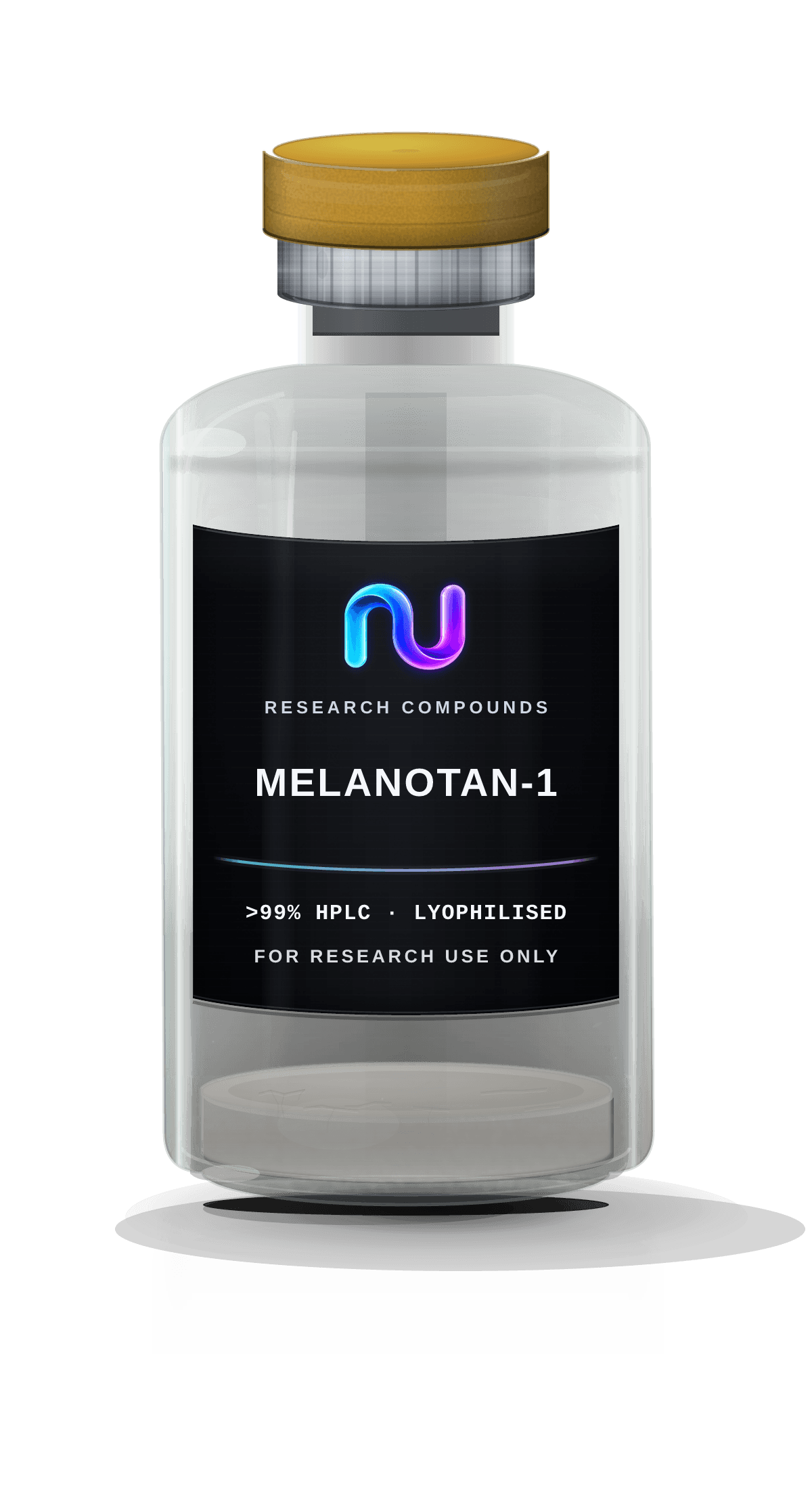
Melanotan-1 (afamelanotide, Melanotan I) is a linear 13-amino-acid α-MSH analogue, [Nle4,D-Phe7]-α-MSH, studied as a selective MC1R agonist that drives eumelanin synthesis through cAMP signalling without UV exposure. Its literature includes human clinical pharmacology and a phase 3 trial in erythropoietic protoporphyria, alongside largely anecdotal cosmetic pigmentation reports. New-U supplies Melanotan-1 as lyophilised research material in selected vial strengths. It is not the approved finished medicine, and that clinical record must not be transferred to this laboratory material.
Melanotan-1 (Afamelanotide) Research Peptide
Tap a pack to select it
Buy the 10-pack - save 66%/mg. Single vials welcome — checkout needs 3+ vials or any 10-vial pack - build a custom vial pack
In plain terms, Melanotan-1 (afamelanotide) is studied mainly for skin pigment and light protection. Here is what that looks like across the research.
Research explores how it tells the skin to build its own dark pigment without needing sun exposure to trigger the response.
In clinical research it is investigated for shielding very light-sensitive skin, and it is the approved compound (as Scenesse) for the rare light-pain condition EPP.
Studied for whether the extra pigment helps the skin cope better with UV exposure and supports the skin's own repair processes.
Investigated in people who naturally make little pigment, to see whether it can still build a protective tan in that group.
In short: Melanotan-1 (afamelanotide, Scenesse) is a selective MC1R agonist that drives UV-independent eumelanin production - the only melanocortin peptide currently FDA- and EMA-approved for human therapeutic use.
These points summarise lab themes, not human outcomes.
Melanotan-1 is a linear 13-amino-acid analogue of α-MSH with two non-natural substitutions (Nle4 and D-Phe7) that block enzymatic degradation and give it much higher affinity for the melanocortin 1 receptor than native α-MSH. Unlike its cyclic cousin Melanotan-2, MT-1 is relatively selective for MC1R, so its main pharmacological action is melanogenesis rather than appetite suppression or central arousal.
The practical consequence is UV-independent tanning. MT-1 tells melanocytes in the skin to start making eumelanin even without sun exposure, and the resulting pigment gives broad-spectrum UV absorption, free-radical scavenging, and enhanced DNA repair. That is exactly what you need if you have a condition like erythropoietic protoporphyria (EPP), where even brief light exposure causes painful skin reactions.
MT-1 is marketed as Scenesse and is EMA-approved (2014) and FDA-approved (2019) for EPP. More than 25 years of clinical follow-up have accumulated with no late effects reported. It is supplied here as sterile lyophilised powder.
Afamelanotide (Melanotan I, NDP-MSH) is a linear 13-amino-acid synthetic analogue of α-MSH ([Nle4,D-Phe7]-α-MSH, MW 1646.87 Da) with Nle4 and D-Phe7 substitutions conferring enhanced MC1R binding affinity, proteolytic resistance, and prolonged biological activity compared to native α-MSH. MC1R activation initiates adenylate cyclase-cAMP-PKA-CREB signaling, driving MITF-dependent transcription of tyrosinase, TYRP1, and DCT melanogenesis genes for eumelanin biosynthesis independent of UV stimulation (Barnetson et al., Journal of Investigative Dermatology, 2006). Eumelanin provides broad-spectrum photoprotection by absorbing UVB, UVA, and visible light while scavenging free radicals and enhancing DNA repair. Approved by the EMA (2014) and FDA (2019) as Scenesse for erythropoietic protoporphyria (EPP), with no late effects reported 25 years after first exposure. Effective in individuals carrying MC1R variant alleles (Val60Leu, Arg151Cys, Arg160Trp).
MT-1 selectively activates MC1R on melanocytes, turning on the cAMP/PKA/MITF cascade that drives eumelanin biosynthesis independently of UV exposure.
| Pathway | Effect | Why it matters |
|---|---|---|
| MC1R activation | Selective agonist on melanocytes | Triggers pigmentation without the MC4R / MC5R side effects of non-selective analogs |
| cAMP / PKA / CREB | Second messenger cascade | Classical melanogenic signalling pathway |
| MITF transcription | Upregulates melanogenesis genes | Drives transcription of tyrosinase, TYRP1, and DCT - the eumelanin biosynthesis machinery |
| Eumelanin biosynthesis | Produces broad-spectrum UV-absorbing dark pigment | Provides DNA-protective photoshield that works without sun exposure |
| Nle4 / D-Phe7 | Non-natural amino acids block protease degradation | Gives extended biological activity compared with native α-MSH |
Barnetson et al. (Journal of Investigative Dermatology, 2006) established the clinical pharmacology of MT-1 in humans, showing reliable pigmentation without the central effects of non-selective melanocortin analogs. The Nle4 substitution prevents methionine oxidation while D-Phe7 resists proteolysis, which together give the peptide enough circulating stability to drive meaningful receptor occupancy. The implant formulation (Scenesse) releases 16 mg over roughly 60 days, delivering sustained MC1R activation at low effective doses. Importantly, MT-1 is effective in individuals carrying MC1R loss-of-function variants (Val60Leu, Arg151Cys, Arg160Trp) who have weak endogenous pigmentation.
Melanotan-1 (afamelanotide, MT-1) is a synthetic linear 13-amino-acid analogue of α-MSH ([Nle4,D-Phe7]-α-MSH, MW ~1647 Da) that selectively activates the melanocortin-1 receptor (MC1R) to drive eumelanin synthesis. It is the molecule approved as Scenesse (a 16 mg implant) for erythropoietic protoporphyria. New-U supplies it as a research-grade lyophilised powder for laboratory research use only - not the approved drug.
MT-1 is a linear 13-amino-acid peptide that is relatively selective for MC1R (pigmentation). MT-2 is a cyclic 7-amino-acid peptide that hits all four melanocortin receptors non-selectively, which is why research reports it producing appetite suppression, nausea, and central arousal effects that MT-1 largely avoids. MT-1 is also the only one of the two FDA/EMA-approved for any indication.
The strongest data is in erythropoietic protoporphyria: a randomised phase 3 trial (Langendonk et al., NEJM 2015) reported that afamelanotide increased pain-free time in sunlight for EPP patients, which supported its EMA and FDA approval as Scenesse. Mechanistically, studies describe reliable MC1R-driven eumelanin accumulation without the central effects of non-selective analogues. This is summarised published research, not a human-use claim.
In the research literature, yes. Afamelanotide's clinical trial program tested populations carrying MC1R variant alleles (such as Val60Leu, Arg151Cys, and Arg160Trp) associated with weak natural pigmentation, and reported a pigmentation response even in those genotypes - one reason it was approved for EPP. Reported for research context only.
Published pharmacology describes a short plasma half-life of roughly 30 minutes after subcutaneous administration, but the studied biological pigmentation effect persists for several days because MC1R activation and slow receptor recycling outlast the circulating peptide. The Nle4 substitution prevents methionine oxidation and D-Phe7 resists proteolysis, extending activity versus native α-MSH. This is descriptive research context - not human-use dosing guidance.
Normal tanning requires UV damage - skin darkens as a response to DNA damage from sun exposure. MT-1 activates the same downstream pigmentation pathway (MC1R / cAMP / MITF / tyrosinase) directly at the receptor level, so in research models pigment accumulates without the upstream DNA-damage signal. The protective pigment is the same; only the trigger differs. Reported for research context only.
The finished pharmaceutical afamelanotide (Scenesse) is FDA- and EMA-approved for erythropoietic protoporphyria - that approval applies to the prescription implant, NOT to research-grade powder. New-U's Melanotan-1 is an unapproved research compound supplied strictly for laboratory research; buyers are responsible for compliance in their own jurisdiction.
Keep the lyophilised powder frozen at −20 °C. For research preparation it is dissolved in bacteriostatic water; the reconstituted vial is then refrigerated at 1-6 °C and protected from light. The linear structure is slightly more sensitive than cyclic MT-2, so prompt use after reconstitution is preferable. This is laboratory handling information only, not a human-use instruction.
Right here - Melanotan-1 is supplied directly by New-U Research Compounds on this page as lyophilised research-grade material with a >99% HPLC purity specification, and shipped direct from source worldwide in discreet, tracked packaging.
Melanotan-1 pricing is shown live on this page, per pack size - sealed 10-vial research packs, or single vials where listed (an order needs at least 3 single vials in total, or any 10-vial pack). Shipping is free on orders over $350.
Add the Melanotan-1 pack size you need to your cart and check out: enter your shipping details, then choose your payment method - cryptocurrency or card - on the next step.
At checkout you can pay by card or crypto. New-U supports BTC and selected stablecoin and network-asset payments across Ethereum, Solana, TRON, Polygon, Base, BNB Chain and Linea. You choose your method after confirming your order.
Yes - we ship worldwide in discreet, unmarked, tracked packaging; lyophilised peptides are stable through the tracked transit window. Delivery typically takes 6–14 business days, and shipping is free on orders over $350.
Research use only - all claims made on this site are for testing and research use only.
| Stability | Lyophilised powder: store in freezer (−20 °C). Reconstituted: refrigerate 1–6 °C, away from sunlight. Use within the validated stability window for the specific batch and formulation. |
|---|---|
| Notes | Full SC bioavailability; no oral or transdermal bioavailability detected. Nle4 substitution prevents methionine oxidation; D-Phe7 resists proteolysis. Implant formulation provides controlled release at lower effective doses than daily injections. Non-immunogenic per long-term clinical follow-up. CAS 75921-69-6. |
Overall: Mixed (human + animal)
As afamelanotide (Scenesse), this molecule is EMA- (2014) and FDA-approved (2019) for erythropoietic protoporphyria on the strength of a phase 3 RCT - Tier 1 for that photoprotection indication. Its tanning/cosmetic use is unapproved and largely anecdotal, and the research-grade powder supplied here is NOT the finished drug (Scenesse) - it is unapproved laboratory material.
Last reviewed: 16 June 2026 · New-U Research Compounds
| Molecular Formula | C78H111N21O19 |
|---|---|
| Molecular Weight | 1646.87 Da |
| Sequence | Ac-Ser-Tyr-Ser-Nle-Glu-His-D-Phe-Arg-Trp-Gly-Lys-Pro-Val-NH2 |
| Purity | >99% (HPLC) |
| Form | Lyophilised powder |
| Route | Subcutaneous injection or implant (Scenesse) |
| Clinical dose | 16 mg implant every 60 days (EPP) |
| CAS Number | 75921-69-6 |
| Storage | Lyophilised: −20 °C freezer. Reconstituted: 1-6 °C, away from light. |
Melanotan-1 (afamelanotide) is the melanocortin analogue that made it to market. Where Melanotan-2 remains a research-only compound, MT-1 was carried through full clinical trials as afamelanotide and approved as Scenesse for erythropoietic protoporphyria (EPP) - a rare genetic condition where even brief light exposure causes severe skin pain. EMA approval came in 2014 and FDA approval in 2019 (Langendonk et al., New England Journal of Medicine, 2015), with the safety follow-up now spanning more than 25 years in exposed patients and no late effects reported. Its defining feature is relative MC1R selectivity: as a linear 13-amino-acid peptide it drives pigmentation without the appetite, nausea and central-arousal profile of the non-selective cyclic MT-2.
The pharmacology behind Scenesse is elegant. In EPP, patients cannot make enough functional heme, and the excess protoporphyrin IX that accumulates in skin reacts with light to produce the pain reaction. Activating MC1R with MT-1 drives UV-independent eumelanin synthesis, giving a protective dark-pigment layer before sunlight exposure - the same pathway studied for tanning research, but here used as a photoshield. Its plasma half-life is short (roughly 30 minutes after subcutaneous administration), yet the studied pigmentation effect persists for days because melanocortin-1 receptor activation and slow receptor recycling outlast the circulating peptide.
New-U Research Compounds supplies Melanotan-1 (afamelanotide) as a research-grade lyophilised powder at >99% HPLC purity, verified by independent third-party labs. All material is strictly for in-vitro and preclinical laboratory research use and is not a substitute for prescribed Scenesse or any medically supervised treatment. Nothing on this page is medical advice.
Los menús se manejan bien y el pedido se hace rápido. Para mí, más que suficiente.
| Compound | Price | Purity spec | COA |
|---|---|---|---|
| Melanotan-1 | from $81 | >99% HPLC | On request |
| Melanotan-2 | from $81 | >99% HPLC | 2 published batches |
| PT-141 | from $108 | >99% HPLC | On request |
Descriptive catalog comparison for research sourcing decisions - not dosing guidance.
Part of the Skin & cosmetic research research area — explore related compounds, guides and sources.
From our community
Facebook account deactivated