
Tanning & skin pigment
Research explores how it darkens the skin by switching on natural pigment production, with little or no sun needed. Small early human studies and animal work both look at this.
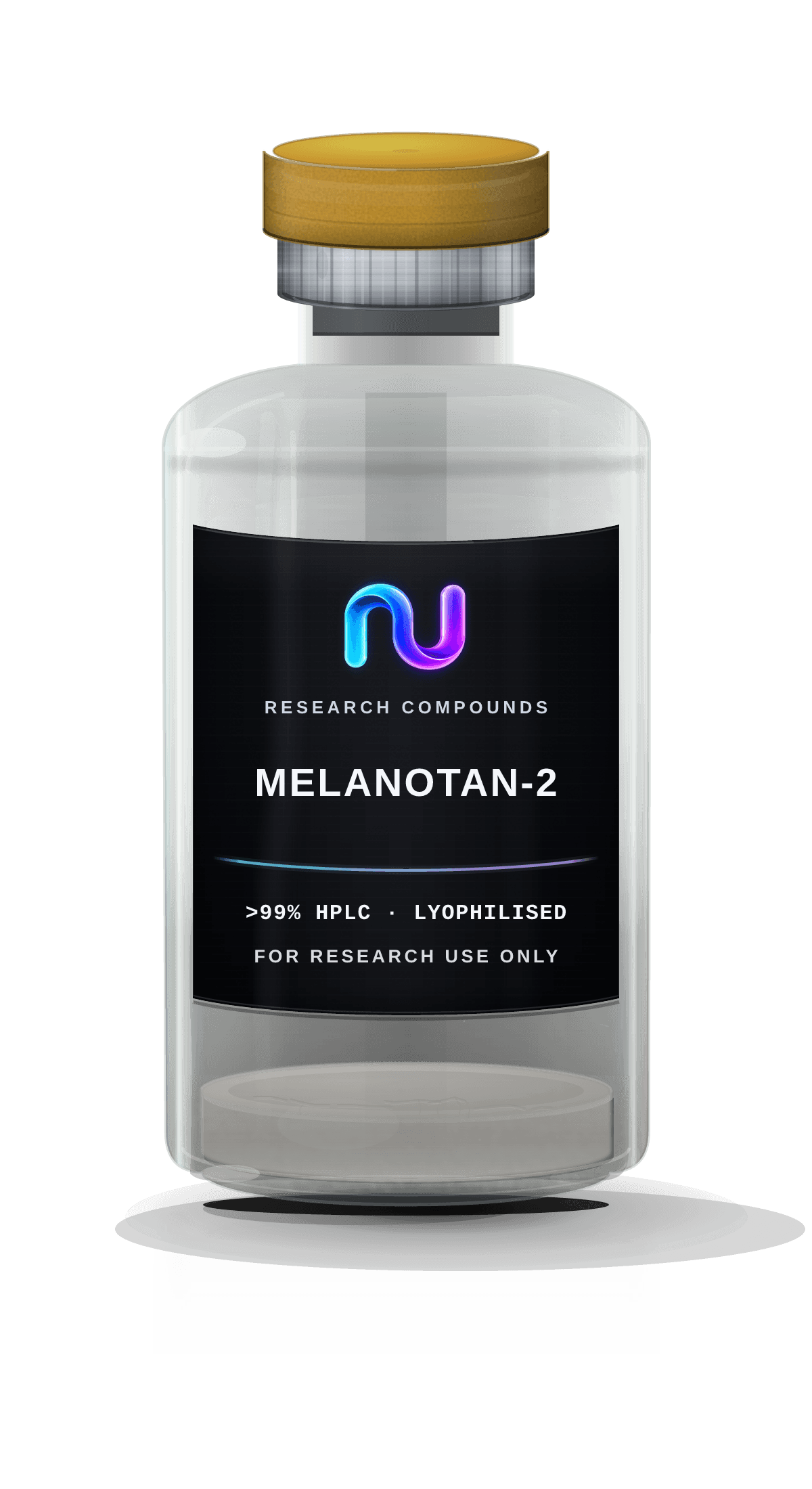
Melanotan-2 (Melanotan II, MT-2) is a synthetic lactam-bridged cyclic heptapeptide derived from α-MSH that acts as a non-selective melanocortin receptor agonist at MC1R, MC3R, MC4R and MC5R. Its literature combines receptor pharmacology and rodent studies with small early human pilot studies of pigmentation and arousal endpoints, while long-term safety data are largely anecdotal. New-U supplies Melanotan-2 as lyophilised research material in selected vial strengths. It is not an approved medicine, and these findings do not establish human safety or efficacy.
Melanotan-2 (Melanotan II, MT-2) Research Peptide
Tap a pack to select it
Buy the 10-pack - save 66%/mg. Single vials welcome — checkout needs 3+ vials or any 10-vial pack - build a custom vial pack
In plain terms, Melanotan-2 is studied for skin tanning plus libido and appetite, because it hits several melanocortin receptors at once. Here is what that looks like across the research.
Research explores how it darkens the skin by switching on natural pigment production, with little or no sun needed. Small early human studies and animal work both look at this.
Animal studies and early human research investigate its effect on arousal and sexual function, the brain pathway that later inspired the FDA-approved PT-141.
Animal studies look at reduced food intake and changes in body composition through the brain's appetite circuits.
Used in research as a benchmark compound for mapping how the melanocortin receptor family works.
In short: Melanotan-2 (MT-2) is a cyclic non-selective melanocortin receptor agonist studied for UV-independent skin pigmentation, appetite modulation, and sexual arousal research.
These points summarise lab themes, not human outcomes.
Melanotan-2 is a lab-engineered shortened and cyclised version of α-MSH, the natural hormone your body uses to trigger tanning. The modifications make it far more resistant to enzyme breakdown and much more potent than the natural molecule at binding all four melanocortin receptors.
Because MT-2 is non-selective, it hits the receptors that control pigmentation (MC1R), sexual arousal and appetite (MC4R), and exocrine function (MC5R) at the same time. In research this produces the characteristic triple signature: darker pigmentation, reduced food intake, and upregulated libido in animal models.
Unlike its selective cousin afamelanotide (Melanotan-1), MT-2 is not approved for any human therapeutic use. It is a research compound only, and its non-selective profile is part of why bremelanotide (PT-141) was later developed as a more targeted MC4R agonist.
Melanotan II is a synthetic lactam-bridged cyclic heptapeptide (Ac-Nle-c[Asp-His-D-Phe-Arg-Trp-Lys]-NH₂, MW 1024.18 Da) derived from truncation and cyclization of α-MSH, preserving the His-D-Phe-Arg-Trp pharmacophore essential for melanocortin receptor activation. It functions as a non-selective agonist of MC1R (melanogenesis), MC3R (energy homeostasis), MC4R (sexual function and appetite), and MC5R (exocrine secretion), crossing the blood-brain barrier to exert central neuroendocrine effects (Hruby et al., Journal of Medicinal Chemistry, 1995). MC1R activation stimulates eumelanin biosynthesis through cAMP-PKA-CREB-MITF transcriptional cascading, while MC4R agonism in hypothalamic nuclei mediates both appetite suppression and pro-erectile/arousal signaling. Pharmacokinetic analysis in rats demonstrates IV t½ of 0.5-1.5 hours, Vss of 0.2-0.5 L/kg, and oral bioavailability of 4.6% (Ugwu et al., Pharmaceutical Research, 1994).
MT-2 binds all four melanocortin receptors, triggering melanin production in the skin and activating appetite and arousal circuits in the brain.
| Pathway | Effect | Why it matters |
|---|---|---|
| MC1R (skin) | Activates cAMP/PKA/CREB/MITF to turn on tyrosinase | Produces eumelanin, the dark pigment that provides UV protection |
| MC4R (hypothalamus) | Reduces food intake and triggers arousal signalling | Drives both appetite suppression and pro-erectile effects |
| MC3R (energy balance) | Modulates nutrient partitioning and metabolism | Contributes to body-composition changes seen in animal models |
| MC5R (exocrine) | Stimulates sebaceous and lacrimal secretion | Explains facial flushing and oily skin sometimes seen in research protocols |
| Cyclic lactam bridge | Locks the peptide into an active conformation | Protects against proteolytic breakdown and extends duration of action |
Hruby and colleagues (Journal of Medicinal Chemistry, 1995) designed MT-2 as a lactam-bridged cyclic heptapeptide preserving the conserved His-D-Phe-Arg-Trp pharmacophore. The D-Phe7 substitution confers protease resistance and superpotent receptor binding. Rat PK (Ugwu et al., Pharmaceutical Research, 1994) gives an IV t½ of 0.5-1.5 h, Vss 0.2-0.5 L/kg, and ~4.6% oral bioavailability. Because MT-2 crosses the blood-brain barrier, receptor activation is both peripheral and central - which is why nausea and facial flushing are the most commonly reported side effects in research.
Melanotan-2 (MT-2) is a synthetic cyclic heptapeptide analogue of α-MSH (Ac-Nle-c[Asp-His-D-Phe-Arg-Trp-Lys]-NH₂, MW 1024.18 Da) that non-selectively activates the MC1R, MC3R, MC4R and MC5R melanocortin receptors. It is supplied as a lyophilised research-grade powder for laboratory use only - it is not approved for human use.
In research models MT-2 activates MC1R to stimulate eumelanin synthesis (the pathway behind UV-independent pigmentation), and activates MC4R in the hypothalamus, which is associated with appetite suppression and arousal signalling. These are findings in animal/research models; New-U makes no human-use or cosmetic claims.
Because MT-2 stimulates melanocyte MC1R directly, melanogenesis can be triggered in research models with little or no UV exposure - unlike a normal tan that requires sunlight. Published observations note that UV exposure still substantially accelerates and deepens the studied pigmentation response. This is research context only, not a cosmetic or human-use recommendation.
There is no credible scientific evidence that MT-2 changes iris (eye) colour. The melanocytes it acts on are in the skin and hair; the documented pigmentation effects are darker skin and darkening of existing moles/freckles, not eye colour. Reported for research context only.
Lyophilised MT-2 is dissolved in bacteriostatic water for multi-use research vials. Concentration in mg/mL equals the vial mass in mg divided by the millilitres of diluent added - e.g. a 10 mg vial reconstituted with 1 mL gives 10 mg/mL. Keep the reconstituted vial refrigerated at 1–6 °C and protected from light. This is laboratory preparation math only; no human-use dosing guidance is provided.
Melanotan-1 (afamelanotide) is a linear 13-amino-acid α-MSH analog that is more selective for MC1R and is EMA/FDA-approved as Scenesse for erythropoietic protoporphyria. Melanotan-2 is a smaller cyclic heptapeptide that activates MC1R, MC3R, MC4R, and MC5R non-selectively, producing broader effects and more side effects.
Those effects come from non-selective activation of MC4R and MC5R in the brain and exocrine glands. MC4R activation in hypothalamic nuclei drives both appetite suppression and nausea, while MC5R stimulates sebaceous secretion and vasomotor responses that show up as facial flushing.
PT-141 (bremelanotide) is essentially an active metabolite of Melanotan-2 with a free carboxylic acid instead of an amide at the C-terminus. It is more selective for MC4R-mediated sexual arousal pathways and is FDA-approved as Vyleesi for generalised HSDD in premenopausal women.
Keep lyophilised powder at −20 °C in the freezer. Once reconstituted with bacteriostatic water, refrigerate at 1-6 °C and protect from light. Reconstituted solutions are generally stable for several weeks under those conditions.
The research literature typically describes a low-microgram subcutaneous "loading" phase followed by smaller intermittent "maintenance" amounts, with melanogenesis driving the studied pigmentation response. New-U publishes this only as descriptive research context - it is not a dosing instruction.
In pigmentation research, MC1R activation increases eumelanin synthesis, so studied endpoints describe a gradual darkening over roughly 1-4 weeks of repeated exposure that fades once dosing stops. Magnitude depends heavily on baseline skin type, amount and UV exposure. Reported for research context only - not a cosmetic or human-use claim.
Pigmentation is cumulative rather than immediate: pigmentation research describes a gradual darkening building over roughly 1-4 weeks of repeated low-dose exposure, then fading over weeks once dosing stops as melanocytes turn over. The peptide itself clears quickly (rodent IV half-life ~0.5-1.5 h) but the studied pigment effect outlasts the circulating compound. These are descriptive research-context observations, not human-use or cosmetic guidance.
The literature most commonly reports nausea, facial flushing, appetite suppression and darkening of existing moles/freckles, arising from non-selective MC3R/MC4R/MC5R activation. New-U supplies Melanotan-2 as a research compound only and makes no safety or human-use claims; these are summarised research findings, not medical advice.
Melanotan-2 is not approved by the FDA, EMA or any major regulator for human use - only the related, more selective afamelanotide (Melanotan-1 / Scenesse) and bremelanotide (PT-141 / Vyleesi) hold approvals for specific indications. Melanotan-2 is sold in the US strictly as a research compound; buyers are responsible for compliance in their jurisdiction.
Right here - Melanotan-2 is supplied directly by New-U Research Compounds on this page as lyophilised research-grade material, with an independent Janoshik Analytical Certificate of Analysis published on this page, and shipped direct from source worldwide in discreet, tracked packaging.
Melanotan-2 pricing is shown live on this page, per pack size - sealed 10-vial research packs, or single vials where listed (an order needs at least 3 single vials in total, or any 10-vial pack). The batch Certificate of Analysis is published on this page, and shipping is free on orders over $350.
Yes. Melanotan-2 has an independent Janoshik Analytical Certificate of Analysis, which reports 99.866% purity for the sample analysed. The report number and test date are on the certificate, published on this page and on our COA page rather than packed with orders. View the Melanotan-2 Certificate of Analysis →
Add the Melanotan-2 pack size you need to your cart and check out: enter your shipping details, then choose your payment method - cryptocurrency or card - on the next step. The batch Certificate of Analysis (COA) is published on this page, so you can check it before you order.
At checkout you can pay by card or crypto. New-U supports BTC and selected stablecoin and network-asset payments across Ethereum, Solana, TRON, Polygon, Base, BNB Chain and Linea. You choose your method after confirming your order.
Yes - we ship worldwide in discreet, unmarked, tracked packaging; lyophilised peptides are stable through the tracked transit window. Delivery typically takes 6–14 business days, and shipping is free on orders over $350.
Research use only - all claims made on this site are for testing and research use only.
| Half-life | ~0.5-1.5 h (IV, rat); functional duration extends 24-36 h subcutaneously |
|---|---|
| Absorption route | Subcutaneous; Tmax 0.5-1 h (rodent models) |
| Bioavailability | ~4.6% oral (rat, Ugwu et al. 1994); ~100% subcutaneous |
| Metabolism / clearance | Proteolytic cleavage; cyclic lactam bridge resists enzymatic degradation vs. linear α-MSH |
| Stability | Lyophilised: −20 °C freezer. Reconstituted with bacteriostatic water: refrigerate 1-6 °C, protect from light; stable several weeks. |
| Notes | Vss 0.2-0.5 L/kg; CL ~0.3 L/kg/h. Crosses the blood-brain barrier, producing both peripheral and central effects. |
Research-context subcutaneous dosing reported in the literature. Not a clinical recommendation.
| Dose | Frequency | Duration | Notes |
|---|---|---|---|
| 0.025-0.1 mg | Microdose titration (research protocols) | 3-7 days | Used in some protocols to assess tolerability before escalation |
| 0.25-0.5 mg | Once daily (loading) | 1-2 weeks | Subcutaneous; most commonly reported loading phase in self-experiment literature |
| 0.5-1.0 mg | 2-3× per week (maintenance) | Ongoing | Titrate to desired pigmentation endpoint |
Overall: Mixed (human + animal)
Mechanism is well-characterised in human and animal receptor pharmacology (Tier 1-2). Pigmentation and arousal endpoints have small human pilot studies (Tier 1). Long-term safety in research subjects is predominantly anecdotal (Tier 3). MT-2 itself is not FDA-approved; bremelanotide (PT-141, closely related) is approved for HSDD.
Last reviewed: 16 June 2026 · New-U Research Compounds
| Molecular Formula | C50H69N15O9 |
|---|---|
| Molecular Weight | 1024.18 Da |
| Sequence | Ac-Nle-c[Asp-His-D-Phe-Arg-Trp-Lys]-NH2 |
| Purity | >99% (HPLC) |
| Form | Lyophilised powder |
| Half-life | ~1 h (IV, rodent) |
| Route | Subcutaneous injection |
| Solubility | Bacteriostatic water or sterile saline |
| Storage | Lyophilised: −20 °C freezer. Reconstituted: 1-6 °C, away from light. |
Melanotan-2 came out of a University of Arizona search for an α-MSH analog that could protect fair-skinned people from UV damage without requiring sun exposure. The cyclic structure and D-Phe substitution solved two problems at once - it made the peptide stable in the bloodstream, and it turned it into a much more potent agonist than the natural hormone it was modelled on.
The non-selective profile is both MT-2's strength and its limitation. It does produce the expected UV-independent pigmentation, but it also activates MC4R in the hypothalamus, which is why research subjects routinely experience nausea, facial flushing, and changes in appetite and libido. That hypothalamic arm of the pharmacology is exactly what inspired the development of the more targeted MC4R agonist bremelanotide (PT-141).
New-U Research Compounds supplies Melanotan-2 as a lyophilised powder at >99% HPLC purity, independently verified by third-party labs. Material is strictly for in-vitro and preclinical research. MT-2 is not approved for human therapeutic use, is a WADA-prohibited substance for competing athletes, and is not a substitute for medically supervised treatment of any condition.
The tracking link made a difference while I waited for Melanotan II. Far better than having no updates.
The items were packed neatly, not just shoved together. Small detail but I noticed it.
All the items were there when I checked the parcel. Smooth process overall and no complaints from me.
| Compound | Price | Purity spec | COA |
|---|---|---|---|
| Melanotan-2 | from $81 | >99% HPLC | 2 published batches |
| Melanotan-1 | from $81 | >99% HPLC | On request |
| PT-141 | from $108 | >99% HPLC | On request |
Descriptive catalog comparison for research sourcing decisions - not dosing guidance.
Part of the Skin & cosmetic research research area — explore related compounds, guides and sources.
From our community
Facebook account deactivated