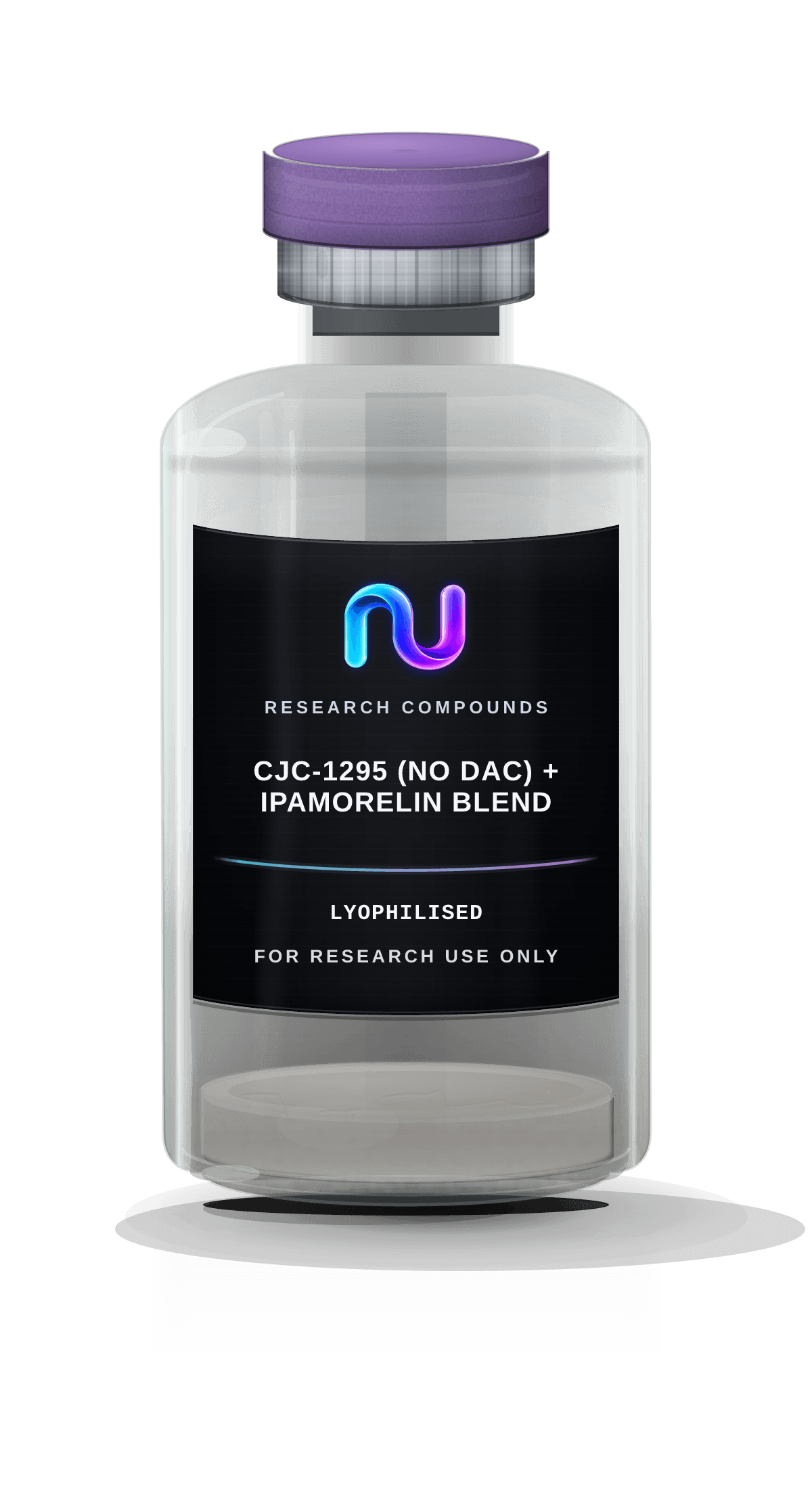
In short: A fixed 1:1 research blend of CJC-1295 (no DAC) and ipamorelin, offered at 5 mg + 5 mg and 10 mg + 10 mg per vial: a growth-hormone-releasing-hormone analogue and a selective ghrelin-receptor agonist in one vial.
Key research facts
- Two growth-hormone-axis research peptides pre-combined at a fixed 1:1 ratio
- Two vial strengths in one product: 5 + 5 mg and 10 + 10 mg
- CJC-1295 (no DAC): tetrasubstituted GHRH(1-29) analogue acting on the GHRH receptor
- Ipamorelin: pentapeptide characterised as a selective growth hormone secretagogue
- Two different receptors on the same cell type, the usual reason the pair is studied together
These points summarise lab themes, not human outcomes.
The two compounds reach the same pituitary cell type through different receptors, which is the whole case for studying them together. CJC-1295 without DAC (modified GRF(1-29)) is the first 29 residues of growth-hormone-releasing hormone with four substitutions that make it resistant to the enzymes that normally inactivate the native peptide, and it acts on the GHRH receptor. Ipamorelin, Aib-His-D-2Nal-D-Phe-Lys-NH2, was developed at Novo Nordisk and acts on a ghrelin-type receptor instead.
The ipamorelin paper is the useful reference for the second half of the pair. It reports that ipamorelin released growth hormone from rat pituitary cells with a potency and efficacy similar to GHRP-6, that antagonist profiling put its action at a GHRP-like receptor rather than the GHRH receptor, and that in conscious swine it did not raise ACTH or cortisol beyond the levels seen after GHRH stimulation, even at doses more than 200 times its GH-releasing ED50, where GHRP-6 and GHRP-2 did.
There is no study of this fixed blend cited here. The vial strengths differ only in quantity (A-2-10 is 5 mg of each compound, A-2-20 is 10 mg of each). Supplied as lyophilised powder for in-vitro and preclinical research only.
- Research class: Fixed two-compound research blend
- Components: CJC-1295 (no DAC) + Ipamorelin
- Vial strengths: 10 mg, 20 mg per vial, chosen from the pack-size menu
- Research focus: Pituitary growth hormone release through the GHRH receptor and the ghrelin-type receptor
- Evidence base: Rat, pig and in-vitro data for ipamorelin; human data for the long-acting DAC relative of CJC-1295; none on this blend
This blend supplies CJC-1295 without DAC and ipamorelin together in each vial at a fixed 1:1 ratio, in two strengths: 5 mg + 5 mg (10 mg per vial) and 10 mg + 10 mg (20 mg per vial). CJC-1295 (no DAC), also called modified GRF(1-29), is a tetrasubstituted analogue of the first 29 residues of growth-hormone-releasing hormone. Ipamorelin is a five-residue synthetic peptide that acts on a different receptor on the same pituitary cells. The two are sold together because they are so often studied as a pair. The blend has no literature of its own. Supplied as lyophilised research powder in sealed 10-vial packs, one strength per pack, strictly for in-vitro and preclinical research. Not for human or veterinary use.
At a glance
- Compound identity Fixed two-compound research blend
- Primary research focus Pituitary growth hormone release through the GHRH receptor and the ghrelin-type receptor
- Mechanism and receptors The blend has no combined mechanism. CJC-1295 (no DAC) is a GHRH-receptor agonist and ipamorelin a ghrelin-type receptor agonist; both act on pituitary somatotrophs through different receptors. Pairing them is a hypothesis about those two routes, not a demonstrated property of the vial.
- Experimental models Ipamorelin GH release and selectivity in rat pituitary cells, rats and swine; GRF(1-29) analogue and albumin-conjugate characterisation in rats.
- Evidence maturity Tier 3: Limited / anecdotal — The blend has no evidence base of its own. Ipamorelin has animal and in-vitro pharmacology; the human CJC-1295 data concern the long-acting DAC conjugate, not the no-DAC form in this vial. No study of the two as a fixed combination is cited. The material is supplied as unapproved laboratory material.
- Research limitations Published clinical findings describe the study materials and protocols used by investigators; they do not establish the effects or safety of this research material.