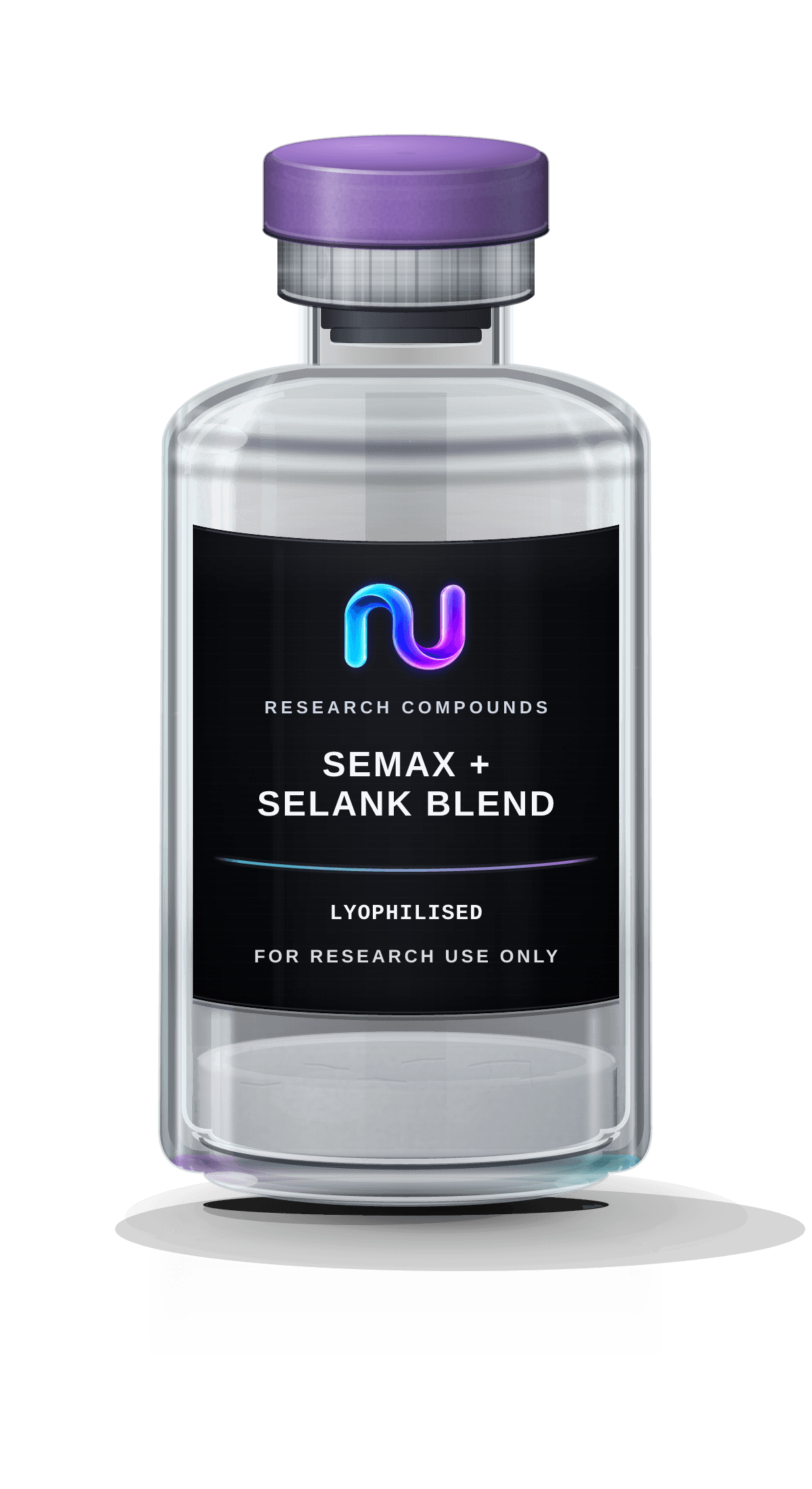
In short: A fixed 1:1 research blend of Semax and Selank, offered at 5 mg + 5 mg and 10 mg + 10 mg per vial: two short synthetic neuropeptides from the same research group in one vial.
Key research facts
- Two neuropeptide research compounds pre-combined at a fixed 1:1 ratio
- Two vial strengths in one product: 5 + 5 mg and 10 + 10 mg
- Semax: ACTH(4-10) analogue studied for BDNF/TrkB and monoamine signalling in rodents
- Selank: tuftsin-derived heptapeptide studied for gene-expression effects in rat frontal cortex
- Both heptapeptides share a C-terminal Pro-Gly-Pro extension
These points summarise lab themes, not human outcomes.
Semax and Selank are close relatives in construction. Each is a seven-residue peptide ending in Pro-Gly-Pro, a tail that is described as protecting the shorter parent sequence from enzymatic breakdown. Semax takes its front end from ACTH(4-10) (Met-Glu-His-Phe), Selank from the tuftsin tetrapeptide (Thr-Lys-Pro-Arg). Both come from the Institute of Molecular Genetics in Moscow, and their published pharmacology is largely rodent work from that group and its collaborators.
The studies cited here are specific. In rats a single Semax application of 50 micrograms per kilogram raised hippocampal BDNF protein 1.4-fold and TrkB phosphorylation 1.6-fold, and a separate study found Semax raised striatal serotonin metabolite 5-HIAA by 25% in tissue and up to 180% extracellularly without changing dopamine on its own. For Selank, a gene-expression study in rat frontal cortex reported significant changes in 45 of 84 neurotransmission genes one hour after rats were given Selank or GABA (300 micrograms per kilogram) and in 22 at three hours, with the gene-expression changes of the two correlating at one hour.
No study of the two as a fixed blend is cited. The ratio does not change between strengths: the 10 mg vial is 5 mg of each peptide and the 20 mg vial is 10 mg of each. Supplied as lyophilised powder for in-vitro and preclinical research only.
- Research class: Fixed two-compound research blend
- Components: Semax + Selank
- Vial strengths: 10 mg, 20 mg per vial, chosen from the pack-size menu
- Research focus: Rodent neurotrophin, monoamine and GABA-related gene-expression models
- Evidence base: Rat studies of each peptide separately; none on the blend, and no human data cited
This blend supplies Semax and Selank together in each vial at a fixed 1:1 ratio, in two strengths: 5 mg + 5 mg (10 mg per vial) and 10 mg + 10 mg (20 mg per vial). Semax (Met-Glu-His-Phe-Pro-Gly-Pro) is an analogue of the ACTH(4-10) fragment; Selank (Thr-Lys-Pro-Arg-Pro-Gly-Pro) is built on the tetrapeptide tuftsin. Both carry a C-terminal Pro-Gly-Pro extension and both were developed at the Institute of Molecular Genetics of the Russian Academy of Sciences. The blend has no literature of its own: the studies cited concern each peptide separately in rodents. Supplied as lyophilised research powder in sealed 10-vial packs, one strength per pack, strictly for in-vitro and preclinical research. Not for human or veterinary use.
At a glance
- Compound identity Fixed two-compound research blend
- Primary research focus Rodent neurotrophin, monoamine and GABA-related gene-expression models
- Mechanism and receptors The blend has no combined mechanism. Semax is studied for hippocampal BDNF/TrkB signalling and monoamine effects; Selank for broad changes in neurotransmission-related gene expression with a GABAergic signature. The two are independent compounds sharing a vial.
- Experimental models Semax and hippocampal BDNF and TrkB expression in rats; Semax and striatal serotonergic and dopaminergic measures in rodents.
- Evidence maturity Tier 3: Limited / anecdotal — The blend has no evidence base of its own, and this page cites no human study of either peptide. The studies cited are rodent experiments from one research group and its collaborators, with neurochemical and gene-expression readouts. No study of the two as a fixed combination is cited. The material is supplied as unapproved laboratory material.
- Research limitations Most published findings come from cell and animal models; they cannot be treated as evidence of human efficacy or safety.