Research compounds for metabolic and energy-balance studies. The category brings together incretin-receptor agonists supplied under GLP1-RC catalogue codes, long-acting amylin analogues, and peptides studied in mitochondrial function, NAD+ metabolism and cellular ageing. Receptor targets and half-lives differ widely between them, so compare each specification before choosing. Laboratory research use only.
Shop format
Choose single vials or a 10-vial pack on each product
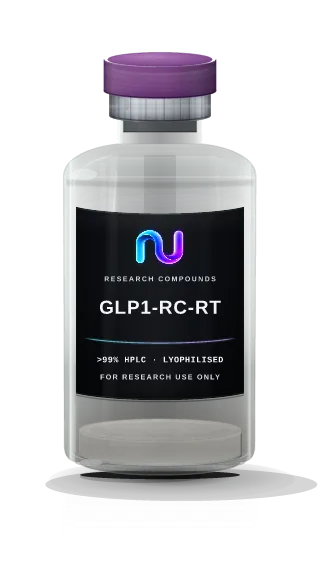
Retatrutide is an investigational triple receptor agonist targeting GLP-1, GIP and glucagon receptors. Studied in receptor-pharmacology and metabolic research, with GLP1-RC-RT supplied as laboratory research material.
Reduced glutathione (GSH) is a naturally occurring tripeptide central to intracellular redox chemistry. Research uses include glutathione-peroxidase pathways, oxidative-stress assays and cellular antioxidant systems.
MOTS-c is a 16-amino-acid peptide encoded by mitochondrial DNA. Investigated in preclinical models of AMPK signalling, cellular energy balance and glucose metabolism.
Tirzepatide is a dual agonist of GIP and GLP-1 receptors. GLP1-RC-TZ research material is listed for comparative incretin-receptor pharmacology, insulin-signalling and metabolic-pathway studies.
Cagrilintide is a long-acting amylin analogue investigated for amylin- and calcitonin-receptor signalling. Its research includes food-intake neuroendocrine signalling in preclinical models and interaction with incretin signalling.
SS-31, also known as elamipretide, is a mitochondria-targeted tetrapeptide associated with cardiolipin interactions at the inner mitochondrial membrane. Studied for mitochondrial membrane function and cellular bioenergetics.
NAD+ is a cellular redox coenzyme, not a peptide. Studied in metabolism, mitochondrial biochemistry and NAD+-dependent enzyme systems, including sirtuins, PARPs and CD38.
5-Amino-1MQ is a synthetic small molecule, not a peptide. It inhibits nicotinamide N-methyltransferase (NNMT) and is studied in preclinical NAD+ metabolism and adipocyte biology.
Semaglutide is a long-acting GLP-1 receptor agonist analogue with a lipid side chain that supports albumin binding. GLP1-RC-SM is supplied for laboratory incretin-receptor and metabolic-pathway research.
FOXO4-DRI is a D-retro-inverso peptide designed to interfere with FOXO4-p53 interactions. Explored in cell and animal models of senescent-cell survival and apoptosis signalling.
Vitamin B12 (cobalamin) is a cobalt-containing cofactor involved in methionine synthase and methylmalonyl-CoA mutase activity. Supplied as research material for biochemical and metabolic assays; not a peptide.
Liraglutide is an acylated GLP-1 analogue with a C16 fatty-acid modification supporting albumin binding. Studied in GLP-1 receptor pharmacology and metabolic-signalling research.
PNC-27 is a synthetic chimeric peptide incorporating a p53-derived sequence and membrane-targeting segment. Investigated in cell-line and membrane-interaction studies; evidence is early-stage.
Eloralintide (LY3841136) is an investigational selective amylin-receptor agonist. Studied for amylin-pathway pharmacology and neuroendocrine energy-balance signalling.
Follistatin 344 is a follistatin precursor isoform studied in the activin/myostatin signalling system. Research focuses on ligand sequestration, muscle-regulatory pathways and isoform biology.
Follow New-U in GoogleAdd New-U as a preferred source for future research updates and articles.
Metabolic Research covers incretin and amylin receptor agonists alongside compounds studied in mitochondrial and cellular-ageing models. GLP1-RC-SM (semaglutide research material) is a GLP-1 receptor agonist. GLP1-RC-TZ (tirzepatide) is a dual GIP/GLP-1 receptor agonist. GLP1-RC-RT (retatrutide) adds glucagon-receptor activity as a triple agonist. Cagrilintide is a long-acting acylated amylin analogue active at amylin and calcitonin receptors. Eloralintide is a selective, long-acting amylin-receptor agonist. MOTS-c is a mitochondrial-derived peptide studied in AMPK signalling. 5-Amino-1MQ is a small-molecule NNMT inhibitor. SS-31 binds cardiolipin in the inner mitochondrial membrane. NAD+ and glutathione are the central redox coenzyme and the principal cellular thiol. Khavinson short-peptide bioregulators have their own category, Short-Peptide Bioregulators. FOXO4-DRI is studied for disrupting the FOXO4–p53 interaction in senescent cells. Choose by receptor target rather than by category label.
Focus: GLP-1, GIP and related metabolic signalling pathways.
Typical models: food intake, glucose handling and energy balance in lab studies.
Every listing shows strength, pack size and price; published Certificates of Analysis are listed on /coa.
Sold for laboratory research only - not for human use.