Janoshik & Freedom Diagnostics verified RP-HPLC + ESI-MS Published third-party COAs Lab-direct, shipped worldwide
₿ -- • Ξ -- • ◎ --
Skip to main content
Metabolic / Longevity

PNC-27 | Chimeric p53-Penetratin HDM-2 Peptide

aka PNC-27, p53 (12-26)-membrane residency peptide chimera, chimeric p53-penetratin peptide
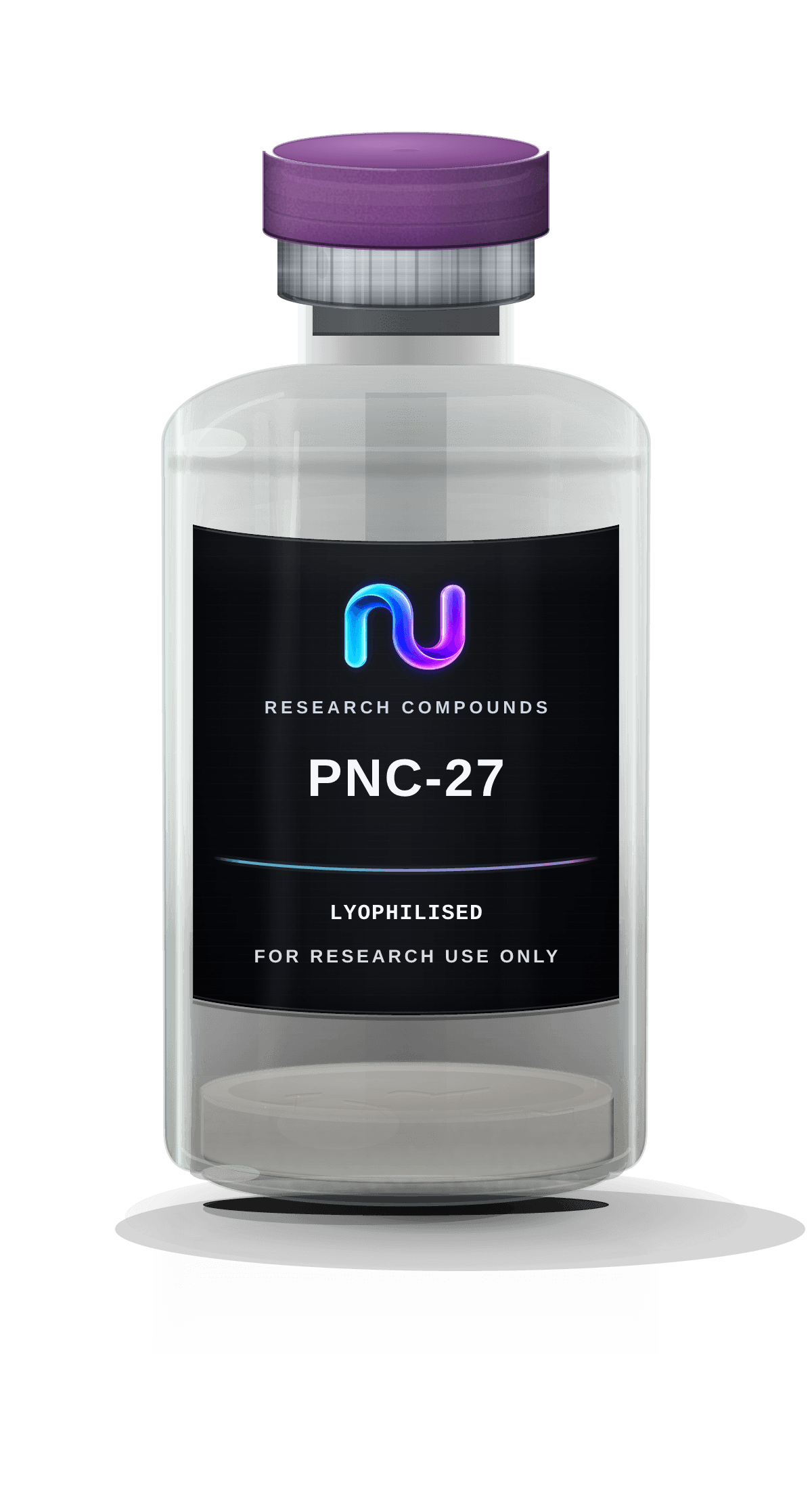
PNC-27 research vial — Metabolic / Longevity compound supplied by New-U Research Compounds

PNC-27 is a 32-residue chimeric p53-penetratin peptide: residues 12-26 of the p53 tumour-suppressor protein, which form an HDM-2 binding domain, joined to a 17-residue membrane-residency leader. Studies in cultured cell lines, using electron microscopy, NMR and modelling, examine HDM-2 binding at the cell membrane and selective membrane-pore formation. New-U supplies PNC-27 as lyophilised research material in 5 mg and 10 mg vials; no analytical report has been published yet. The record comes from a few connected groups, some holding patents on the peptide, and no clinical data are cited.

Scientific Research Context

  • Peptide structure in solution
  • HDM-2 at the cell membrane
  • Intact peptide in the membrane
Explore the research

Product features

  • Vial strengths5 mg · 10 mg2 strengths, all in stock. Pick one in the selector.
  • FormatsSingle vial · 10-vial packPrice per vial and pack total update with your selection.
  • FormLyophilised powderSupplied in sealed vials. Storage conditions are listed in the specifications.

Compare pack sizes

Tap a pack to select it

Lab-direct · sealed vials · packs or samples
10 × 5 mg
Per vial
$24.50
10 vials50total mg
$245
10 × 10 mg
Per vial
$48.00
10 vials100total mg
$480
Sample1 × 5 mg
$49
Sample1 × 10 mg
$96

Buy the 10-pack - save 50%/mg. Single vials welcome — checkout needs 3+ vials or any 10-vial pack - build a custom vial pack

Published research areas

PNC-27: Scientific Research Context

What the published literature on PNC-27 examines in cultured cells and in structural work. These are laboratory findings and not claims about the supplied material.

Peptide structure in solution

Two-dimensional NMR was run on the 32-residue sequence in an aqueous environment and in a mixed organic, membrane-mimetic one. In water it showed three alpha-helical domains joined by loops; in the membrane-like solvent the helices lengthened into a U-shaped helix-coil-helix form. [biochemical]

HDM-2 at the cell membrane

A PNAS study reported HDM-2 in the membranes of a variety of cancer cell lines but not in several untransformed lines, and reported PNC-27 colocalising with membrane-bound HDM-2. Untransformed MCF-10-2A cells that were made to express membrane HDM-2 became susceptible to the peptide. [in vitro]

Intact peptide in the membrane

Using a green label at the amino end and a red label at the carboxyl end, MCF-7 cells showed combined yellow punctate fluorescence at 30 minutes, which the authors read as intact peptide. [in vitro]

Pore structure by electron microscopy

Gold-labelled antibodies against PNC-27 and HDM-2 were found in roughly 1:1 ratios in layered ring-shaped structures in pores near the surface of treated cancer cells. No pores were seen in treated untransformed fibroblasts. [in vitro, electron microscopy]

🧬 Detailed compound research profile

PNC-27 Scientific Overview

In short: PNC-27 is a 32-residue chimeric peptide: a 15-residue p53 segment that binds HDM-2, fused to a 17-residue penetratin-type leader.

Key research facts

  • Defined 32-residue chimera: p53 residues 12-26 followed by a 17-residue leader
  • Its p53 segment is the HDM-2 binding domain, so the peptide is used to study HDM-2 at the cell membrane
  • Examined by NMR in water and in membrane-mimetic solvent
  • Tracked as an intact double-labelled peptide in cell-membrane imaging
  • A related shorter analogue, PNC-28, gives a comparison point for the leader sequence

These points summarise lab themes, not human outcomes.

The first fifteen residues, Pro-Pro-Leu-Ser-Gln-Glu-Thr-Phe-Ser-Asp-Leu-Trp-Lys-Leu-Leu, correspond to residues 12 to 26 of p53. The remaining seventeen, Lys-Lys-Trp-Lys-Met-Arg-Arg-Asn-Gln-Phe-Trp-Val-Lys-Val-Gln-Arg-Gly, are the membrane residency leader, attached at the carboxyl end. The free peptide has an N-terminal amine and a C-terminal acid.

The cited literature is cell-line, microscopy and structural work. The studies reported that the peptide formed pores in the membranes of the cancer cell lines examined while untransformed lines were reported to be unaffected, and they proposed HDM-2 at the plasma membrane as the target. Several authors of the cited papers declare patents on PNC-27 and PNC-28, and the work has not been summarised here from any independent laboratory. No controlled human data are cited on this page.

New-U Research Compounds supplies PNC-27 as a lyophilised research powder. No analytical report for the supplied material has been published yet, so this page states no purity figure and no certificate. It is for in-vitro and preclinical research only and is not a medicine.

  • Research class: Chimeric p53-derived cell-penetrating peptide
  • Structure: p53 residues 12-26 (HDM-2 binding domain) plus 17-residue leader
  • Evidence base: Cell-line, electron-microscopy, NMR and modelling studies; no controlled human data cited

PNC-27 is a laboratory peptide built from two parts. Its first fifteen residues reproduce stretch 12 to 26 of the p53 tumour-suppressor protein, the region that engages HDM-2, and its remaining seventeen residues are a cell-penetrating leader of the penetratin type, also called a membrane residency peptide. The published work on it comes from a small number of related academic groups and uses cultured cell lines, electron microscopy, NMR and modelling. It is supplied as lyophilised powder in sealed 10-vial packs, with single-vial samples available, strictly for in-vitro and preclinical research. Not for human or veterinary use.

At a glance

  • Compound identity Chimeric p53-derived cell-penetrating peptide
  • Mechanism and receptors The authors of the cited work propose that PNC-27 binds HDM-2 sitting in the plasma membrane and that the resulting complexes line transmembrane pores. This is a hypothesis built from imaging and modelling in cell lines.
  • Evidence maturity Tier 3: Limited / anecdotal — The cited record is preclinical: cultured cell lines, electron microscopy, NMR spectroscopy and computational modelling, largely from a small set of connected research groups, some of whose authors declare patents on the peptide. No controlled human data are cited. The tier describes the literature, not the supplied material, for which no analytical report has been published yet.
  • Research limitations Most published findings come from cell and animal models; they cannot be treated as evidence of human efficacy or safety.

⚙️ Proposed membrane model

PNC-27: Proposed Mechanism in the Literature

The authors of the cited work propose that PNC-27 binds HDM-2 sitting in the plasma membrane and that the resulting complexes line transmembrane pores. This is a hypothesis built from imaging and modelling in cell lines.

Pathway Effect Why it matters
HDM-2 binding by the p53 segment The 12-26 stretch adopts a conformation that the authors found superimposable on HDM-2-bound p53 The structural basis for proposing HDM-2 as the peptide target
Membrane-bound HDM-2 HDM-2 was detected in the membranes of cancer lines tested but not of untransformed lines The proposed reason the reported effect differed between cell types
Pore formation Ring-shaped structures with both PNC-27 and HDM-2 labels were seen in pores The proposed route to the membrane disruption and lysis reported in the treated cancer cells
Role of the leader Modelling placed the leader pointing away from the 1:1 complex; the authors suggest it may line the pore Left as an open question in the 2022 paper
Deeper dive for scientific readers

The 2022 Biomedicines paper combines conformational energy calculations with immuno-scanning electron microscopy. It reports approximately 1:1 labelling of the two proteins in ring-shaped structures, and it offers two alternative arrangements for how the pore is lined. The 2010 PNAS paper supplies the membrane HDM-2 data. All of this concerns cultured cells; the page makes no statement about behaviour in people.

❓ FAQ

PNC-27 Frequently Asked Questions

What is PNC-27?

PNC-27 is a 32-residue chimeric peptide made of p53 residues 12-26, an HDM-2 binding domain, followed by a 17-residue membrane-residency leader. It is supplied here as laboratory research material only.

What does the published research measure?

The cited papers examined the peptide in cultured cell lines, by electron microscopy, by NMR and by modelling. They reported membrane pores in the cancer cell lines tested and none in the untransformed cells used as controls. They are laboratory findings and not claims about the supplied material.

Are there human data?

No controlled human data are cited on this page. The literature referenced here is in-vitro and structural work, so it does not establish safety, effect or intended use in people.

Why is there no molecular weight or formula listed?

None of the sources opened for this page states one, so the page omits them rather than quote an unverified number.

Is PNC-27 for human use?

No. It is sold for in-vitro and preclinical research only, is not a medicine, and is not for human or veterinary use.

Where can I buy PNC-27?

Right here - PNC-27 is supplied directly by New-U Research Compounds on this page, as lyophilised research-grade material, and shipped direct from source worldwide in discreet, tracked packaging.

How much does PNC-27 cost?

PNC-27 pricing is shown live on this page, per pack size - sealed 10-vial research packs, or single vials where listed (an order needs at least 3 single vials in total, or any 10-vial pack). Larger vial strengths lower the per-mg cost, and shipping is free on orders over $350.

How do I buy PNC-27?

Add the PNC-27 pack size you need to your cart and check out: enter your shipping details, then choose your payment method - cryptocurrency or card - on the next step.

What payment methods can I use to buy PNC-27?

At checkout you can pay by card or crypto. New-U supports BTC and selected stablecoin and network-asset payments across Ethereum, Solana, TRON, Polygon, Base, BNB Chain and Linea. You choose your method after confirming your order.

How fast is shipping, and do you ship worldwide?

Yes - we ship worldwide in discreet, unmarked, tracked packaging; lyophilised peptides are stable through the tracked transit window. Delivery typically takes 6–14 business days, and shipping is free on orders over $350.

Is it legal to buy PNC-27?

In the United States, PNC-27 is sold strictly for laboratory and research purposes only. It is not approved by the FDA for human consumption and is not sold for that purpose. Regulatory status varies by jurisdiction - buyers are responsible for compliance in their own region.

Research use only - all claims made on this site are for testing and research use only.

⏱️ Pharmacology

Pharmacokinetics

Stability Lyophilised powder: store in freezer (−20 °C). Reconstituted: refrigerate 1–6 °C, away from sunlight.
Notes Laboratory research material. No amount, schedule or administration guidance is published or recommended on this page.
📊 Evidence

Evidence Tier

Overall: Tier 3: Limited / anecdotal

The cited record is preclinical: cultured cell lines, electron microscopy, NMR spectroscopy and computational modelling, largely from a small set of connected research groups, some of whose authors declare patents on the peptide. No controlled human data are cited. The tier describes the literature, not the supplied material, for which no analytical report has been published yet.

Literature

Databases & peer-reviewed sources

Last reviewed: 13 October 2026 · New-U Research Compounds

  1. Sarafraz-Yazdi E, Mumin S, Cheung D, et al. PNC-27, a Chimeric p53-Penetratin Peptide Binds to HDM-2 in a p53 Peptide-like Structure, Induces Selective Membrane-Pore Formation and Leads to Cancer Cell Lysis. Biomedicines 2022. · 2022 · PMID: 35625682 · DOI: 10.3390/biomedicines10050945
  2. Sarafraz-Yazdi E, Bowne WB, Adler V, et al. Anticancer peptide PNC-27 adopts an HDM-2-binding conformation and kills cancer cells by binding to HDM-2 in their membranes. Proc Natl Acad Sci U S A 2010. · 2010 · PMID: 20080680 · DOI: 10.1073/pnas.0909364107
  3. Sookraj KA, Bowne WB, Adler V, et al. The anti-cancer peptide, PNC-27, induces tumor cell lysis as the intact peptide. Cancer Chemother Pharmacol 2010. · 2010 · PMID: 20182728 · DOI: 10.1007/s00280-009-1166-7
  4. Rosal R, Pincus MR, Brandt-Rauf PW, et al. NMR solution structure of a peptide from the mdm-2 binding domain of the p53 protein that is selectively cytotoxic to cancer cells. Biochemistry 2004. · 2004 · PMID: 14967026 · DOI: 10.1021/bi035718g
✅ At a glance

PNC-27 Key Characteristics

  • 32 residues: p53 12-26 (15 residues) plus a 17-residue leader
  • Free N-terminal amine and C-terminal acid
  • Studied in cultured cells, by NMR, by electron microscopy and by modelling
  • No controlled human data cited; no amount or schedule guidance on this page
  • Supplied as 10-vial packs of 5 or 10 mg vials, or as single vials
🧪 Technical data

PNC-27 Specifications

Sequence PPLSQETFSDLWKLLKKWKMRRNQFWVKVQRG (32 residues)
p53 segment Residues 1-15 (p53 12-26)
Leader Residues 16-32, membrane residency peptide
Form Lyophilised powder
Pack 10 vials × 5 mg or 10 mg; single-vial samples available
Analytical report None published yet
Storage Lyophilised: −20 °C freezer. Reconstituted: 1-6 °C, away from light.
📖 In depth

About PNC-27: Chimeric p53 Peptide Research Guide

PNC-27 was first characterised structurally in 2004, when two-dimensional NMR on the 32-residue sequence described amphipathic structures in both aqueous and membrane-like solvent. Later work moved to cells: the 2010 PNAS paper tied the reported effect to HDM-2 in the plasma membrane, and the 2022 Biomedicines paper used electron microscopy to look at the pores themselves.

Nothing in that record establishes an effect, a safe amount or a use in people, and this page does not suggest one. Several authors of the cited studies declare patents on the peptide, and the studies were run on cell lines and in vitro systems.

New-U Research Compounds supplies PNC-27 as a lyophilised research powder in sealed 10-vial packs of 5 or 10 mg vials, with single-vial samples. No analytical report for the supplied material has been published yet, and this page makes no purity or certificate claim. It is for in-vitro and preclinical research only, and nothing here is medical advice.

⭐ Reviews

Customer Reviews

No customer reviews yet - be the first to share your experience.

Purchased this? Write a review
⚖️ Compare

PNC-27 vs related Metabolic / Longevity compounds

CompoundPricePurity specCOA
PNC-27 from $245 Not published On request
MOTS-C from $103 >99% HPLC 2 published batches
5-Amino-1MQ from $93 >99% HPLC 1 published batch

Descriptive catalog comparison for research sourcing decisions - not dosing guidance.

🔗 Keep exploring

More on PNC-27