
Fat loss & metabolism
Animal studies look at whether blocking a fat-tissue enzyme shrinks fat cells and lowers body weight in diet-induced obesity models.
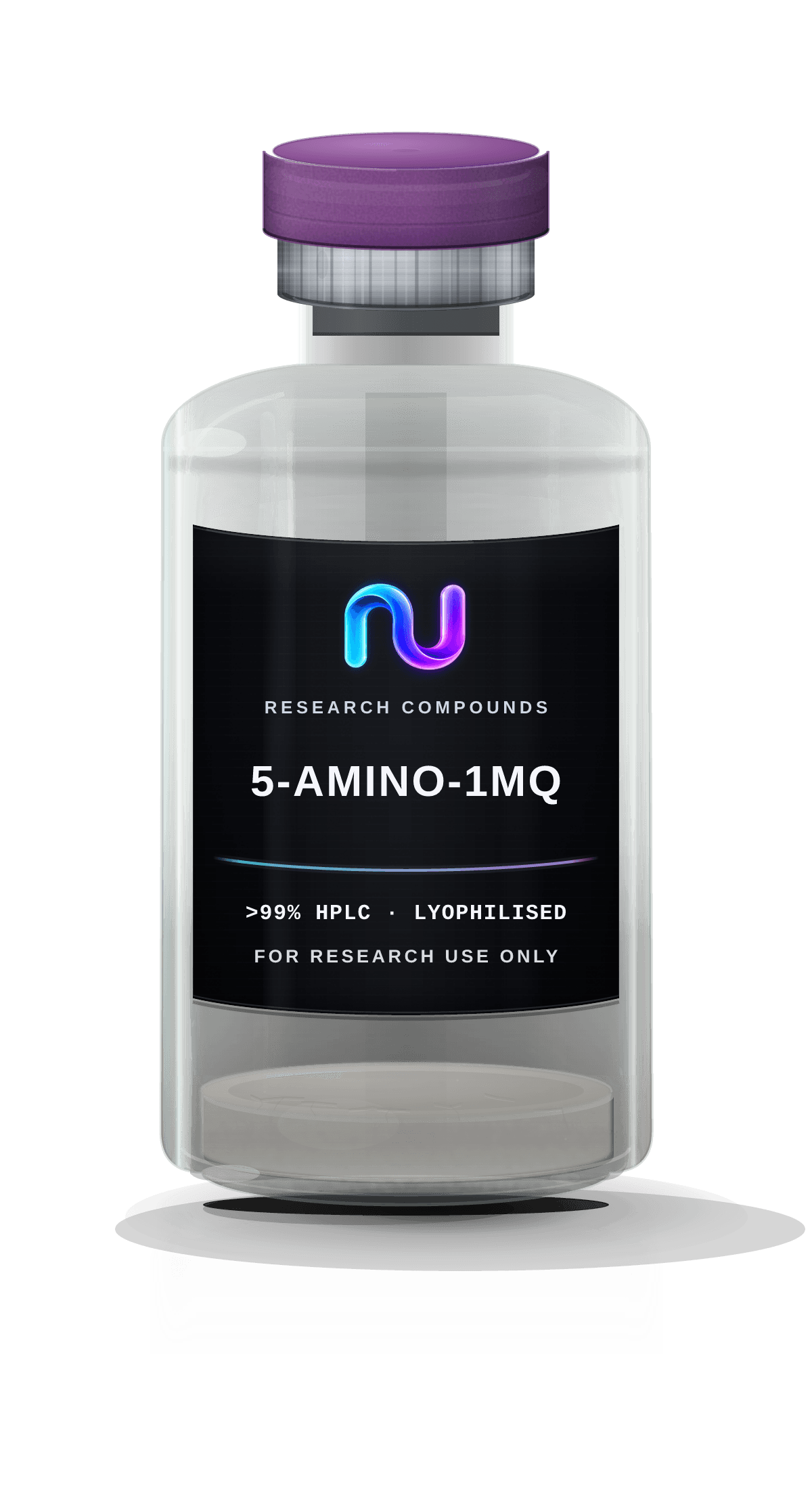
5-Amino-1MQ (5-amino-1-methylquinolinium) is a small-molecule NNMT inhibitor, not a peptide, that blocks nicotinamide N-methyltransferase while sparing related SAM-dependent methyltransferases. Its published work is preclinical: diet-induced-obesity mouse models that examine adipose mass and cellular NAD+ and SAM pools, plus rat pharmacokinetics. New-U supplies 5-Amino-1MQ as research material in 5, 10 and 50 mg vials. No human data have been published, and rodent findings do not establish effects in people.
5-Amino-1MQ (NNMT Inhibitor) Research Compound
Tap a pack to select it
Buy the 10-pack - save 67%/mg. Single vials welcome — checkout needs 3+ vials or any 10-vial pack - build a custom vial pack
In plain terms, 5-Amino-1MQ is studied mainly as a fat-cell and cellular-energy compound. Here is what that looks like across the research.
Animal studies look at whether blocking a fat-tissue enzyme shrinks fat cells and lowers body weight in diet-induced obesity models.
Research explores how it protects the cell NAD+ pool, a molecule central to how cells make and manage energy.
Animal studies look at improved grip strength in older mice, an unusual finding for a compound aimed at fat metabolism.
Preclinical work studies the enzyme it targets as a driver of age-related metabolic slowdown.
In short: 5-Amino-1MQ is a selective NNMT inhibitor small molecule that preserves intracellular NAD+ and SAM pools, reduces adipocyte hypertrophy, and improves grip strength in diet-induced obesity models.
These points summarise lab themes, not human outcomes.
5-Amino-1MQ is not actually a peptide - it is a small membrane-permeable molecule that blocks an enzyme called nicotinamide N-methyltransferase (NNMT). NNMT normally methylates nicotinamide using SAM as the methyl donor, and in obese or aged tissue it is frequently overactive, acting as a "methyl sink" that drains both NAD+ and SAM pools.
By selectively shutting off NNMT, 5-Amino-1MQ frees up nicotinamide for NAD+ biosynthesis and preserves SAM for the rest of the methylation reactions that cells need. The downstream result, in preclinical work, is reduced adipocyte size, lower body weight, and improved skeletal muscle function in diet-induced obesity models.
Because 5-Amino-1MQ is an orally bioavailable small molecule, it differs from most peptides on this site in both structure and handling. It is supplied as a research-grade material for in-vitro and preclinical study of NNMT pharmacology and metabolic regulation.
5-Amino-1MQ (5-Amino-1-Methylquinolinium) is a small-molecule, membrane-permeable inhibitor of nicotinamide N-methyltransferase (NNMT), the enzyme responsible for methylating nicotinamide to 1-methylnicotinamide (1-MNA) while consuming S-adenosylmethionine (SAM). By selectively blocking NNMT without inhibiting related SAM-dependent methyltransferases, 5-Amino-1MQ prevents the "methyl sink" that depletes cellular NAD+ and SAM pools (Neelakantan et al., Biochemical Pharmacology, 2018). In high-fat diet mouse models, 5-Amino-1MQ significantly reduced body weight, white adipose mass, and adipocyte size while improving grip strength beyond exercise alone (Neelakantan et al., PNAS, 2022). Rat pharmacokinetic studies demonstrate oral bioavailability of approximately 38.4% with a plasma half-life of 3.8–6.9 hours.
5-Amino-1MQ blocks the NNMT enzyme, preserving intracellular NAD+ and SAM and preventing the methyl-sink effect that drives metabolic dysfunction in obese tissue.
| Pathway | Effect | Why it matters |
|---|---|---|
| NNMT inhibition | Selectively blocks nicotinamide N-methyltransferase | Stops the methyl-sink reaction that drains NAD+ and SAM pools |
| NAD+ preservation | Spares nicotinamide for NAD+ biosynthesis | Supports SIRT1 signalling and metabolic regulation |
| SAM preservation | Keeps the universal methyl donor available | Maintains epigenetic methylation across the transcriptome |
| Lipogenesis suppression | Reduces de novo fat synthesis in adipocytes | Shifts adipose tissue toward a leaner profile |
| Membrane permeability | Crosses cell membranes passively | Enables oral dosing and broad tissue distribution |
Neelakantan et al. (Biochemical Pharmacology, 2018) developed 5-Amino-1MQ as a selective NNMT inhibitor that spares closely related SAM-dependent methyltransferases. A follow-up study (Neelakantan et al., PNAS, 2022) reported reduced body weight, white adipose mass, adipocyte size, and improved grip strength in high-fat-diet mice treated with 5-Amino-1MQ. Rat pharmacokinetics show Cmax 2252 ng/mL, AUC 14431 h·ng/mL, IV t½ 3.8 h, oral t½ 6.9 h, and oral bioavailability 38.4% - all unusually favourable for a small molecule metabolic compound.
In the literature 5-Amino-1MQ is used as a selective NNMT inhibitor tool compound to study fat-cell metabolism, NAD+ and SAM biology, and diet-induced obesity. Preclinical mouse studies have looked at whether blocking NNMT shrinks adipocytes, lowers body weight, and improves glucose handling.
No - it is a small molecule (5-amino-1-methylquinolinium) not a peptide. It is included in the research metabolic toolkit because it targets an enzyme pathway (NNMT) that affects the same NAD+ and SAM pools that peptide-based metabolic research often tries to influence.
NNMT uses nicotinamide as its substrate to produce 1-methylnicotinamide. Every nicotinamide molecule that gets methylated is one that can no longer be recycled into NAD+. When NNMT is overactive (as in obese adipose tissue), it drains the nicotinamide pool and limits NAD+ biosynthesis. Blocking NNMT with 5-Amino-1MQ preserves nicotinamide for NAD+ regeneration.
The data is preclinical. In high-fat-diet mouse models, 5-Amino-1MQ has been reported to reduce body weight, white adipose mass, and adipocyte size, and a 2024 study found NNMT inhibition improved glucose tolerance and fatty-liver markers in diet-induced obese mice without reducing food intake - pointing to an adipose/energy-expenditure mechanism rather than appetite suppression. No human clinical efficacy has been established.
Rat pharmacokinetic studies describe roughly 38% oral bioavailability with a plasma half-life around 3.8 h IV and 6.9 h oral, and very high water solubility (>100 mg/mL). That oral profile is unusual for a metabolic compound and is one reason it is studied with once-daily oral protocols. No human PK data has been published.
Both are studied for metabolism, but they are structurally and mechanistically different. 5-Amino-1MQ is a small-molecule NNMT inhibitor that preserves NAD+/SAM pools, while MOTS-c is a 16-amino-acid mitochondrial-derived peptide that activates AMPK as an "exercise mimetic". One is an enzyme inhibitor taken orally; the other is an injectable signalling peptide.
Unlike most peptides on this site, 5-Amino-1MQ is a stable small molecule that does not require freezing. Store it in a cool, dry place at room temperature; it is shelf-stable in that state.
Right here - 5-Amino-1MQ is supplied directly by New-U Research Compounds on this page as lyophilised research-grade material, with an independent Lingda Laboratory Certificate of Analysis published on this page, and shipped direct from source worldwide in discreet, tracked packaging.
5-Amino-1MQ pricing is shown live on this page, per pack size - sealed 10-vial research packs, or single vials where listed (an order needs at least 3 single vials in total, or any 10-vial pack). Larger vial strengths lower the per-mg cost, the batch Certificate of Analysis is published on this page, and shipping is free on orders over $350.
Yes. 5-Amino-1MQ has an independent Lingda Laboratory Certificate of Analysis, which reports 99.38% purity for the sample analysed. The report number and test date are on the certificate, published on this page and on our COA page rather than packed with orders. View the 5-Amino-1MQ Certificate of Analysis →
Add the 5-Amino-1MQ pack size you need to your cart and check out: enter your shipping details, then choose your payment method - cryptocurrency or card - on the next step. The batch Certificate of Analysis (COA) is published on this page, so you can check it before you order.
At checkout you can pay by card or crypto. New-U supports BTC and selected stablecoin and network-asset payments across Ethereum, Solana, TRON, Polygon, Base, BNB Chain and Linea. You choose your method after confirming your order.
Yes - we ship worldwide in discreet, unmarked, tracked packaging; lyophilised peptides are stable through the tracked transit window. Delivery typically takes 6–14 business days, and shipping is free on orders over $350.
In the United States, 5-Amino-1MQ is sold strictly for laboratory and research purposes only. It is not approved by the FDA for human consumption and is not sold for that purpose. Regulatory status varies by jurisdiction - buyers are responsible for compliance in their own region.
Research use only - all claims made on this site are for testing and research use only.
| Stability | Store in cool, dry place. Shelf-stable at room temperature. |
|---|---|
| Notes | Rat PK data: Cmax 2252 ng/mL (oral), AUC₀₋∞ 14431 h·ng/mL (oral), t½ 3.80 h (IV) / 6.90 h (oral), oral bioavailability F% = 38.4%. High water solubility (>100 mg/mL) facilitates renal elimination. Biological effects on metabolism persist beyond plasma clearance, suggesting tissue retention or active metabolite formation. No human PK data published. |
Overall: Tier 2: Animal / preclinical
5-Amino-1MQ is a small-molecule NNMT inhibitor (not a peptide). Its evidence base is entirely preclinical - diet-induced-obesity rodent models plus rat pharmacokinetics - with no published human data. It is not approved for any indication in any jurisdiction and is supplied as unapproved laboratory material.
Last reviewed: 16 June 2026 · New-U Research Compounds
| Chemical Name | 5-Amino-1-methylquinolinium |
|---|---|
| Molecular Formula | C10H11N2+ (cation) / C10H11IN2 (iodide salt) |
| Molecular Weight | 159.21 (cation) / 286.11 (iodide salt) |
| Purity | >99% (HPLC) |
| Form | Crystalline solid |
| Half-life | 3.8 h IV / 6.9 h oral (rat) |
| Oral bioavailability | ~38% (rat) |
| Solubility | Highly water soluble (>100 mg/mL) |
| Storage | Cool, dry place; shelf-stable at room temperature |
5-Amino-1MQ is a bit of an outlier on a peptide site - it is actually a small molecule rather than a peptide. But it belongs in the metabolic and fat-loss research toolkit for the same reason NAD+ precursors and AMPK activators do: it is a selective NNMT inhibitor, and NNMT (nicotinamide N-methyltransferase) overactivity is increasingly recognised as a driver of obesity, insulin resistance, and aging-related metabolic decline.
The enzyme NNMT methylates nicotinamide using SAM as a methyl donor, producing 1-methylnicotinamide. In healthy lean tissue that reaction runs at baseline, but in obese adipose and aged tissue it is often dramatically upregulated - which drains the nicotinamide pool that cells need for NAD+ biosynthesis and the SAM pool they need for essentially every other methylation reaction. 5-Amino-1MQ blocks that drain at the source, and a 2024 study in Diabetes, Obesity and Metabolism reported that NNMT inhibition with 5A1MQ limited body-weight and fat-mass gain and improved glucose tolerance and liver markers in diet-induced obese mice.
New-U Research Compounds supplies 5-Amino-1MQ as a research-grade material at >99% purity, independently verified by third-party labs. All material is strictly for in-vitro and preclinical research use. The compound is not approved for human therapeutic use, and nothing on this page is medical advice.
Liked that the key details weren't hidden away. Found the right 5-Amino-1MQ option with no guesswork.
Part of the Cognitive & longevity research research area — explore related compounds, guides and sources.
From our community
Facebook account deactivated