
Cellular ageing & longevity
Research explores how it switches the telomerase enzyme back on, lengthening the protective caps on chromosomes that normally shorten as cells age.
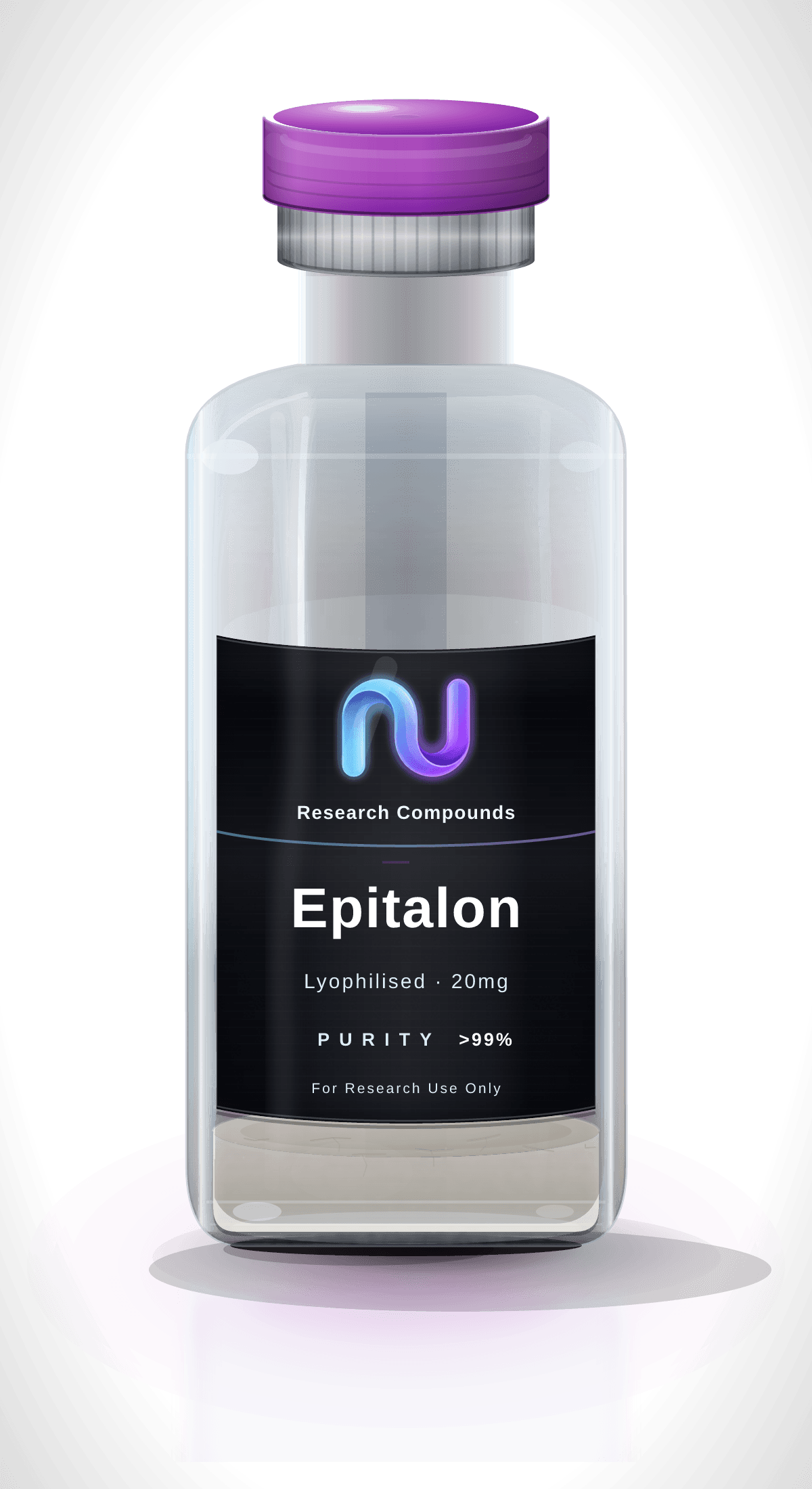
Epitalon, also spelled Epithalon, is the synthetic tetrapeptide Ala-Glu-Asp-Gly (AEDG), identified by Vladimir Khavinson's group as the active component of the bovine pineal extract epithalamin. Its best-documented data are in vitro, where it reactivated hTERT expression and extended fibroblast proliferation past the Hayflick limit; animal work reports restored pineal melatonin secretion. New-U supplies Epitalon as lyophilised research material in vial strengths from 5 mg to 100 mg. Human data are small and variable, often concern epithalamin rather than AEDG, and do not establish clinical effects.
What It's Researched For
Epitalon (Epithalon) | AEDG Peptide Bioregulator
Tap a pack to select it
Buy the 10-pack - save 57%/mg. Single vials welcome — checkout needs 3+ vials or any 10-vial pack - build a custom vial pack
In plain terms, Epitalon is studied mainly as a cellular-ageing and longevity compound. Here is what that looks like across the research.
Research explores how it switches the telomerase enzyme back on, lengthening the protective caps on chromosomes that normally shorten as cells age.
In classic cell-culture studies it let human cells keep dividing well past their usual limit, a key longevity-research finding.
Animal studies look at restored melatonin output from the pineal gland, the hormone tied to the sleep-wake rhythm.
Widely used as a reference compound in research on how and why cells stop dividing as they grow old.
In short: Epitalon (also spelled Epithalon) is a four-amino-acid tetrapeptide that reactivates telomerase expression in human somatic cells, extending replicative lifespan beyond the Hayflick limit in classic fibroblast aging experiments.
These points summarise lab themes, not human outcomes.
Epitalon is a very small peptide - just four amino acids (Ala-Glu-Asp-Gly) - identified as the bioactive core of a larger pineal extract called epithalamin. It was developed by Vladimir Khavinson's group at the St. Petersburg Institute of Bioregulation and Gerontology as part of a decades-long Russian research programme on "bioregulator peptides" - short peptides that seemed to reset age-related gene expression.
What makes Epitalon interesting in longevity research is its effect on telomerase. Human somatic cells typically stop expressing hTERT (the catalytic subunit of telomerase) as they mature, which means their telomeres shorten with each division until they hit the Hayflick limit and stop dividing. Epitalon upregulates hTERT expression and elongates telomeres in human fibroblasts, extending proliferative lifespan in experimental models.
Epitalon has become a staple of longevity and telomere biology research. Supplied here as sterile lyophilised powder for in-vitro and preclinical research - it is not an approved medicine anywhere in the world.
Epitalon (Ala-Glu-Asp-Gly) is a synthetic tetrapeptide identified as the bioactive component of bovine pineal extract epithalamin, developed by Vladimir Khavinson at the St. Petersburg Institute of Bioregulation and Gerontology. Epitalon reactivates telomerase catalytic subunit (hTERT) expression in human somatic cells, with 12-fold hTERT upregulation observed in 21NT breast epithelial cells at 1 μg/mL (Khavinson et al., Bulletin of Experimental Biology and Medicine, 2003). Treatment of human fetal fibroblasts extended proliferative capacity beyond the 44th passage versus senescence at passage 34 in controls, demonstrating Hayflick limit extension (Khavinson et al., Neuroendocrinology Letters, 2003). Epitalon interacts with the ATTTC DNA motif present in the hTERT promoter region and forms complexes with histones H1/6 and H1/3.
Epitalon binds specific DNA motifs and histone proteins in the hTERT promoter region, switching on telomerase expression and allowing telomeres to lengthen in cells that had turned the enzyme off.
| Pathway | Effect | Why it matters |
|---|---|---|
| hTERT reactivation | 12× upregulation in 21NT breast epithelial cells | Restores the catalytic subunit of telomerase in somatic cells |
| Telomere elongation | Extends telomeres past the Hayflick limit in human fibroblasts | Delays replicative senescence in cell culture aging models |
| ATTTC DNA binding | Binds specific DNA motifs in the hTERT promoter | Direct promoter-level regulation rather than indirect signalling |
| Histone H1 complex | Forms complexes with histones H1/6 and H1/3 | Remodels chromatin at the hTERT locus to favour transcription |
| Pineal melatonin support | Restores melatonin secretion in aged primates | Nudges circadian and neuroendocrine function toward a younger state |
Khavinson et al. (Bulletin of Experimental Biology and Medicine, 2003) reported 12-fold hTERT upregulation at 1 μg/mL in 21NT breast epithelial cells. A parallel study (Khavinson et al., Neuroendocrinology Letters, 2003) showed extended proliferative capacity of human fetal fibroblasts beyond passage 44, versus senescence at passage 34 in controls. The DNA-binding mechanism involves the ATTTC motif in the hTERT promoter and formation of complexes with histones H1/6 (ΔG = −64.51 kcal/mol). No formal human pharmacokinetic data has been published.
Epitalon (AEDG) is studied as a telomerase-activating bioregulator peptide and a tool compound in telomere biology, cellular-senescence, and longevity research. Cell-culture work has examined hTERT reactivation and telomere elongation, while animal studies have looked at pineal melatonin output and lifespan endpoints.
Yes - the two spellings refer to the same tetrapeptide (Ala-Glu-Asp-Gly). "Epitalon" and "Epithalon" are interchangeable transliterations of the Russian name. You will also see "Epithalone" and "AEDG peptide" in the literature, all referring to the same compound.
Epitalon binds specific DNA motifs (the ATTTC element) in the hTERT promoter and forms complexes with histone proteins, which favours transcription of hTERT - the catalytic subunit of telomerase. Re-expressing hTERT in somatic cells that had silenced it lets telomeres lengthen rather than shorten with each division. This is a promoter-level mechanism rather than indirect signalling, which is unusual for such a small peptide.
That is a longevity research question that has not been definitively answered. The cell-culture telomere-elongation data is clear, and there are animal studies showing increased maximum lifespan. Human longevity data is limited to small studies and the related pineal extract epithalamin, not the synthetic AEDG peptide. It remains a research compound, not a validated longevity therapy.
Published Russian research protocols describe a pulsed pattern - around 5-10 mg subcutaneously once daily for 10-20 consecutive days, followed by a 4-6 month rest period before the next cycle. This pulse-then-rest design mirrors the original animal study schedules. These figures are descriptive of the literature and are not a recommendation; the material is for laboratory research only.
Both are studied in aging research but work on opposite ends of the problem. Epitalon is a telomerase activator that aims to slow telomere-driven senescence by keeping cells dividing, whereas FOXO4-DRI is a senolytic that selectively kills cells that have already become senescent. One delays the onset of senescence; the other clears existing "zombie" cells.
Keep the lyophilised powder frozen at −20 °C. After reconstitution with bacteriostatic water, refrigerate at 1-6 °C and protect from light. The tetrapeptide is small and simple, so it tolerates standard peptide handling well within the normal usage window.
Right here - Epitalon is supplied directly by New-U Research Compounds on this page as lyophilised research-grade material, with an independent Lingda Laboratory Certificate of Analysis published on this page, and shipped direct from source worldwide in discreet, tracked packaging.
Epitalon pricing is shown live on this page, per pack size - sealed 10-vial research packs, or single vials where listed (an order needs at least 3 single vials in total, or any 10-vial pack). The batch Certificate of Analysis is published on this page, and shipping is free on orders over $350.
Yes. Epitalon has an independent Lingda Laboratory Certificate of Analysis, which reports 99.68% purity for the sample analysed. The report number and test date are on the certificate, published on this page and on our COA page rather than packed with orders. View the Epitalon Certificate of Analysis →
Add the Epitalon pack size you need to your cart and check out: enter your shipping details, then choose your payment method - cryptocurrency or card - on the next step. The batch Certificate of Analysis (COA) is published on this page, so you can check it before you order.
At checkout you can pay by card or crypto. New-U supports BTC and selected stablecoin and network-asset payments across Ethereum, Solana, TRON, Polygon, Base, BNB Chain and Linea. You choose your method after confirming your order.
Yes - we ship worldwide in discreet, unmarked, tracked packaging; lyophilised peptides are stable through the tracked transit window. Delivery typically takes 6–14 business days, and shipping is free on orders over $350.
In the United States, Epitalon is sold strictly for laboratory and research purposes only. It is not approved by the FDA for human consumption and is not sold for that purpose. Regulatory status varies by jurisdiction - buyers are responsible for compliance in their own region.
Research use only - all claims made on this site are for testing and research use only.
| Stability | Lyophilised powder: store in freezer (−20 °C). Reconstituted: refrigerate 1–6 °C, away from sunlight. Use within the validated stability window for the specific batch and formulation. |
|---|---|
| Notes | Formal human pharmacokinetic parameters (t½, Vd, bioavailability) have not been published. As a tetrapeptide (MW 390.35 Da), Epitalon is subject to rapid peptidase hydrolysis releasing constituent amino acids. Subcutaneous and intraperitoneal routes are standard in published animal protocols. BBB penetration has been demonstrated in animal models. Oral bioavailability is not characterized. |
Overall: Mixed (human + animal)
Epitalon's best-documented mechanism data are in-vitro - hTERT reactivation and telomere elongation in human cell culture (Khavinson et al., Bull Exp Biol Med, 2003; PMID 12937682). Animal work reports pineal melatonin restoration, and human data are limited to small longevity studies of variable rigor, much of which concerns the related pineal extract epithalamin rather than the synthetic AEDG tetrapeptide. Epitalon has no Western regulatory approval and is supplied as unapproved laboratory material.
Last reviewed: 16 June 2026 · New-U Research Compounds
| Molecular Formula | C14H22N4O9 |
|---|---|
| Molecular Weight | 390.35 Da |
| Sequence | Ala-Glu-Asp-Gly (AEDG) |
| Purity | 99.68% (HPLC) |
| Form | Lyophilised powder |
| Target | hTERT promoter / histone H1 complexes |
| Route | Subcutaneous or intraperitoneal injection |
| Solubility | Bacteriostatic water or sterile saline |
| Storage | Lyophilised: −20 °C freezer. Reconstituted: 1-6 °C, away from light. |
Epitalon comes from a distinct research lineage - the Russian "bioregulator peptide" programme led by Vladimir Khavinson at the St. Petersburg Institute of Bioregulation and Gerontology. The programme's central hypothesis was that organs produce very short peptides (two to four amino acids) that regulate their own gene expression, and that supplementing those peptides could reset age-related expression patterns in target tissues. Epitalon - the synthetic AEDG tetrapeptide (Ala-Glu-Asp-Gly) - is the pineal-derived member of that family.
The mechanism that drew mainstream attention is telomerase reactivation. In a foundational in-vitro study (Khavinson et al., Bull Exp Biol Med, 2003), Epithalon induced telomerase catalytic-subunit (hTERT) expression, telomerase activity, and telomere elongation in human somatic cells, and extended the proliferative capacity of human fetal fibroblasts past the Hayflick limit - the normal boundary at which somatic cells stop dividing due to telomere shortening. That gives it an unusual place in the longevity and telomere-biology research toolkit.
New-U Research Compounds supplies Epitalon (also often spelled Epithalon) as a research-grade lyophilised powder at 99.68% HPLC purity, verified by an independent third-party lab (Lingda Laboratory, report YLBP20261242, September 2026). All material is strictly for in-vitro and preclinical research use. Epitalon is not approved for human therapeutic use in any major jurisdiction, and nothing on this page constitutes medical advice.
The items arrived protected and the packaging was tidy. Better than some orders I've had elsewhere.
Viskas buvo tvarkingai sudėta, todėl patikrinti užsakymą buvo paprasta.
| Compound | Price | Purity spec | COA |
|---|---|---|---|
| Epitalon | from $91 | 99.68% HPLC | 2 published batches |
| MOTS-C | from $103 | >99% HPLC | 2 published batches |
| 5-Amino-1MQ | from $93 | >99% HPLC | 1 published batch |
Descriptive catalog comparison for research sourcing decisions - not dosing guidance.
Part of the Cognitive & longevity research research area — explore related compounds, guides and sources.
From our community
Facebook account deactivated