
Belly fat & metabolism
In clinical human trials, studied for reducing deep visceral abdominal fat over several months while sparing fat just under the skin.
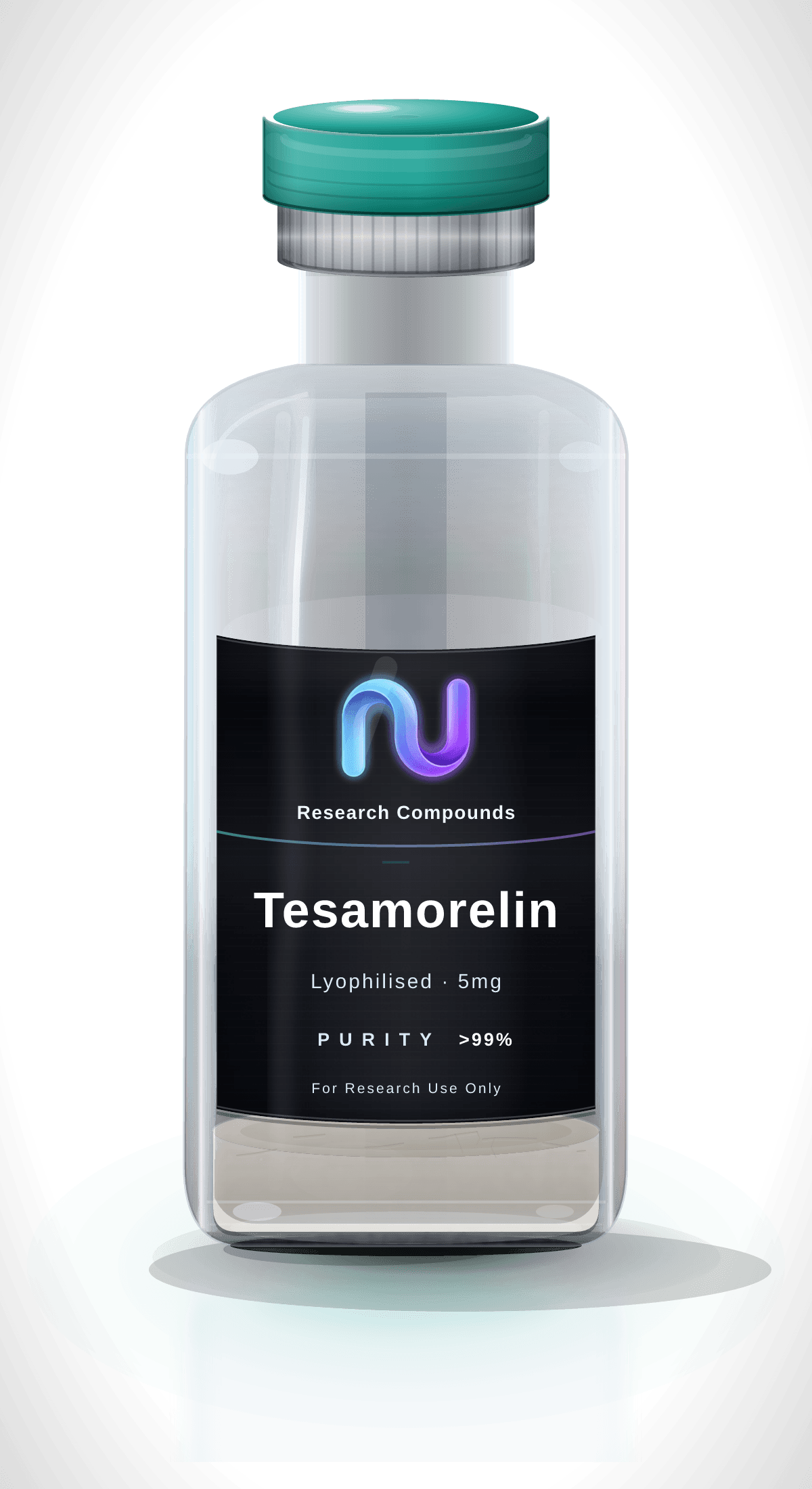
Tesamorelin is a stabilised analogue of human growth-hormone-releasing hormone, based on the GHRH(1-44) sequence. Its research literature covers GHRH receptor signalling and downstream pituitary GH/IGF-1 endocrine responses. New-U provides tesamorelin as lyophilised laboratory research material, with pack and vial options shown on the page. Published research on a named molecule should not be taken as a claim about the safety or clinical equivalence of this supply.
Tesamorelin Research Peptide | GHRH Analogue
Tap a pack to select it
Buy the 10-pack - save 53%/mg. Single vials welcome — checkout needs 3+ vials or any 10-vial pack - build a custom vial pack
In plain terms, tesamorelin is the most clinically studied compound in this family, best known for research on deep belly fat. Here is what that looks like across the research.
In clinical human trials, studied for reducing deep visceral abdominal fat over several months while sparing fat just under the skin.
Human research investigates whether it lowers fat stored in the liver, a fast-growing area of metabolic study.
Clinical research explores support for lean body mass through the natural rise in growth hormone and IGF-1.
Studied alongside the fat-loss work for improvements in blood-fat markers such as triglycerides.
Investigated for the age-related GH decline, drawing on the strongest human dataset of any compound in this class.
In short: Tesamorelin is a synthetic GHRH(1-44) analogue engineered for DPP-IV resistance, studied for visceral fat reduction, IGF-1 elevation, and metabolic research. The molecule is approved as the prescription medicine Egrifta for HIV-associated lipodystrophy; the material supplied here is unapproved laboratory research material, not that product.
These points summarise lab themes, not human outcomes.
Tesamorelin is a 44-amino-acid synthetic version of growth hormone releasing hormone (GHRH), the hypothalamic signal that tells the pituitary to pulse out growth hormone. Researchers attached a small trans-3-hexenoic acid tag to the N-terminus, which blocks the DPP-IV enzyme that would otherwise chew up native GHRH within minutes.
The practical effect is that tesamorelin can survive long enough after a subcutaneous injection to actually drive a physiologic GH pulse. Unlike injecting GH itself, tesamorelin preserves the natural negative-feedback loop - somatostatin can still turn off the pituitary - so you get a more physiological release pattern without overshoot.
FDA-approved in 2010 for HIV-associated lipodystrophy, tesamorelin is widely studied as a visceral fat reduction tool and is under investigation for metabolic dysfunction-associated steatotic liver disease (MASLD). Supplied here as sterile lyophilised powder for research use.
Tesamorelin is a synthetic 44-amino acid analogue of endogenous growth hormone-releasing hormone (GHRH) featuring an N-terminal trans-3-hexenoic acid moiety conjugated to Tyr1, conferring resistance to dipeptidyl peptidase-IV (DPP-IV) cleavage and enhanced GHRHR binding affinity compared to native GHRH(1-44). Receptor activation on anterior pituitary somatotroph cells triggers calcium influx and membrane depolarization, facilitating pulsatile GH secretion that preserves physiological somatostatin-mediated negative feedback, a key pharmacological distinction from exogenous rhGH administration (Falutz et al., NEJM, 2007). FDA-approved in 2010 for HIV-associated lipodystrophy, tesamorelin reduced visceral fat by ~15–18% over 26 weeks with concomitant IGF-1 elevation of 1.5–3-fold. Research by Stanley et al. (Lancet HIV, 2019) further demonstrated significant hepatic-fat reduction and slowed fibrosis progression in HIV-associated NAFLD over 12 months, supporting investigation in metabolic dysfunction contexts.
Tesamorelin binds the GHRH receptor on pituitary somatotrophs to drive a natural pulse of growth hormone, which then raises IGF-1 and mobilises visceral fat.
| Pathway | Effect | Why it matters |
|---|---|---|
| GHRH receptor | Agonist at the pituitary somatotroph GHRHR | Triggers calcium-dependent GH exocytosis following a near-native release pattern |
| DPP-IV resistance | N-terminal hexenoic acid blocks DPP-IV cleavage | Keeps the peptide active long enough to generate a measurable GH pulse |
| Somatostatin feedback | Preserves the natural off-switch for GH release | Maintains pulsatility and avoids the excess seen with direct GH dosing |
| Hepatic IGF-1 | Elevates IGF-1 by 1.5-3× over baseline | Drives most of the downstream anabolic and metabolic effects |
| Visceral lipolysis | Selectively reduces visceral adipose tissue | 18% VAT reduction at 26 weeks in HIV lipodystrophy trials |
Falutz et al. (NEJM, 2007) reported the landmark phase 3 data showing ~18% visceral fat reduction at 26 weeks with 2 mg daily tesamorelin in 412 participants. Stanley et al. (Lancet HIV, 2019) then demonstrated reduced liver fat and slowed fibrosis progression in HIV-associated NAFLD over 12 months, suggesting a role in metabolic dysfunction research beyond lipodystrophy. Elimination half-life is short (~8-26 min) but the GH pulse it triggers lasts 2-4 h, and IGF-1 accumulates with daily dosing. Absolute SC bioavailability is under 4%, which is why subcutaneous dosing is in the milligram rather than microgram range.
Tesamorelin is a synthetic 44-amino-acid analogue of growth-hormone-releasing hormone (GHRH) stabilised with an N-terminal hexenoic acid. It signals the pituitary to release growth hormone and is the molecule approved (as Egrifta) to reduce excess visceral fat in HIV-associated lipodystrophy. New-U's tesamorelin is research-grade material supplied for laboratory use only - not the approved drug.
In the research and clinical literature tesamorelin activates the pituitary GHRH receptor to raise growth hormone and IGF-1, with a notable effect on visceral (deep abdominal) adipose tissue. These are findings for the molecule and imply no human therapeutic effect.
Clinically the approved drug is used to reduce visceral fat in HIV-associated lipodystrophy. In the research literature it is a tool compound for GH-axis and adipose-tissue studies. New-U supplies research-grade tesamorelin strictly for in-vitro and animal-model research.
The pharmaceutical tesamorelin (Egrifta) is FDA-approved for HIV-associated lipodystrophy. That approval applies to the finished prescription drug - NOT to research-grade material. New-U's tesamorelin is an unapproved research powder and is not a substitute for the prescription product.
As the approved drug Egrifta, tesamorelin has a human safety dataset under medical supervision. That record does not extend to research-grade material, which is not a sterile approved medicine and carries no human safety assurances.
All three are GHRH analogs, but tesamorelin is a full 44-amino-acid version with an N-terminal hexenoic acid for DPP-IV resistance. Sermorelin is the shorter 29-residue truncation with a shorter half-life, and CJC-1295 uses either tetrasubstitution (no-DAC) or covalent albumin binding (DAC) for different duration profiles. Tesamorelin has the strongest clinical dataset.
They act on opposite ends of the same axis: tesamorelin is a GHRH-receptor analogue acting upstream on the pituitary, while ipamorelin is a selective ghrelin-receptor (GHSR) agonist. Tesamorelin has the heavier clinical dataset and a specific visceral-fat signal, whereas ipamorelin is prized for clean GH release with minimal cortisol or prolactin effect. Because they engage different receptors, the two are studied together as a complementary GHRH + secretagogue pairing rather than as substitutes.
GH itself preferentially mobilises visceral adipose tissue because visceral fat is more sensitive to catecholamine and GH-driven lipolysis than subcutaneous fat. Tesamorelin generates a physiologic GH pulse that targets exactly this compartment, which is why VAT drops while SAT is largely preserved.
Like any GH-driven protocol, tesamorelin can transiently raise fasting glucose and worsen insulin sensitivity because GH opposes insulin action. Clinical trials reported modest glycemic changes that are typically manageable but warrant monitoring in research protocols.
Keep the lyophilised powder frozen at −20 °C. After reconstitution with bacteriostatic water, refrigerate at 1-6 °C, protect from light, and use within the peptide's typical stability window. Avoid shaking, which can denature the peptide.
Tesamorelin is a GHRH analogue studied for its effect on visceral fat via the body's own GH release. The published clinical literature on the reference drug reports that the visceral-fat reduction is not maintained after the peptide is discontinued - visceral adipose tissue tends to return toward baseline - because the effect depends on ongoing GH-axis stimulation rather than a permanent change. Those findings describe the approved medicine in human studies; tesamorelin here is an unapproved research-grade peptide.
Right here - Tesamorelin is supplied directly by New-U Research Compounds on this page as lyophilised research-grade material, with an independent Janoshik Analytical Certificate of Analysis published on this page, and shipped direct from source worldwide in discreet, tracked packaging.
Tesamorelin pricing is shown live on this page, per pack size - sealed 10-vial research packs, or single vials where listed (an order needs at least 3 single vials in total, or any 10-vial pack). Larger vial strengths lower the per-mg cost, the batch Certificate of Analysis is published on this page, and shipping is free on orders over $350.
Yes. Tesamorelin has an independent Janoshik Analytical Certificate of Analysis, which reports 98.589% purity for the sample analysed. The report number and test date are on the certificate, published on this page and on our COA page rather than packed with orders. View the Tesamorelin Certificate of Analysis →
Add the Tesamorelin pack size you need to your cart and check out: enter your shipping details, then choose your payment method - cryptocurrency or card - on the next step. The batch Certificate of Analysis (COA) is published on this page, so you can check it before you order.
At checkout you can pay by card or crypto. New-U supports BTC and selected stablecoin and network-asset payments across Ethereum, Solana, TRON, Polygon, Base, BNB Chain and Linea. You choose your method after confirming your order.
Yes - we ship worldwide in discreet, unmarked, tracked packaging; lyophilised peptides are stable through the tracked transit window. Delivery typically takes 6–14 business days, and shipping is free on orders over $350.
In the United States, Tesamorelin is sold strictly for laboratory and research purposes only. It is not approved by the FDA for human consumption and is not sold for that purpose. Regulatory status varies by jurisdiction - buyers are responsible for compliance in their own region.
Research use only - all claims made on this site are for testing and research use only.
| Half-life | Elimination t½ ~8–26 min; the triggered GH pulse lasts 2–4 h |
|---|---|
| Absorption route | Subcutaneous injection; Tmax ~0.15 h (median) |
| Bioavailability | Absolute subcutaneous bioavailability <4% (the reason dosing is in the milligram, not microgram, range) |
| Metabolism / clearance | Proteolytic clearance; the N-terminal trans-3-hexenoyl group confers DPP-IV resistance |
| Stability | Lyophilised: −20 °C. Reconstituted: 1–6 °C, protect from light; avoid shaking |
| Notes | IGF-1 accumulates over weeks of daily dosing; AUC ~34% higher in HIV-infected than healthy subjects. |
In the registration trials the reference drug was administered as 2 mg once daily subcutaneously, with visceral-fat and IGF-1 effects measured over 26–52 weeks. New-U supplies research vials at 2 mg, 5 mg, 10 mg and 20 mg. These figures describe the published clinical-trial schedule for the approved drug and are recorded here as research context only.
Overall: Tier 1: Human clinical
Tesamorelin has the strongest clinical dataset of the GHRH-analogue class and is FDA-approved as a finished pharmaceutical. The research-grade material supplied here is NOT the approved drug and is unapproved laboratory material.
Last reviewed: 16 June 2026 · New-U Research Compounds
| Molecular Formula | C221H366N72O67S |
|---|---|
| Molecular Weight | 5135.9 Da |
| Sequence | 44-aa GHRH analog with N-terminal hexenoic acid |
| Purity | 98.6% (HPLC; current certificate covers the 10 mg batch) |
| Form | Lyophilised powder |
| Half-life | 8-26 min (elimination); pulse lasts 2-4 h |
| Bioavailability (SC) | <4% |
| Route | Subcutaneous injection, once daily |
| Storage | Lyophilised: −20 °C freezer. Reconstituted: 1-6 °C, away from light. |
Tesamorelin (TH-9507) is a stabilised GHRH(1-44) analogue developed by Theratechnologies specifically to solve the problem of excess visceral fat in people with HIV-associated lipodystrophy - a tissue-distribution syndrome that standard weight-loss approaches could not address. The small N-terminal trans-3-hexenoic acid tag that makes tesamorelin DPP-IV resistant is the whole difference between a peptide that lasts minutes and one that can generate a measurable, physiologic growth-hormone pulse.
The phase 3 results were striking. Falutz et al. (NEJM, 2007) reported roughly an 18% reduction in visceral adipose tissue over 26 weeks without significant changes in subcutaneous fat, and that selective visceral effect is why tesamorelin remains a reference compound for researchers studying metabolic dysfunction more broadly. Newer work in HIV-associated NAFLD (Stanley et al., Lancet HIV 2019) showed reduced liver fat and slowed fibrosis progression over 12 months, anchoring its current interest in MASLD/MASH research. Because it works upstream on the GHRH receptor, it is also studied alongside ghrelin-receptor secretagogues such as ipamorelin.
New-U Research Compounds supplies tesamorelin as a sterile lyophilised powder in 2 mg, 5 mg, 10 mg or 20 mg vials. The 98.6% HPLC purity figure is from the current independent third-party Certificate of Analysis, which covers the 10 mg batch; the 2 mg and 20 mg packs have no certificate of their own yet. It is for in-vitro and preclinical laboratory research only, is not the approved drug (Egrifta), and is not a substitute for any prescribed pharmaceutical. Nothing on this page is medical advice.
Looked for Tesamorelin and had another straightforward experience. No unnecessary steps at checkout.
I had Tesamorelin in my basket and checked out without fuss. The rest of the process was just as straightforward.
I always double-check the basket before paying. This time the item and quantity were right there in front of me.
| Compound | Price | Purity spec | COA |
|---|---|---|---|
| Tesamorelin | from $100 | 98.6% HPLC | 1 published batch |
| Sermorelin | from $86 | >99% HPLC | On request |
| CJC-1295 (with DAC) | from $209 | >99% HPLC | 2 published batches |
Descriptive catalog comparison for research sourcing decisions - not dosing guidance.
Part of the Growth hormone secretagogue research research area — explore related compounds, guides and sources.
From our community
Facebook account deactivated