
Strong GH release
Research explores how it produces one of the largest growth-hormone pulses of any compound in this family per dose.
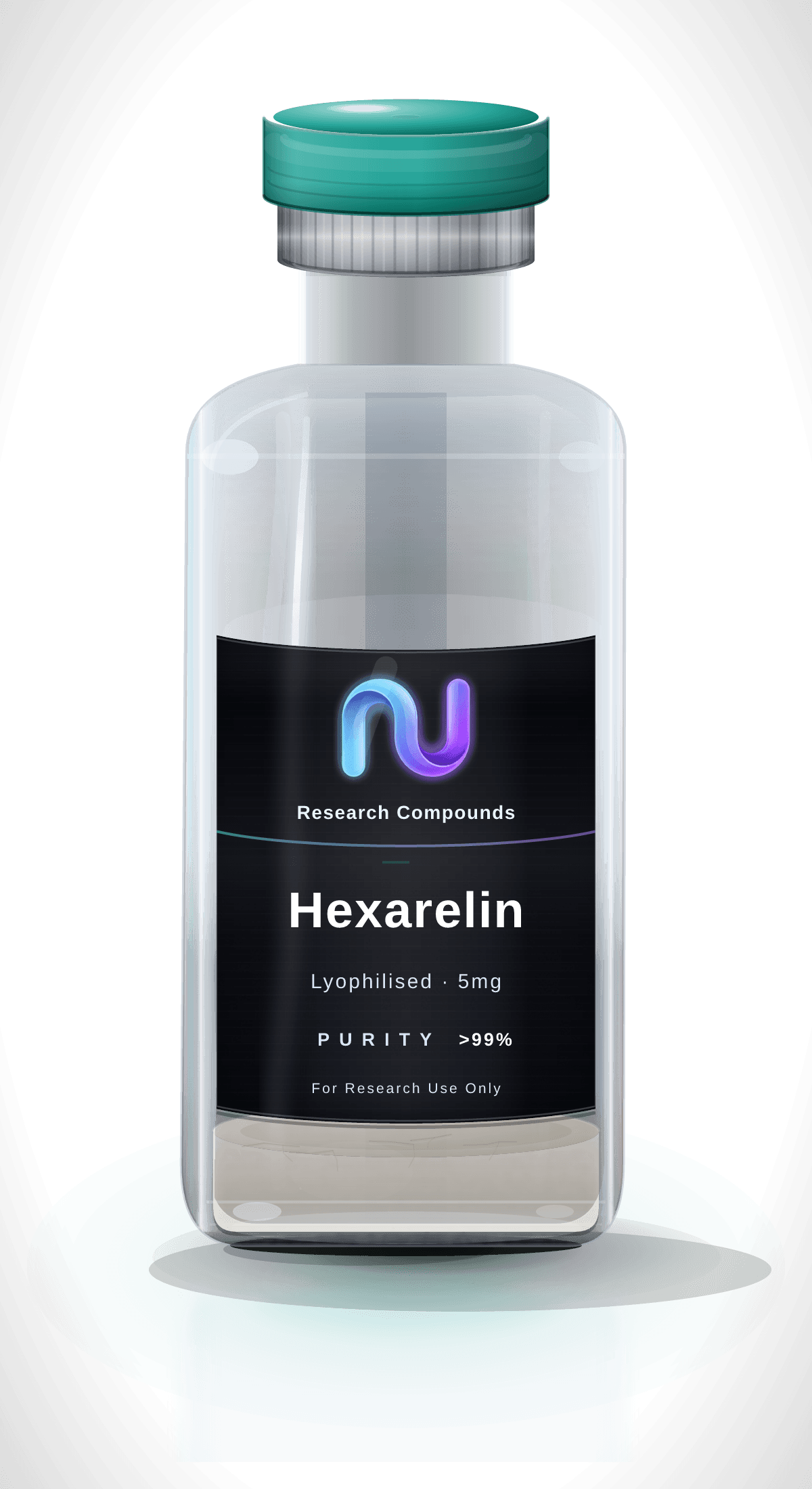
Hexarelin (examorelin) is a synthetic hexapeptide, His-D-2MeTrp-Ala-Trp-D-Phe-Lys-NH2, built on the GHRP-6 scaffold and acting as a GHS-R1a (ghrelin receptor) agonist. Human endocrine-challenge studies describe its GH release and its synergy with GHRH, while rat and perfused-heart work examines GH-independent cardiac effects linked to the CD36 receptor. New-U supplies hexarelin as lyophilised research material for laboratory investigation. It reached Phase II trials without approval, and these findings do not establish clinical effects.
What It's Researched For
Hexarelin (Examorelin) Research Peptide
Tap a pack to select it
Buy the 10-pack - save 58%/mg. Single vials welcome — checkout needs 3+ vials or any 10-vial pack - build a custom vial pack
In plain terms, hexarelin is one of the strongest growth-hormone releasers studied, with an unusual second action on the heart. Here is what that looks like across the research.
Research explores how it produces one of the largest growth-hormone pulses of any compound in this family per dose.
Animal studies look at a separate, growth-hormone-independent action on heart cells, an angle unique to hexarelin in this class.
Studied for how its powerful growth-hormone and IGF-1 signal supports lean mass and recovery.
Investigated alongside GHRH compounds, where even a small partner dose produces a much larger combined growth-hormone release.
A classic tool for studying how the response fades with constant use and recovers after a break, which is why research favours lower amounts and cycling.
In short: Hexarelin is a potent six-amino-acid growth hormone secretagogue that uniquely activates both the ghrelin receptor (for GH release) and CD36 scavenger receptors on cardiomyocytes (for cardioprotective signalling).
These points summarise lab themes, not human outcomes.
Hexarelin (also known as examorelin) is a synthetic hexapeptide built on the GHRP-6 scaffold with two non-natural amino-acid substitutions (D-2-methyltryptophan and D-phenylalanine) that dramatically improve metabolic stability. It binds the ghrelin receptor GHS-R1a very tightly and releases more GH per dose than even native GHRH.
What makes hexarelin genuinely unusual is its second receptor. Alongside its GH-releasing activity, it activates CD36 scavenger receptors on heart muscle cells, producing cardioprotective effects that are independent of GH release entirely. Phase II trials explored hexarelin for both growth hormone deficiency and congestive heart failure.
Hexarelin is widely used in research as a potent GH release benchmark and as a tool compound for studying CD36 signalling in cardiac tissue. Supplied here as sterile lyophilised powder for preclinical research.
Hexarelin (examorelin) is a synthetic hexapeptide growth hormone secretagogue with the sequence His-D-2MeTrp-Ala-Trp-D-Phe-Lys-NH2, derived from the GHRP-6 scaffold with enhanced metabolic stability via D-2-methyltryptophan and D-phenylalanine substitutions. It binds GHS-R1a (ghrelin receptor) with high affinity, activating phospholipase C/IP3/DAG signaling and intracellular calcium mobilization in pituitary somatotrophs. Hexarelin is notable for producing greater GH release than equimolar GHRH, and when co-administered with even low-dose GHRH (0.125 mcg/kg), generates "massive" synergistic GH secretion with minimal cortisol or prolactin elevation (Ghigo et al., European Journal of Clinical Pharmacology, 1996). Uniquely among GHRPs, hexarelin also activates CD36 scavenger receptors on cardiomyocytes, mediating cardioprotective effects through calcium channel modulation independent of GH release (Bisi et al., Journal of Clinical Endocrinology & Metabolism, 1999). Phase II trials explored applications in growth hormone deficiency and congestive heart failure.
Hexarelin hits two receptors: GHS-R1a on pituitary cells to release growth hormone, and CD36 on heart cells to improve cardiac function - a dual-target pharmacology no other GHRP matches.
| Pathway | Effect | Why it matters |
|---|---|---|
| GHS-R1a (ghrelin receptor) | Potent agonist on pituitary somatotrophs | Drives GH release larger than equimolar GHRH |
| CD36 scavenger receptor | Activates CD36 on cardiomyocytes | Delivers cardioprotective effects independent of GH release |
| PLC / IP3 / calcium | Canonical GHSR signalling for GH exocytosis | The mechanism behind all ghrelin-receptor GH releasing peptides |
| GHRH synergy | Massive GH release when combined with GHRH | Even sub-threshold GHRH doses multiply hexarelin's GH output |
| Non-natural amino acids | D-2MeTrp and D-Phe block protease cleavage | Gives longer duration and higher oral stability than GHRP-6 |
Massoud et al. (J Clin Endocrinol Metab, 1996) showed that hexarelin with very low-dose GHRH produces massive synergistic GH release with no rise in cortisol. Bodart et al. (Circ Res, 2002) identified CD36 as a cardiac hexarelin-binding protein; in perfused hearts hexarelin raised coronary perfusion pressure, while Locatelli et al. (Endocrinology, 1999) reported GH-independent protection against ischaemia-reperfusion damage in rats, so the cardiac findings are mixed. GH Tmax ≈ 30 min; GH returns to baseline within 240 min; functional SC t½ ≈ 1-2 h. In a 16-week study in 12 healthy older adults the GH response fell by roughly 45% and recovered four weeks after stopping (Rahim et al., 1998): a partial, reversible attenuation.
Hexarelin is a more potent version of the GHRP-6 scaffold with two non-natural amino-acid substitutions (D-2-methyltryptophan and D-phenylalanine) that improve stability and GH-releasing potency. It also has clearer CD36-mediated cardiac effects than the simpler GHRP-6.
CD36 is a scavenger receptor that handles fatty acid uptake and calcium channel modulation in cardiomyocytes. Hexarelin activation of cardiac CD36 improves calcium handling and has been proposed as a mechanism for its cardioprotective effects in post-ischemic injury models.
Yes, hexarelin produces some cortisol and prolactin elevation at higher doses, more than ipamorelin but generally less than GHRP-6. Low-dose protocols minimise those secondary effects while preserving GH release.
Keep the lyophilised powder frozen at −20 °C. After reconstitution with bacteriostatic water, refrigerate at 1-6 °C and protect from light. The non-natural amino acid substitutions give it better shelf stability than simpler GHRPs.
Both are ghrelin-receptor (GHSR) agonists that release growth hormone, but hexarelin is the more potent GH releaser and adds CD36-mediated cardiac activity, while ipamorelin is the cleaner, more selective option with minimal cortisol, prolactin or appetite effect. Hexarelin also shows a partial, reversible fall in GH response with repeated administration (Rahim et al., 1998). See our Hexarelin vs Ipamorelin research comparison for the full mechanism breakdown.
Both are hexapeptide ghrelin-receptor agonists, but hexarelin is the more potent GH releaser per dose and uniquely adds CD36-mediated cardiac activity, while GHRP-2 produces a more modest GH pulse with a milder cortisol and prolactin profile. Hexarelin also shows a partial, reversible fall in GH response with repeated administration (Rahim et al., 1998). Both are supplied strictly for laboratory research, not human use.
Research protocols describe low-microgram subcutaneous amounts, often split through the day, with lower amounts used to limit cortisol/prolactin rise and receptor desensitisation. New-U publishes this as descriptive research context only - it is not a dosing instruction, and hexarelin is supplied strictly for laboratory research, not human use.
Beyond growth-hormone release, hexarelin is studied for CD36-mediated cardioprotective effects in post-ischaemic injury models and for calcium-handling in cardiomyocytes - an angle the simpler GHRPs lack. These are preclinical research findings; New-U makes no therapeutic claims.
Partially. In a 16-week study in 12 healthy older adults the GH response to hexarelin fell from 19.1 to 10.5 µg/L·h and returned to 19.4 four weeks after stopping (Rahim et al., 1998), which the authors called partial and reversible. Reported for research context only, not a human-use protocol.
Right here - Hexarelin is supplied directly by New-U Research Compounds on this page as lyophilised research-grade material with a >99% HPLC purity specification, and shipped direct from source worldwide in discreet, tracked packaging.
Hexarelin pricing is shown live on this page, per pack size - sealed 10-vial research packs, or single vials where listed (an order needs at least 3 single vials in total, or any 10-vial pack). Shipping is free on orders over $350.
Add the Hexarelin pack size you need to your cart and check out: enter your shipping details, then choose your payment method - cryptocurrency or card - on the next step.
At checkout you can pay by card or crypto. New-U supports BTC and selected stablecoin and network-asset payments across Ethereum, Solana, TRON, Polygon, Base, BNB Chain and Linea. You choose your method after confirming your order.
Yes - we ship worldwide in discreet, unmarked, tracked packaging; lyophilised peptides are stable through the tracked transit window. Delivery typically takes 6–14 business days, and shipping is free on orders over $350.
In the United States, Hexarelin is sold strictly for laboratory and research purposes only. It is not approved by the FDA for human consumption and is not sold for that purpose. Regulatory status varies by jurisdiction - buyers are responsible for compliance in their own region.
Research use only - all claims made on this site are for testing and research use only.
| Stability | Lyophilised powder: store in freezer (−20 °C). Reconstituted: refrigerate 1–6 °C, away from sunlight. Use within the validated stability window for the specific batch and formulation. |
|---|---|
| Notes | GH Tmax ≈ 30 min; GH returns to baseline within 240 min with t½ ≈ 55 min; SC t½ ≈ 1–2 h; detectable up to 8 h post-administration. GH plateau at 140 mU/L at 1.0 mcg/kg dose. Partial reversible tolerance develops with chronic use (50–75% efficacy reduction over weeks–months). |
Overall: Tier 2: Animal / preclinical
Hexarelin (examorelin) has genuine human endocrine-challenge pharmacology and reached Phase II trials in two indications, but none led to approval. It is not approved by any regulator for human therapeutic use; the material supplied here is unapproved research material.
Last reviewed: 16 June 2026 · New-U Research Compounds
| Molecular Formula | C47H58N12O6 |
|---|---|
| Molecular Weight | 887.04 Da |
| Sequence | His-D-2MeTrp-Ala-Trp-D-Phe-Lys-NH2 |
| Purity | >99% (HPLC) |
| Form | Lyophilised powder |
| Half-life | ~55 min (GH return to baseline) |
| Route | Subcutaneous injection, 1-3× daily |
| GH Tmax | ~30 min post-dose |
| Storage | Lyophilised: −20 °C freezer. Reconstituted: 1-6 °C, away from light. |
Hexarelin (examorelin) occupies a unique spot in the growth hormone releasing peptide family. It is the most potent GH releaser that the classical GHRP scaffold has produced, but it is also the only GHRP with well-characterised activity at a second receptor (CD36) that has nothing to do with GH. That dual pharmacology is why hexarelin reached Phase II clinical trials in two completely different conditions - growth hormone deficiency and congestive heart failure.
In comparative studies, hexarelin with even sub-threshold GHRH produces what the original investigators described as "massive" synergistic GH release - far larger than the sum of the two components alone. That synergy is the foundation of the modern stack philosophy where a GHRP and a GHRH analog are combined to exploit two complementary receptors.
New-U Research Compounds supplies hexarelin as a research-grade lyophilised powder at >99% HPLC purity, verified by independent third-party labs. All material is for in-vitro and preclinical research only. Hexarelin is not approved for human therapeutic use, and nothing on this page constitutes medical advice.
No dispatch or packaging issues — clean outer pack, protected vial, and easy-to-check COA before storage.
| Compound | Price | Purity spec | COA |
|---|---|---|---|
| Hexarelin | from $109 | >99% HPLC | On request |
| Tesamorelin | from $100 | 98.6% HPLC | 1 published batch |
| Sermorelin | from $86 | >99% HPLC | On request |
Descriptive catalog comparison for research sourcing decisions - not dosing guidance.
Part of the Growth hormone secretagogue research research area — explore related compounds, guides and sources.
From our community
Facebook account deactivated