
Long-acting GH support
Human research explores how one dose keeps growth hormone raised for about a week, so studies do not need daily injections.
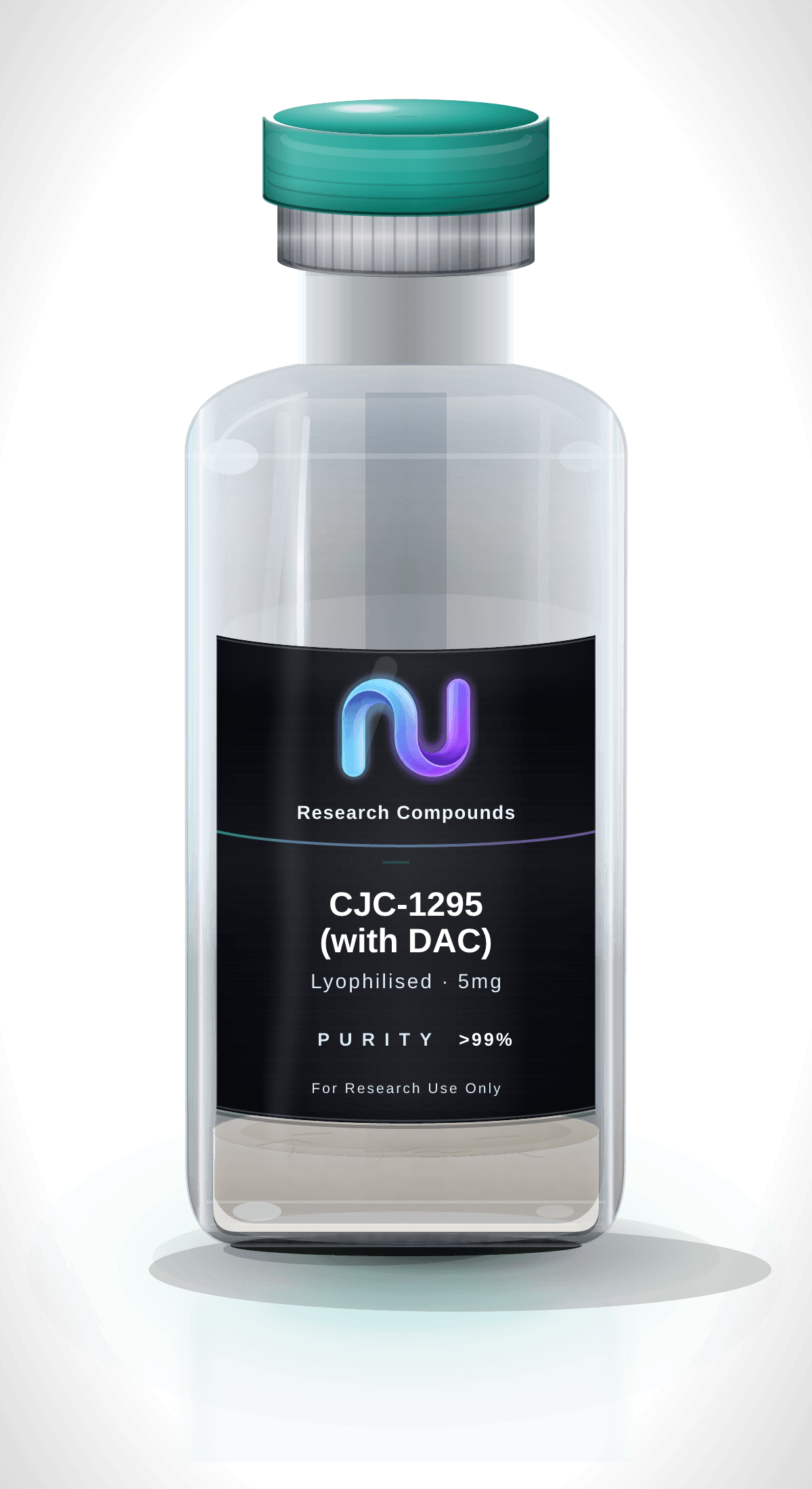
CJC-1295 with DAC (DAC:GRF) is a long-acting GHRH analogue: a tetrasubstituted GHRH(1-29) sequence carrying a maleimidopropionic acid Drug Affinity Complex that binds serum albumin. That conjugation extends its reported half-life from about seven minutes to 5.8-8.1 days, and the literature covers GHRH receptor activation, GH and IGF-1 pharmacodynamics and early-phase human studies. New-U supplies CJC-1295 with DAC as lyophilised research material in selected vial strengths. The compound was never approved, and early human data do not establish clinical benefit.
CJC-1295 with DAC (DAC:GRF) | Long-Acting GHRH Analogue
Tap a pack to select it
Buy the 10-pack - save 57%/mg. Single vials welcome — checkout needs 3+ vials or any 10-vial pack - build a custom vial pack
In plain terms, CJC-1295 with DAC is the long-acting version studied for steady, week-long growth-hormone support from a single dose. Here is what that looks like across the research.
Human research explores how one dose keeps growth hormone raised for about a week, so studies do not need daily injections.
Studied for the sustained rise in growth hormone and IGF-1 that supports lean body mass and protein building.
Research examines shifts in body composition that follow steady, longer-term growth-hormone elevation.
Early human studies look at how IGF-1, the main downstream messenger of growth hormone, stays elevated for many days after a single dose.
Often studied with ipamorelin, where one compound works the growth-hormone switch and the other works a second switch for a larger combined effect.
In short: CJC-1295 with DAC is a long-acting GHRH analog that covalently bonds to serum albumin, extending its functional half-life from minutes to roughly 6-8 days for weekly GH research protocols.
These points summarise lab themes, not human outcomes.
CJC-1295 DAC is GHRH(1-29) with two things stacked on top. First, it is tetrasubstituted (D-Ala2, Gln8, Ala15, Leu27) to resist the DPP-IV enzyme that would otherwise chew it up. Second, it carries a small chemistry tag called a Drug Affinity Complex (DAC) that covalently snaps onto the free cysteine (Cys34) of serum albumin within minutes of injection.
That second modification is the big deal. Once the peptide is piggy-backing on albumin, it is shielded from both enzymatic degradation and kidney filtration. Functional half-life jumps from about 7 minutes (native GHRH) to roughly 6-8 days - about a 700-fold extension.
The practical research consequence is that a single subcutaneous injection keeps GH elevated 2-10x above baseline for roughly a week, with IGF-1 elevation persisting even longer. That makes CJC-1295 DAC the go-to tool for studies that want prolonged GH axis activation without daily dosing.
CJC-1295 with DAC is a tetrasubstituted analogue of GHRH(1-29) featuring D-Ala2, Gln8, Ala15, and Leu27 substitutions for DPP-IV resistance, plus a C-terminal Lys30 conjugated to N-ε-3-maleimidopropionamide (MPA), the Drug Affinity Complex, which covalently binds the free thiol of serum albumin (Cys34) within minutes of subcutaneous injection (Jette et al., Endocrinology, 2005). This bioconjugation extends the functional half-life approximately 700-fold over native GHRH, from ~7 minutes to 5.8–8.1 days, enabling sustained GHRH receptor activation and prolonged pulsatile GH release. In a clinical pharmacodynamic study, a single injection produced dose-dependent 2–10-fold increases in plasma GH for ≥6 days and 1.5–3-fold IGF-1 elevations persisting 9–11 days, with multiple dosing maintaining elevated IGF-1 for up to 28 days (Teichman et al., Journal of Clinical Endocrinology & Metabolism, 2006). The sustained GH elevation profile distinguishes CJC-1295 DAC from the no-DAC variant, making it a subject of research in growth hormone optimization and body composition studies.
CJC-1295 DAC hijacks serum albumin as a carrier, letting a GHRH analog stay in circulation for a week and continuously nudge the pituitary to release growth hormone.
| Pathway | Effect | Why it matters |
|---|---|---|
| GHRH receptor | Full agonist at the pituitary somatotroph GHRHR | Triggers cAMP-dependent GH exocytosis like native GHRH |
| DAC / albumin conjugation | Covalent bond to serum albumin Cys34 within ~15 min | Shields the peptide from degradation and renal clearance for days |
| Tetrasubstitution | D-Ala2, Gln8, Ala15, Leu27 block proteases | Stops DPP-IV and common oxidation pathways from inactivating the peptide |
| Pulsatile GH release | Drives 2-10× GH elevation for 6+ days per dose | Provides prolonged GHRH axis activation from a single injection |
| IGF-1 accumulation | IGF-1 elevation persists 9-28 days with repeat dosing | Produces a steady anabolic downstream signal |
Jette et al. (Endocrinology, 2005) characterised the maleimidopropionic acid (MPA) DAC chemistry and demonstrated the ~700-fold half-life extension via covalent albumin binding. Teichman et al. (JCEM, 2006) then reported the human PD study in 66 healthy adults: a single SC injection produced dose-dependent 2-10× plasma GH elevation lasting 6+ days, with 1.5-3× IGF-1 increases persisting 9-11 days after one dose and accumulating over 28 days with repeated dosing.
CJC-1295 is a synthetic analogue of growth-hormone-releasing hormone (GHRH 1-29) with four amino-acid substitutions that resist enzymatic breakdown. It activates the pituitary GHRH receptor to drive growth-hormone release. This DAC version adds a "Drug Affinity Complex" tag that binds serum albumin, extending its half-life to ~6-8 days. Supplied as a lyophilised research-grade powder for laboratory use only.
In research models CJC-1295 binds the GHRH receptor on the pituitary and stimulates the release of growth hormone, which in turn raises IGF-1. The DAC tag sustains that signal for days rather than minutes. These are findings in cell and animal models; no human therapeutic effect is implied.
In published animal studies CJC-1295 has generally been well tolerated, but there are no controlled human safety trials, so human safety is not established. It is a research compound, not a medicine; New-U makes no human-use claims and supplies it for laboratory research only.
No. CJC-1295 is an investigational research peptide and is not approved by the FDA, EMA, or any other regulator for human therapeutic use. It is sold strictly for preclinical and in-vitro research.
DAC stands for "Drug Affinity Complex". It is a small chemistry tag - specifically maleimidopropionic acid - attached to the C-terminal lysine of the peptide. When you inject the peptide, the DAC reacts with the free thiol of cysteine-34 on serum albumin, forming a covalent bond. The peptide then piggy-backs on albumin for days.
Both share the same tetrasubstituted GHRH(1-29) backbone. The DAC version carries the albumin-binding tag and lasts ~6-8 days; the no-DAC version (often called Modified GRF 1-29) has no DAC tag and lasts roughly 30 minutes. DAC is used for sustained elevation; no-DAC is used for physiologic pulses.
Neither is universally "better" - they answer different research questions. The DAC form gives sustained, days-long GH/IGF-1 elevation from a single dose and is studied on roughly weekly schedules thanks to its 6-8 day half-life. The no-DAC form (Modified GRF 1-29) produces short, natural-shaped GH pulses and is studied with more frequent dosing. The choice depends on whether a study needs continuous elevation or pulsatile signalling. Neither is an approved medicine.
GHRH analogs like CJC-1295 and ghrelin-receptor agonists like ipamorelin hit two different receptors (GHRHR and GHSR) that synergise in GH release. Combining them produces larger, cleaner GH pulses than either peptide alone, which is why this is a standard research pairing.
Keep the lyophilised powder frozen at −20 °C. After reconstitution with bacteriostatic water, refrigerate at 1-6 °C and protect from light. The DAC chemistry is relatively stable once the peptide is in solution, but plan dosing to use reconstituted material within the standard peptide-stability window.
CJC-1295 is a GHRH analogue that stimulates the pituitary's own GH release rather than replacing a hormone. In the research literature, ending administration returns the GH/IGF-1 axis toward its untreated baseline; the DAC form's albumin binding means it clears over a week or more, so the stimulus tapers gradually rather than stopping instantly. Unlike exogenous HGH, no axis-shutdown rebound is described. These are research-model observations.
Right here - CJC-1295 (with DAC) is supplied directly by New-U Research Compounds on this page as lyophilised research-grade material, with an independent Lingda Laboratory Certificate of Analysis published on this page, and shipped direct from source worldwide in discreet, tracked packaging.
CJC-1295 (with DAC) pricing is shown live on this page, per pack size - sealed 10-vial research packs, or single vials where listed (an order needs at least 3 single vials in total, or any 10-vial pack). The batch Certificate of Analysis is published on this page, and shipping is free on orders over $350.
Yes. CJC-1295 (with DAC) has an independent Lingda Laboratory Certificate of Analysis, which reports 99.68% purity for the sample analysed. The report number and test date are on the certificate, published on this page and on our COA page rather than packed with orders. View the CJC-1295 (with DAC) Certificate of Analysis →
Add the CJC-1295 (with DAC) pack size you need to your cart and check out: enter your shipping details, then choose your payment method - cryptocurrency or card - on the next step. The batch Certificate of Analysis (COA) is published on this page, so you can check it before you order.
At checkout you can pay by card or crypto. New-U supports BTC and selected stablecoin and network-asset payments across Ethereum, Solana, TRON, Polygon, Base, BNB Chain and Linea. You choose your method after confirming your order.
Yes - we ship worldwide in discreet, unmarked, tracked packaging; lyophilised peptides are stable through the tracked transit window. Delivery typically takes 6–14 business days, and shipping is free on orders over $350.
In the United States, CJC-1295 (with DAC) is sold strictly for laboratory and research purposes only. It is not approved by the FDA for human consumption and is not sold for that purpose. Regulatory status varies by jurisdiction - buyers are responsible for compliance in their own region.
Research use only - all claims made on this site are for testing and research use only.
| Half-life | Terminal t½ 5.8–8.1 days; covalent albumin (Cys34) binding occurs within ~15 min of injection |
|---|---|
| Absorption route | Subcutaneous injection; the Drug Affinity Complex conjugates to serum albumin in circulation |
| Bioavailability | Sustained systemic exposure via covalent albumin binding (shielded from proteolysis and renal filtration) |
| Metabolism / clearance | Gradual proteolytic degradation of the albumin-bound peptide; no CYP-mediated interactions |
| Stability | Lyophilised: −20 °C. Reconstituted: 1–6 °C, protect from light |
| Notes | GH elevation persists ≥6 days per dose; IGF-1 elevation 9–11 days after a single dose, reaching steady state over ~28 days with repeated dosing (Teichman 2006). |
The human pharmacodynamic study (Teichman 2006) administered single and repeated subcutaneous doses to characterise GH/IGF-1 kinetics; the long albumin-bound half-life is why once-weekly schedules are described in the research literature. These are experimental parameters from controlled and community research settings, recorded as context only.
Overall: Mixed (human + animal)
Human pharmacodynamic and early-phase clinical data exist for the reference compound, but CJC-1295 DAC was never approved. The research-grade material supplied here is unapproved laboratory material.
Last reviewed: 16 June 2026 · New-U Research Compounds
| Molecular Formula | Modified GHRH(1-29) with MPA DAC tag |
|---|---|
| Molecular Weight | 3647.3 Da |
| Backbone | GHRH(1-29) with D-Ala2, Gln8, Ala15, Leu27 substitutions |
| Purity | >99% (HPLC) |
| Form | Lyophilised powder |
| Half-life | 5.8-8.1 days |
| Route | Subcutaneous injection, weekly |
| Albumin binding | Covalent via maleimidopropionic acid to Cys34 |
| Storage | Lyophilised: −20 °C freezer. Reconstituted: 1-6 °C, away from light. |
CJC-1295 with DAC came out of ConjuChem's work on covalent drug-affinity complex chemistry, which aimed to give short-lived peptides a ride on serum albumin for days instead of minutes. The original therapeutic target was HIV-associated lipodystrophy and growth hormone deficiency, and the molecule actually reached Phase II clinical trials before development stalled - not for safety reasons, but because the commercial landscape shifted toward other GH secretagogues.
For researchers, CJC-1295 DAC is the long-acting reference point in the GHRH analog family. It is the tool you reach for when you want sustained GH/IGF-1 elevation from a single injection and when daily dosing is not practical. Its close sibling, CJC-1295 without DAC (modified GRF 1-29), is the short-acting counterpart that produces physiologic pulses instead.
New-U Research Compounds supplies CJC-1295 DAC as a research-grade lyophilised powder at >99% HPLC purity, verified by independent third-party labs. All material is strictly for in-vitro and preclinical research. It is not approved for human therapeutic use, and nothing on this page constitutes medical advice.
No customer reviews yet - be the first to share your experience.
Purchased this? Write a review| Compound | Price | Purity spec | COA |
|---|---|---|---|
| CJC-1295 (with DAC) | from $209 | >99% HPLC | 2 published batches |
| Tesamorelin | from $100 | 98.6% HPLC | 1 published batch |
| Sermorelin | from $86 | >99% HPLC | On request |
Descriptive catalog comparison for research sourcing decisions - not dosing guidance.
Part of the Growth hormone secretagogue research research area — explore related compounds, guides and sources.
From our community
Facebook account deactivated