
Sleep & nightly GH pulse
Studied for nudging the natural overnight growth-hormone surge, which is why research dosing is timed to bedtime.
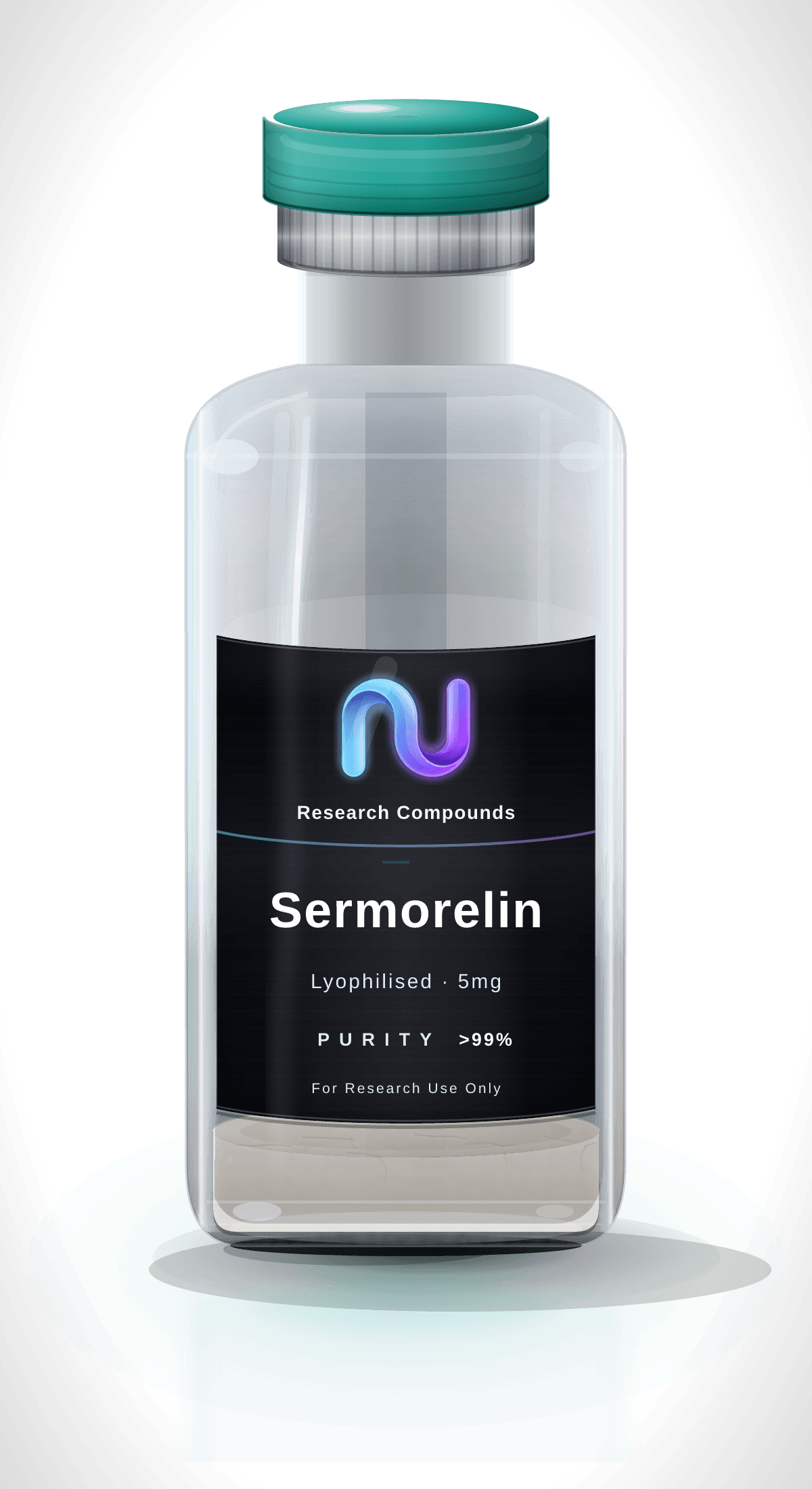
Sermorelin (GRF 1-29, or GHRH(1-29)) is the synthetic 29-amino-acid N-terminal fragment of growth hormone-releasing hormone, the shortest sequence that fully activates the GHRH receptor. Its literature covers somatotroph cAMP signalling and pulsatile GH release, with human pharmacokinetic data gathered while it was an approved medicine, an approval that lapsed in 2008. New-U supplies sermorelin as lyophilised research material in selected vial strengths. It is no longer an approved product and is supplied for laboratory research only.
Sermorelin (GRF 1-29) | GHRH(1-29) Peptide Fragment
Tap a pack to select it
Buy the 10-pack - save 57%/mg. Single vials welcome — checkout needs 3+ vials or any 10-vial pack - build a custom vial pack
In plain terms, sermorelin is studied for prompting the body to release its own growth hormone in natural pulses. Here is what that looks like across the research.
Studied for nudging the natural overnight growth-hormone surge, which is why research dosing is timed to bedtime.
Research explores how the gentle rise in growth hormone and IGF-1 supports lean body mass and recovery over time.
Investigated for shifts in body composition that follow a more natural, pulse-like growth-hormone signal.
As a former approved diagnostic with extensive human data, studied for the age-related drop in growth hormone and the IGF-1 axis.
Often studied alongside ipamorelin, where the two work through different switches for a larger combined growth-hormone pulse.
In short: Sermorelin is the synthetic 29-amino-acid N-terminal fragment of GHRH and the shortest peptide that still acts as a full growth hormone releasing hormone receptor agonist.
These points summarise lab themes, not human outcomes.
Sermorelin is a trimmed-down version of the body's own GHRH. The natural hormone is 44 amino acids long, but as early as the 1980s researchers showed the first 29 residues retained essentially all the receptor-activating activity. That discovery made sermorelin the pharmacological baseline for every GHRH analog that followed.
Unlike injecting growth hormone directly, sermorelin tells the pituitary to release its own GH in natural pulses. The hypothalamic somatostatin brake is still active, so the pituitary never gets stuck in the "on" position - a key reason researchers use GHRH analogs when they want to study physiologic GH dynamics rather than brute-force elevation.
Sermorelin was FDA-approved as Geref in 1997 for pediatric growth hormone deficiency, then voluntarily withdrawn in 2008 for commercial rather than safety reasons. It remains a well-characterised research tool for studying the GHRH axis. Supplied here as sterile lyophilised powder for research use.
Sermorelin acetate is the synthetic 29-amino acid N-terminal fragment of endogenous GHRH(1-44), representing the shortest fully functional GHRHR agonist sequence. It binds the GHRH receptor on anterior pituitary somatotrophs, activating adenylyl cyclase and cAMP-dependent signaling to stimulate both GH synthesis and pulsatile secretion under physiological somatostatin feedback control (Ling et al., Biochemical and Biophysical Research Communications, 1984). Unlike exogenous rhGH, sermorelin preserves the hypothalamic-pituitary GH neuroendocrine axis by promoting endogenous GH gene transcription and maintaining tachyphylaxis-resistant pulsatile release patterns. Originally FDA-approved in 1997 for pediatric growth hormone deficiency diagnosis and treatment (Geref Diagnostic), it was voluntarily discontinued in 2008 for commercial reasons. Pharmacokinetic studies by Prakash and Goa (BioDrugs, 1999) demonstrated rapid absorption with a Tmax of 5–20 minutes and rapid clearance of 2.4–2.8 L/min, consistent with its role as a short-acting pituitary stimulus.
Sermorelin binds the GHRH receptor on pituitary somatotrophs and triggers a pulse of natural growth hormone, preserving the body's own feedback control.
| Pathway | Effect | Why it matters |
|---|---|---|
| GHRH receptor | Full agonist at the pituitary somatotroph GHRHR | Triggers cAMP-dependent GH exocytosis |
| cAMP / PKA | Activates adenylyl cyclase inside somatotrophs | The canonical second messenger that releases stored GH |
| GH gene transcription | Drives pituitary GH gene expression over time | Preserves long-term somatotroph function rather than depleting stores |
| Somatostatin feedback | Leaves the natural off-switch intact | Maintains pulsatility and avoids tachyphylaxis |
| GHRP synergy | Combines with ghrelin-receptor agonists for additive GH release | Common research pairing with ipamorelin, GHRP-2, or GHRP-6 |
Ling et al. (Biochemical and Biophysical Research Communications, 1984) originally showed that the N-terminal 29 residues of GHRH(1-44) were sufficient for full receptor activation. Prakash and Goa (BioDrugs, 1999) characterised the pharmacokinetics in detail: Tmax 5-20 min SC, t½ 11-12 min, absolute SC bioavailability ~6%, clearance 2.4-2.8 L/min, Vd 23.7-25.8 L. The short half-life is intentional - it is what produces pulsatile, physiologic GH release rather than sustained stimulation.
Sermorelin is a synthetic 29-amino-acid peptide corresponding to the active fragment of growth-hormone-releasing hormone (GHRH 1-29). It signals the pituitary to release its own growth hormone. It is supplied as a lyophilised research-grade powder for laboratory use only.
In research models sermorelin binds the pituitary GHRH receptor and prompts a natural, pulse-like release of growth hormone (and downstream IGF-1), rather than supplying GH directly. These are findings in research models; New-U supplies it for laboratory research only and implies no human therapeutic effect.
Sermorelin is a well-characterised GHRH analogue and reliably stimulates pituitary GH release in published studies, which is why it is so widely researched. Effectiveness for any human outcome is a separate, medically-supervised question outside our scope - it is sold strictly as a research compound.
In the research literature sermorelin is used as a tool compound to study the GH/IGF-1 axis, pituitary function and body-composition endpoints, often paired with a ghrelin-receptor agonist such as ipamorelin. New-U supplies it strictly for in-vitro and animal-model research.
Sermorelin has a long research and (historically) clinical record as a GHRH analogue, but research-grade material is not an approved sterile medicine and carries no human safety assurances. New-U supplies it for laboratory research only and makes no human-use or safety claims.
Sermorelin was historically FDA-approved (as Geref) but that branded product was discontinued; it is no longer marketed as an approved drug, though it remains available through compounding pharmacies by prescription. New-U's sermorelin is research-grade material supplied for laboratory research only - not an approved medicine.
HGH is the finished hormone and directly activates the GH receptor on every tissue. Sermorelin works one step upstream - it tells the pituitary to secrete its own GH in a physiologic pulse, preserving somatostatin feedback. That generally produces a more natural release pattern but a lower peak than direct HGH dosing.
The body naturally releases most of its GH during early deep sleep via a hypothalamic GHRH pulse. Evening dosing of sermorelin aligns the induced pulse with this natural rhythm, amplifying the physiologic nocturnal surge rather than creating a new one at an unusual time.
Yes - combining a GHRH analog with a ghrelin-receptor agonist is a common research pairing. The two mechanisms are complementary (GHRHR plus GHSR), and the combined GH release is larger than either peptide alone in published studies.
Keep the lyophilised powder frozen at −20 °C. After reconstitution with bacteriostatic water, refrigerate at 1-6 °C and protect from light. Sermorelin is relatively stable once reconstituted but should be used within the standard peptide-stability window.
In the clinical and preclinical literature, sermorelin-induced GH release has been studied for downstream effects on the GH/IGF-1 axis - body composition, sleep architecture, recovery markers and IGF-1 elevation - while preserving the pituitary's own somatostatin feedback. These are research findings; sermorelin is not sold for human use and New-U makes no therapeutic claims.
Published research and the historical clinical record (sermorelin was once marketed as Geref) describe microgram-to-low-milligram subcutaneous amounts once daily, typically at night to match the natural nocturnal GH pulse. New-U publishes this only as descriptive research context - it is not a dosing instruction, and sermorelin is supplied strictly for laboratory research, not human use.
The research and historical clinical literature most commonly note injection-site reactions (redness, swelling), occasional flushing, headache or transient dizziness; serious effects are uncommon at the amounts studied because the pituitary's own feedback caps GH output. This is summarised research context, not medical advice - sermorelin is a research compound, not an approved medicine.
Sermorelin is a GHRH analogue (it acts on the GHRH receptor); ipamorelin is a selective ghrelin-receptor (GHSR) agonist. They drive growth-hormone release through two different receptors, which is why they are frequently co-studied as a complementary pair. See our Ipamorelin vs Sermorelin research comparison for the full mechanism-by-mechanism breakdown.
IGF-1 and GH-pulse changes are measurable within days to weeks in study settings, while body-composition and sleep endpoints are typically assessed over 8-24 weeks of continued research dosing. Timelines depend entirely on the protocol and endpoint measured. Reported for research context only - not a human-use claim.
Sermorelin and other GHRH-analogue research peptides act by prompting the pituitary to release its own growth hormone rather than supplying hormone directly, so the published literature describes the GH/IGF-1 axis returning toward its pre-treatment baseline once stimulation ends - without the shutdown associated with stopping exogenous HGH. Any effects seen in a study fade as the short-acting peptide clears. These are research observations.
Right here - Sermorelin is supplied directly by New-U Research Compounds on this page as lyophilised research-grade material with a >99% HPLC purity specification, and shipped direct from source worldwide in discreet, tracked packaging.
Sermorelin pricing is shown live on this page, per pack size - sealed 10-vial research packs, or single vials where listed (an order needs at least 3 single vials in total, or any 10-vial pack). Larger vial strengths lower the per-mg cost, and shipping is free on orders over $350.
Add the Sermorelin pack size you need to your cart and check out: enter your shipping details, then choose your payment method - cryptocurrency or card - on the next step.
At checkout you can pay by card or crypto. New-U supports BTC and selected stablecoin and network-asset payments across Ethereum, Solana, TRON, Polygon, Base, BNB Chain and Linea. You choose your method after confirming your order.
Yes - we ship worldwide in discreet, unmarked, tracked packaging; lyophilised peptides are stable through the tracked transit window. Delivery typically takes 6–14 business days, and shipping is free on orders over $350.
In the United States, Sermorelin is sold strictly for laboratory and research purposes only. It is not approved by the FDA for human consumption and is not sold for that purpose. Regulatory status varies by jurisdiction - buyers are responsible for compliance in their own region.
Research use only - all claims made on this site are for testing and research use only.
| Stability | Lyophilised powder: store in freezer (−20 °C). Reconstituted: refrigerate 1–6 °C, away from sunlight. Use within the validated stability window for the specific batch and formulation. |
|---|---|
| Notes | IV/SC t½ ≈ 11–12 min; Tmax = 5–20 min (SC); absolute bioavailability ~6% (SC); clearance 2.4–2.8 L/min; Vd = 23.7–25.8 L; GH elevation persists ~3 h despite rapid peptide clearance. Intranasal bioavailability only 3–5%. |
Overall: Mixed (human + animal)
Sermorelin (GHRH 1-29) carries an unusually complete evidence base for a research peptide: the minimal-active-fragment pharmacology was established mechanistically (Ling et al., 1984) and it later became an FDA-approved drug (Geref) with substantial human clinical/PK data. That approval lapsed in 2008 for commercial reasons, so the compound is now research-only - the material supplied here is unapproved laboratory material, not the former finished drug.
Last reviewed: 16 June 2026 · New-U Research Compounds
| Molecular Formula | C149H246N44O42S |
|---|---|
| Molecular Weight | 3357.9 Da |
| Sequence | GHRH residues 1-29, C-terminal amide |
| Purity | >99% (HPLC) |
| Form | Lyophilised powder |
| Half-life | ~11-12 min (IV/SC) |
| Bioavailability (SC) | ~6% |
| Route | Subcutaneous injection, typically evening |
| Storage | Lyophilised: −20 °C freezer. Reconstituted: 1-6 °C, away from light. |
Sermorelin (GHRH 1-29) is the original GHRH analogue. Everything that came after it - tesamorelin, the CJC-1295 family, MOD-GRF - builds on the observation that a 29-residue truncation of the natural hormone retains all the receptor-activating pharmacology. That insight made sermorelin the reference molecule for any research protocol that wants to generate physiologic growth-hormone pulses rather than override them with exogenous hormone, and it is why sermorelin is still studied head-to-head with ipamorelin and the CJC-1295 family.
The clinical backstory is worth knowing. Sermorelin was FDA-approved in 1997 as Geref for pediatric growth hormone deficiency diagnosis and treatment. It was voluntarily discontinued in 2008, not for any safety or efficacy problem, but because the market had moved toward recombinant HGH and the economics no longer worked. The clinical safety and pharmacokinetic data set accumulated during that era is still one of the most complete for any GHRH analog.
New-U Research Compounds supplies sermorelin as a sterile lyophilised powder at >99% HPLC purity, verified by independent third-party labs. It is a research tool for studying the GHRH/GH axis and is not a licensed medicine. Nothing on this page constitutes medical advice.
No customer reviews yet - be the first to share your experience.
Purchased this? Write a review| Compound | Price | Purity spec | COA |
|---|---|---|---|
| Sermorelin | from $86 | >99% HPLC | On request |
| Tesamorelin | from $100 | 98.6% HPLC | 1 published batch |
| CJC-1295 (with DAC) | from $209 | >99% HPLC | 2 published batches |
Descriptive catalog comparison for research sourcing decisions - not dosing guidance.
Part of the Growth hormone secretagogue research research area — explore related compounds, guides and sources.
From our community
Facebook account deactivated