
Endothelial markers
KED was reported to normalise endothelin-1 expression that was raised in atherosclerotic and restenotic endothelium, and to increase connexin and sirtuin-1 expression. [in vitro]
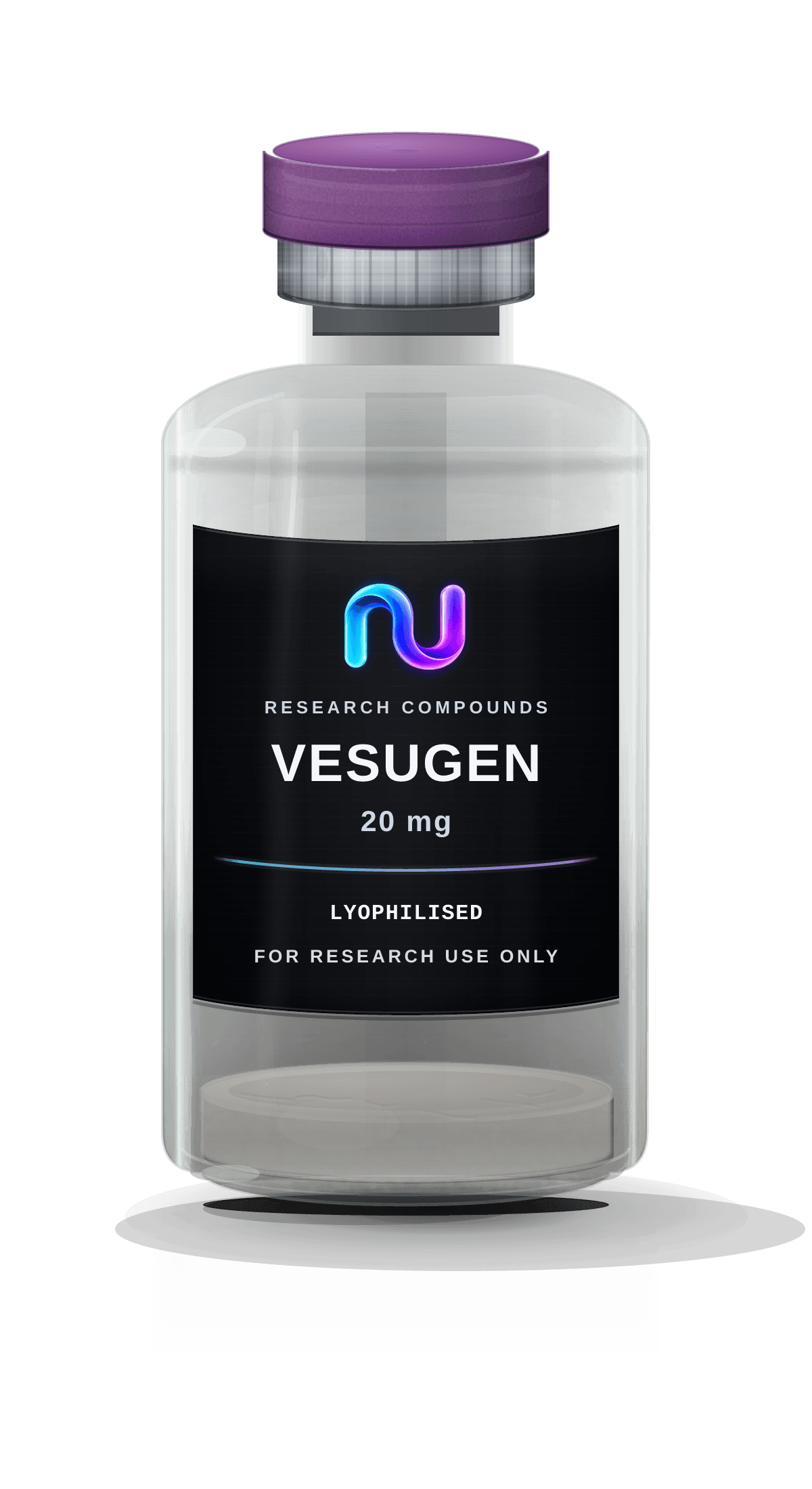
Vesugen (Lys-Glu-Asp, KED; also Vezugen or T-38) is the vascular tripeptide of the bioregulator family, which reviews say was isolated from a polypeptide complex of calf blood vessels, and the stem that Livagen, Pancragen, Testagen and Prostamax extend. Endothelial cultures supply most of its record, with reported changes in endothelin-1, connexin, sirtuin-1 and Ki-67, plus a 5xFAD mouse study of dendritic spine loss. New-U supplies it as a 10-vial pack of 20 mg lyophilised vials. Two small human reports are single-group, no randomised trial exists, and it is supplied for laboratory research only.
Scientific Research Context
Vesugen (KED / T-38) | Vascular Peptide Bioregulator
Tap a pack to select it
What the published literature on Vesugen examines. These are findings about the compound in the studies cited, not claims about the supplied material.
KED was reported to normalise endothelin-1 expression that was raised in atherosclerotic and restenotic endothelium, and to increase connexin and sirtuin-1 expression. [in vitro]
Vesugen was reported to raise Ki-67, which declines with age, in tissue-specific cultures from young and old animals and in dissociated vascular endothelial cultures; docking predicted contact with the MKI67 promoter. [in vitro and in silico]
In 5xFAD mice, KED and Pinealon were reported to prevent dendritic spine loss, and KED "tended to increase" neuroplasticity. In fibroblast-derived human induced neurons, KED promoted dendrite arborisation and had no effect on mitochondrial activity, lysosomal activity or p16. [animal, in vitro and in silico]
Lys-Glu-Asp raised Ki-67 and lowered p53 in pineal organotypic cultures, more in old cultures, and modulated IGF1, FOXO1, TNKS2 and NF-kB expression in human mesenchymal stem-cell cultures. [in vitro]
In short: Vesugen (Lys-Glu-Asp, "KED") is a three-residue synthetic peptide from the Khavinson bioregulator family, studied in vascular endothelial, neuronal and stem-cell cultures.
These points summarise lab themes, not human outcomes.
KED is the stem of four other products in this group: Livagen is KED plus alanine, Pancragen KED plus tryptophan, Testagen KED plus glycine and Prostamax KED plus proline. Its tissue assignment is vascular. Reviews state that KED was isolated from a polypeptide complex of calf blood vessels, in a sentence that cites a 2024 paper this site has not checked, and the patent concerns capillary resistance and microcirculation.
The best-documented work is in cell culture. In endothelial models it was reported to normalise endothelin-1 expression raised in atherosclerotic-type endothelium and to increase connexin and sirtuin-1 expression; in vascular endothelial cultures it raised Ki-67, which declines with age. In 5xFAD mice, KED "tended to increase" neuroplasticity and KED and Pinealon were reported to prevent dendritic spine loss. Further cell studies report effects in pineal organotypic cultures, human mesenchymal stem-cell cultures and fibroblast-derived induced neurons.
It is supplied here as a lyophilised research powder for in-vitro and preclinical use. No analytical report for the supplied material has been published yet, so this page quotes no purity figure.
Vesugen is a synthetic tripeptide with the sequence Lys-Glu-Asp (KED), carried in the Khavinson papers under the lab code T-38 and which pairs it with vascular tissue; reviews state it was isolated from a polypeptide complex of calf blood vessels. A patent with a May 2006 priority date covers the substance. The experiments are in cell and animal models: endothelial cultures (endothelin-1, connexin, sirtuin-1, Ki-67), a transgenic mouse model of neuronal spine loss, pineal organotypic cultures, mesenchymal stem-cell cultures and induced neurons. It is supplied as lyophilised powder strictly for in-vitro and preclinical research. Not for human or veterinary use.
Vesugen is studied as a vascular-matched short peptide that may act on endothelial gene expression. The proposed route is nuclear entry and DNA binding; the data are expression readouts and docking.
| Pathway | Effect | Why it matters |
|---|---|---|
| Endothelin-1 and connexin expression | Endothelin-1 normalised, connexin and sirtuin-1 raised in endothelial models | The core vascular-matching evidence; in vitro |
| Proliferation markers | Ki-67 raised in vascular, pineal and other cultures, with larger effects in old cultures | Reported across tissues by the same network; not a vascular-specific result |
| Spine and dendrite biology | Dendritic spines preserved in a transgenic mouse model; arborisation promoted in induced neurons | Neuronal rather than vascular, tested beside Pinealon |
| DNA-contact prediction | Docking predicted contact with the MKI67 promoter and DNA binding | Computational predictions only |
The Khavinson hypothesis is that ultrashort peptides enter the nucleus and bind promoter sequences. For KED the supporting data are expression readouts in cell culture, one transgenic-mouse study, and docking. The peptide has been co-tested with AED (Cartalax), KE, EDR (Pinealon) and AEDG (Epitalon) in several cell models, and a systematic review lists them as members of one family; no paper found states a derivation among them. All primary literature comes from one St. Petersburg network, much of it in Russian-language journals with English abstracts, and no independent replication was found. Two small human reports exist, both single-group and Russian-language; they are not summarised here.
Vesugen is the name used for the synthetic tripeptide Lys-Glu-Asp (KED), lab code T-38, in the Khavinson short-peptide literature, which pairs it with vascular tissue. It is supplied here as a laboratory research powder only.
Each of those is Lys-Glu-Asp with one more residue at the end: alanine for Livagen, tryptophan for Pancragen, glycine for Testagen and proline for Prostamax. That is a sequence observation; the papers do not state a derivation.
In endothelial cultures it was reported to normalise endothelin-1 and raise connexin, sirtuin-1 and Ki-67. In a transgenic mouse model it was reported to prevent dendritic spine loss, and further cell studies cover pineal, stem-cell and induced-neuron cultures. All of it is preclinical and from one research network.
Two small Russian-language reports exist; both are single-group and neither is relied on here. No randomised trial was found. Vesugen is sold strictly for in-vitro and preclinical research, not for human or veterinary use.
Right here - Vesugen is supplied directly by New-U Research Compounds on this page, as lyophilised research-grade material, and shipped direct from source worldwide in discreet, tracked packaging.
Vesugen pricing is shown live on this page, per pack size - sealed 10-vial research packs. Shipping is free on orders over $350.
Add the Vesugen pack size you need to your cart and check out: enter your shipping details, then choose your payment method - cryptocurrency or card - on the next step.
At checkout you can pay by card or crypto. New-U supports BTC and selected stablecoin and network-asset payments across Ethereum, Solana, TRON, Polygon, Base, BNB Chain and Linea. You choose your method after confirming your order.
Yes - we ship worldwide in discreet, unmarked, tracked packaging; lyophilised peptides are stable through the tracked transit window. Delivery typically takes 6–14 business days, and shipping is free on orders over $350.
In the United States, Vesugen is sold strictly for laboratory and research purposes only. It is not approved by the FDA for human consumption and is not sold for that purpose. Regulatory status varies by jurisdiction - buyers are responsible for compliance in their own region.
Research use only - all claims made on this site are for testing and research use only.
| Stability | Lyophilised powder: store in freezer (−20 °C). Reconstituted: refrigerate 1–6 °C, away from sunlight. |
|---|---|
| Notes | Laboratory research material. No human dosing exists for this compound and none is published or recommended here. |
Overall: Tier 3: Limited / anecdotal
Vesugen has a preclinical record of endothelial, neuronal, pineal and stem-cell culture work, one transgenic-mouse study and docking, all from one St. Petersburg network and partly in Russian-language journals. Two small human reports exist, are single-group and are not relied on here. There is no randomised trial and no independent replication. It is supplied as unapproved laboratory material.
Last reviewed: 13 October 2026 · New-U Research Compounds
| Sequence | Lys-Glu-Asp (KED) |
|---|---|
| Residues | 3 |
| Molecular Formula | C15H26N4O8 |
| Molecular Weight | 390.39 Da (average, free peptide) |
| Form | Lyophilised powder |
| Pack | 10 vials × 20 mg |
| Family | Khavinson short-peptide bioregulator |
| Analytical report | None published yet |
| Storage | Lyophilised: −20 °C freezer. Reconstituted: 1-6 °C, away from light. |
Vesugen has been co-tested with several of the group's other short peptides. The patent covering H-Lys-Glu-Asp-OH (EP 2024387 B1) has a priority date of May 2006 and was filed in Europe that December; PubMed papers on it start in 2008. Its compound record is in PubChem under the name Lysyl-glutamyl-aspartic acid, and a name search for "vesugen" there returns nothing, so look it up by sequence.
Listed CAS numbers could not be confirmed against the registry, so none is published on this page. The formula C15H26N4O8 and average mass of 390.39 Da here are computed from the sequence and match the compound record.
New-U Research Compounds supplies Vesugen as a lyophilised research powder in sealed 10-vial packs of 20 mg vials. No analytical report for the supplied material has been published yet, and this page makes no purity or certificate claim. It is for in-vitro and preclinical research only and nothing here is medical advice.
No customer reviews yet - be the first to share your experience.
Purchased this? Write a review| Compound | Price | Purity spec | COA |
|---|---|---|---|
| Vesugen | from $230 | Not published | On request |
| MOTS-C | from $103 | >99% HPLC | 2 published batches |
| 5-Amino-1MQ | from $93 | >99% HPLC | 1 published batch |
Descriptive catalog comparison for research sourcing decisions - not dosing guidance.
Part of the Cognitive & longevity research research area — explore related compounds, guides and sources.
From our community
Facebook account deactivated