
Whole-body muscle reach
Animal research explores how one injection can reach muscles all over the body, not just at the injection site.
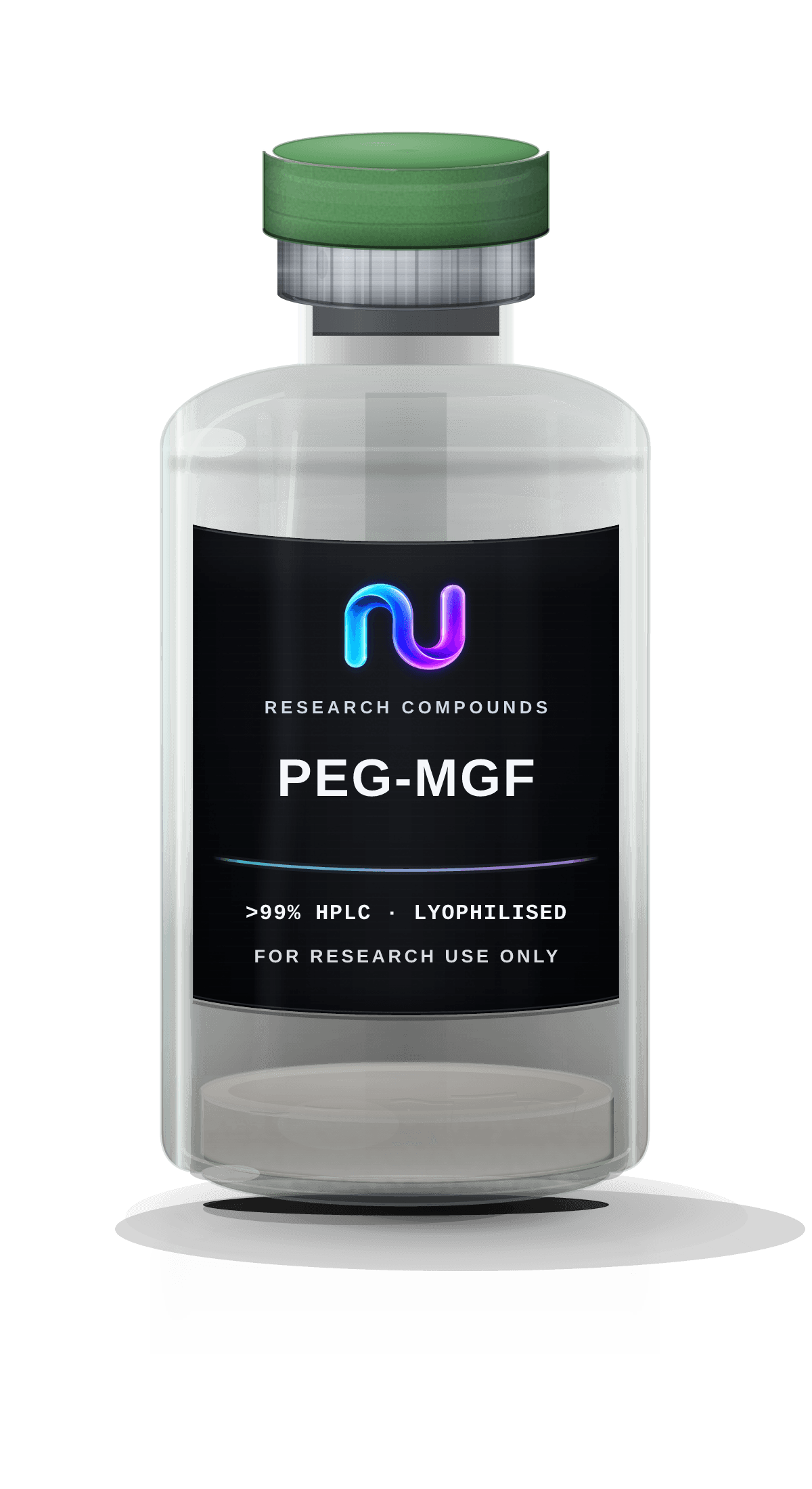
PEG-MGF (PEGylated mechano growth factor) is the 24-amino-acid MGF E-domain peptide conjugated to polyethylene glycol, a modification intended to slow proteolysis and renal clearance. Its extended half-life is an estimate that no published study has measured, and the evidence base is the preclinical native-MGF literature on stretch-induced IGF-1 splice variants in muscle. Whether the E-peptide acts independently of the IGF-1 receptor remains contested. New-U lists PEG-MGF as lyophilised material for laboratory research only.
PEG-MGF (PEGylated MGF E-Domain Peptide)
Tap a pack to select it
Buy the 10-pack - save 66%/mg. Single vials welcome — checkout needs 3+ vials or any 10-vial pack - build a custom vial pack
In plain terms, PEG-MGF is studied as a longer-lasting, whole-body version of the muscle-repair signal MGF. Here is what that looks like across the research.
Animal research explores how one injection can reach muscles all over the body, not just at the injection site.
Studied for waking resting muscle stem cells and starting them multiplying, the first step toward growth.
Preclinical work looks at how it switches on the protein-synthesis machinery muscle uses to rebuild and repair fibres.
Research examines muscle-fibre repair in age-related muscle loss, wasting and post-injury models.
Used as a slow-clearing form of MGF so its repair signal can be studied over hours to days instead of minutes.
In short: PEG-MGF is the PEGylated long-acting form of Mechano Growth Factor, engineered to turn a local 5-minute signal into a systemically active peptide that can reach satellite cells across multiple muscle groups from a single injection.
These points summarise lab themes, not human outcomes.
Native Mechano Growth Factor (MGF) is a 24-residue peptide that the body releases as an early repair signal after muscle damage or heavy mechanical loading. The problem for research use is that native MGF has a circulating half-life of just 5-7 minutes, which limits it to strictly local site-specific injection - inject it into one muscle group and no other muscles see the signal.
PEG-MGF solves that problem by attaching a polyethylene glycol (PEG) chain to the peptide. The PEG shield protects the peptide from being chewed up by enzymes and slows kidney filtration, which is intended to extend circulating half-life from minutes to several hours or days depending on PEG chain size (a vendor estimate; no published pharmacokinetic study of PEG-MGF was found).
The practical consequence is that a single subcutaneous injection of PEG-MGF can activate satellite cells across the entire musculature, rather than only at the injection site. Supplied here as sterile lyophilised powder for in-vitro and preclinical research.
PEG-MGF is the PEGylated form of the 24-amino-acid Mechano Growth Factor E-domain peptide, conjugated to polyethylene glycol (PEG) chains that create a hydrophilic steric shield preventing proteolytic degradation and reducing renal clearance. This extends the biological half-life from the native MGF duration of 5-7 minutes to an estimated several hours to days, fundamentally altering the pharmacological profile from a local autocrine/paracrine factor to a systemically active peptide capable of activating satellite cells across entire musculature from a single subcutaneous injection site. PEG-MGF is built on the MGF E-domain. One research group reported that the E-peptide increases myoblast proliferation through a route independent of the IGF-1 receptor (Yang & Goldspink, FEBS Lett 2002); a two-company replication attempt found no such effect (Fornaro et al., Am J Physiol Endocrinol Metab 2014) and another study found E-peptide effects depend on the IGF-1 receptor (Brisson & Barton, PLoS One 2012), so the mechanism is contested. The PEGylation process also slows glomerular filtration, further extending systemic exposure.
PEG-MGF activates satellite cells through a non-IGF-1R nuclear intracrine mechanism, and the PEG shield lets that signal reach muscle groups all over the body rather than just the injection site.
| Pathway | Effect | Why it matters |
|---|---|---|
| Satellite cell activation | Drives quiescent satellite cells from G0 into proliferation | Early-phase muscle repair trigger |
| Non-IGF-1R mechanism | Acts via nuclear intracrine signalling | Mechanistically distinct from mature IGF-1's receptor pathway |
| PI3K / Akt / mTOR | Downstream anabolic signalling | Drives protein synthesis after satellite cells are mobilised |
| PEG shield | Polyethylene glycol blocks proteases and slows renal clearance | Converts minute-scale MGF into a systemic research tool |
| MyoD / myogenin | Upregulates myogenic transcription factors | Coordinates muscle fiber repair and differentiation |
Goldspink (Journal of Anatomy, 2003) characterised native MGF as a mechanical-loading-induced splice variant of IGF-1 with a distinct C-terminal E-domain. A receptor-independent satellite-cell mechanism has been proposed (Yang & Goldspink, 2002) but is contested: Fornaro et al. (2014) could not reproduce the proliferative effect and Brisson & Barton (2012) found E-peptide effects depend on the IGF-1 receptor. PEGylation is intended to extend half-life from minutes to an estimated several hours or days, depending on the PEG chain. Total MW varies with PEG size but the core peptide is ~2867 Da.
PEG-MGF is the PEGylated, long-acting form of Mechano Growth Factor - the 24-amino-acid IGF-1Ec E-domain peptide with a polyethylene-glycol chain attached. The PEG shield converts a local, minutes-long satellite-cell signal into a systemically active peptide that can reach muscle groups across the body from a single subcutaneous injection.
They share the same E-domain, so the open question about whether the E-peptide acts independently of the IGF-1 receptor applies to both. The intended difference is pharmacokinetics: native MGF is cleared within minutes, while PEG-MGF's PEG shield is designed to extend the half-life to hours or days. That extension is an estimate and has not been measured in a published study.
PEGylation extends the half-life well beyond native MGF's 5-7 minutes - vendor and educational sources commonly cite a window of many hours up to roughly 48-72 hours depending on PEG chain size. These figures are estimates rather than peer-reviewed human pharmacokinetics; no published human PK study of PEG-MGF exists. The point of the modification is the qualitative shift from a local to a systemic signal.
Because the 5-7 minute half-life of native MGF means that injected peptide is degraded or cleared long before it can reach distal muscle groups. No amount of dose escalation fixes that - you would just have higher peak concentrations for the same brief window. PEGylation fundamentally changes the pharmacokinetics rather than just the dose.
Yes - the two peptides operate through different pathways (non-IGF-1R satellite cell activation for MGF; full IGF-1R signalling for IGF-1 LR3) and are sometimes used together in research protocols to target both the stem cell recruitment and terminal differentiation arms of muscle growth.
PEG-MGF is sold strictly as a research-use-only laboratory compound and is not an approved drug for human use. For competing athletes it is prohibited at all times under WADA category S2 (peptide hormones, growth factors, related substances and mimetics). New-U supplies it for in-vitro and preclinical research only.
Keep the lyophilised powder frozen at −20 °C. After reconstitution with bacteriostatic water, refrigerate at 1-6 °C and protect from light. The PEG chain improves stability compared with native MGF, but the underlying peptide is still subject to normal handling precautions.
Right here - PEG-MGF is supplied directly by New-U Research Compounds on this page as lyophilised research-grade material with a >99% HPLC purity specification, and shipped direct from source worldwide in discreet, tracked packaging.
PEG-MGF pricing is shown live on this page, per pack size - sealed 10-vial research packs, or single vials where listed (an order needs at least 3 single vials in total, or any 10-vial pack). Shipping is free on orders over $350.
Add the PEG-MGF pack size you need to your cart and check out: enter your shipping details, then choose your payment method - cryptocurrency or card - on the next step.
At checkout you can pay by card or crypto. New-U supports BTC and selected stablecoin and network-asset payments across Ethereum, Solana, TRON, Polygon, Base, BNB Chain and Linea. You choose your method after confirming your order.
Yes - we ship worldwide in discreet, unmarked, tracked packaging; lyophilised peptides are stable through the tracked transit window. Delivery typically takes 6–14 business days, and shipping is free on orders over $350.
Research use only - all claims made on this site are for testing and research use only.
| Stability | Lyophilised powder: store in freezer (−20 °C). Reconstituted: refrigerate 1–6 °C, away from sunlight. Use within the validated stability window for the specific batch and formulation. |
|---|---|
| Notes | Extended t½ estimated at several hours to days (vs 5-7 min for native MGF). Core peptide MW ~2848 Da; total MW varies with PEG chain size. Single SC injection provides systemic distribution, distinct from native MGF which requires site-specific IM administration. Metabolized in liver and kidneys via standard peptide degradation. Not FDA-approved; limited human clinical data. |
Overall: Tier 3: Limited / anecdotal
PEG-MGF has no published human pharmacokinetic or clinical study; the extended-half-life figures are vendor/educational estimates, and the evidence base is the preclinical native-MGF literature plus extrapolation. It is not approved by any regulator and is a WADA-prohibited substance.
Last reviewed: 16 June 2026 · New-U Research Compounds
| Molecular Formula | PEGylated 24-aa peptide |
|---|---|
| Molecular Weight | ~2867 Da core (varies with PEG chain size) |
| Core Sequence | YQPPSTNKNTKSQRRKGSTFEERK-PEG |
| Purity | >99% (HPLC) |
| Form | Lyophilised powder |
| Half-life | Estimated hours to days (PEG-dependent); not measured in a published study |
| Route | Subcutaneous injection |
| Schedule | 2-3× weekly (no site-specific requirement) |
| Storage | Lyophilised: −20 °C freezer. Reconstituted: 1-6 °C, away from light. |
PEG-MGF (PEGylated Mechano Growth Factor) grew out of a very practical problem in muscle growth-factor research. Native MGF, characterised by Geoffrey Goldspink's group at University College London, is a splice variant of IGF-1 (specifically IGF-1Ec) that the body releases in response to mechanical loading. It activates satellite cells - the stem cells of skeletal muscle - through a non-IGF-1R nuclear intracrine mechanism that is distinct from mature IGF-1.
The problem is that native MGF is too short-lived to be a systemic research tool. With a 5-7 minute half-life, it has to be injected directly into the muscle you want to influence, which limits experiments to short-range local effects. PEGylation solves that by attaching a hydrophilic polyethylene-glycol shield to the peptide: the added bulk raises the molecule above the kidney's filtration threshold and blocks proteases, extending circulating half-life from minutes to an estimated several hours or days depending on PEG chain size. (Those extended half-life figures are vendor/educational estimates - there is no published human pharmacokinetic study of PEG-MGF.)
New-U Research Compounds supplies PEG-MGF as a research-grade lyophilised powder at >99% HPLC purity, verified by independent third-party labs. All material is strictly for in-vitro and preclinical research. PEG-MGF is a WADA-prohibited substance (category S2) for competing athletes, is not approved for human therapeutic use, and nothing on this page constitutes medical advice.
No customer reviews yet - be the first to share your experience.
Purchased this? Write a reviewPart of the Tissue repair & recovery research research area — explore related compounds, guides and sources.
From our community
Facebook account deactivated