
Chromatin melting behaviour
Differential scanning calorimetry of human lymphocyte chromatin showed two melting endotherms shifted to lower temperature by 2.9 and 1.0 °C with Prostamax, with heat redistributed between them. [in vitro, human cells]
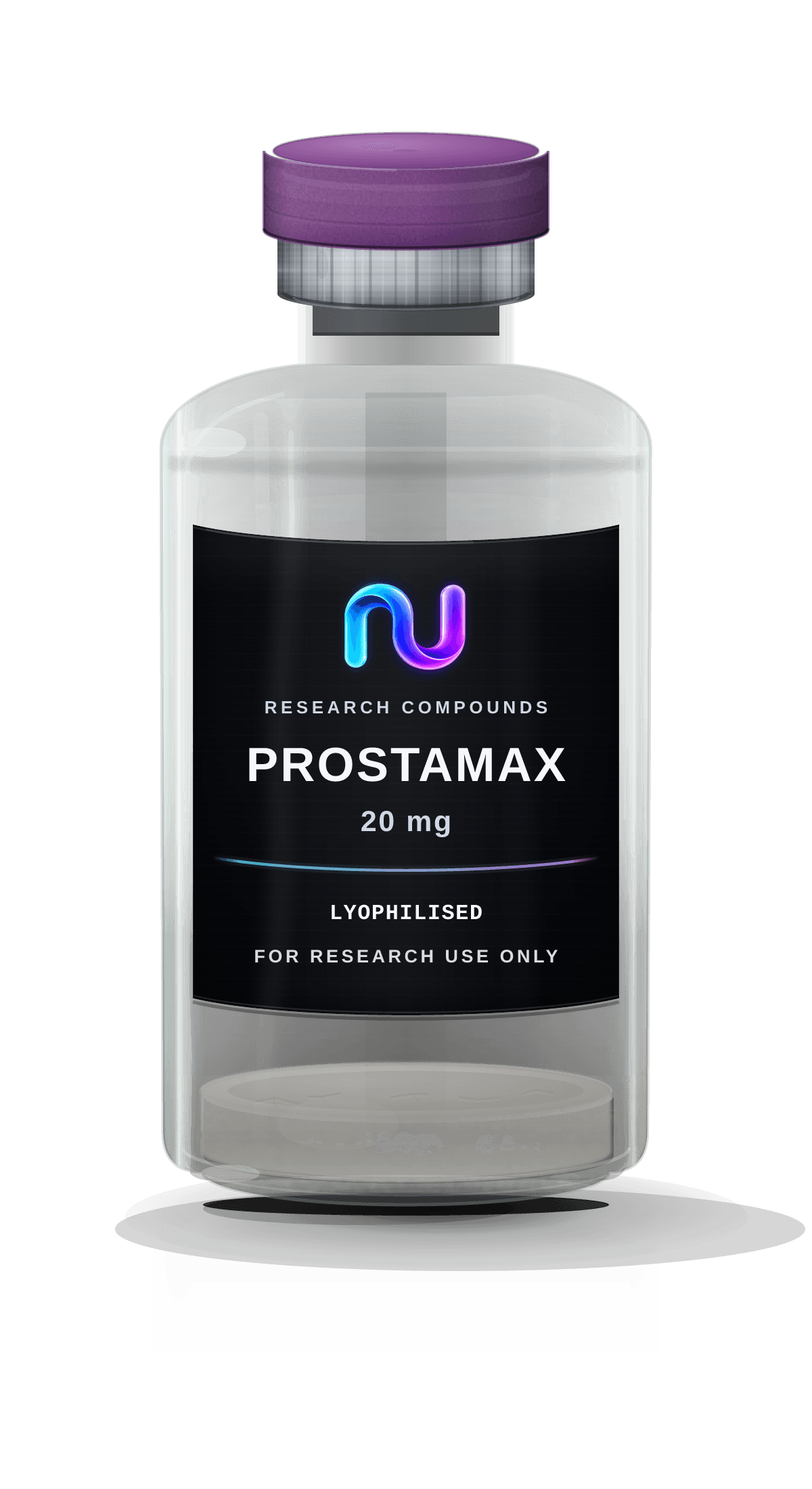
Prostamax, the KEDP peptide, is Lys-Glu-Asp-Pro: Vesugen's Lys-Glu-Asp with a proline added, one residue away from Cortagen, and covered by a European patent on prostate function with a 2001 priority date. It is not Prostatilen, which is a bovine prostate extract. Most experiments use human lymphocytes, measuring chromatin melting by calorimetry and ribosomal gene activation in cells from donors aged 75-88, plus one rat prostate-explant study. New-U supplies sealed packs of ten 20 mg lyophilised vials; with no study of the synthetic peptide in people, it is for laboratory research only.
Scientific Research Context
Prostamax (KEDP) | Synthetic Lys-Glu-Asp-Pro Peptide
Tap a pack to select it
What the published literature on Prostamax examines. These are findings about the compound in the studies cited, not claims about the supplied material.
Differential scanning calorimetry of human lymphocyte chromatin showed two melting endotherms shifted to lower temperature by 2.9 and 1.0 °C with Prostamax, with heat redistributed between them. [in vitro, human cells]
Vilon, Epithalon, Livagen, Prostamax and Cortagen were each reported to activate ribosomal genes and decondense chromatin in these cells; Epithalon, Livagen and Prostamax also decondensed chromosome 1 pericentromeric heterochromatin. [in vitro, human cells]
In cells from donors aged 75-86, Prostamax was reported to lower large pericentromeric heterochromatin variants on chromosomes 1 and 9 and to raise Ag-NOR counts, which the authors interpret as deheterochromatinization. [in vitro, human cells]
In rat explants of heart, lung, prostate and pancreas from 3-week and 18-month donors, each of four peptides at 0.05 ng/ml stimulated growth of its matching tissue; Prostamax was paired with prostate. [ex vivo, rat tissue]
In short: Prostamax (Lys-Glu-Asp-Pro, "KEDP") is a four-residue synthetic peptide from the Khavinson bioregulator family, studied in human lymphocyte chromatin assays and rat tissue-explant cultures.
These points summarise lab themes, not human outcomes.
KEDP is Vesugen (Lys-Glu-Asp) with a proline added, and it differs from Cortagen (Ala-Glu-Asp-Pro) only in its first residue. The patent that covers it is titled for regulation of prostate function and describes tests in rodents. The brand name "Prostamax" does not appear in the patent text, so the link between patent and name rests on the identical sequence and on the group's review tables.
The peptide-specific experiments are almost all in human lymphocytes. Differential scanning calorimetry on lymphocyte chromatin shifted two melting endotherms to lower temperature, by 2.9 and 1.0 °C, which the authors read as partial relaxation of the 30-nm fibre. Leukocytes from donors aged 75-88 showed ribosomal gene activation and chromatin decondensation with Prostamax among five tested peptides. The one prostate-tissue experiment is a rat explant study in which Prostamax stimulated prostate explant growth, as three other peptides did for their own tissues.
It is supplied here as a lyophilised research powder for in-vitro and preclinical use. No analytical report for the supplied material has been published yet, so this page quotes no purity figure.
Prostamax is a synthetic tetrapeptide with the sequence Lys-Glu-Asp-Pro (KEDP), developed by Vladimir Khavinson and colleagues at the St. Petersburg Institute of Bioregulation and Gerontology and covered by a European patent with a January 2001 priority date. The patent title pairs it with prostate function, and a rat explant study stimulated prostate tissue growth. The peptide-specific studies are otherwise on human lymphocytes: differential scanning calorimetry of chromatin, and cytogenetic endpoints in cells from donors aged 75-88. It is not Prostatilen, which is a bovine prostate extract. It is supplied as lyophilised powder strictly for in-vitro and preclinical research. Not for human or veterinary use.
Prostamax is studied as a short peptide that may relax chromatin in lymphocytes. The mechanism is a hypothesis built from calorimetry and cytogenetics; docking suggests peptide-transporter affinity but no transport was measured.
| Pathway | Effect | Why it matters |
|---|---|---|
| Chromatin relaxation | Chromatin melting endotherms shifted to lower temperature in human lymphocytes | The most direct physical measurement; partial relaxation of the 30-nm fibre by the authors' reading |
| Heterochromatin decondensation | Pericentromeric heterochromatin on chromosomes 1 and 9 reduced; ribosomal genes activated | Cytogenetic endpoints in cells from elderly donors; the sister-chromatid-exchange rate also rose, a conventional stress endpoint |
| Tissue-matched growth | Prostate explant growth stimulated, as for other peptides in their own tissues | The only tissue-level result tied to the prostate pairing |
| Transporter docking | Predicted to dock PEPT1 well (second of 26) and LAT1 and LAT2 poorly | A computational ranking; no transport assay |
The Khavinson model proposes that very short peptides enter the nucleus and relax condensed chromatin, switching on genes silenced with age. Prostamax's data fit that picture at the level of calorimetry and cytogenetics, but not at the level of gene expression: none of the cited work measures a prostate-specific transcript. An increase in sister-chromatid exchange accompanied the decondensation in one study, and elevated exchange is conventionally also a marker of cytogenetic stress, so the endpoint cuts both ways. Human data on the synthetic peptide do not exist in the sources found; the human prostate literature concerns Prostatilen, an extract.
Prostamax is the name used for the synthetic tetrapeptide Lys-Glu-Asp-Pro (KEDP), developed in the Khavinson short-peptide programme. The patent behind it is titled for prostate function. It is supplied here as a laboratory research powder only.
No. Prostatilen is a peptide extract from bovine prostate and is studied separately. Prostamax is a defined synthetic tetrapeptide. Human prostate literature that appears in searches concerns the extract, not this peptide.
They share Glu-Asp-Pro at the end. Prostamax starts with lysine (Lys-Glu-Asp-Pro) and Cortagen with alanine (Ala-Glu-Asp-Pro). They have different formulas and masses and are listed as separate compounds.
The human-cell work is in vitro on lymphocytes. No human study of the synthetic peptide and no registered trial were found. Prostamax is sold strictly for in-vitro and preclinical research, not for human or veterinary use.
Right here - Prostamax is supplied directly by New-U Research Compounds on this page, as lyophilised research-grade material, and shipped direct from source worldwide in discreet, tracked packaging.
Prostamax pricing is shown live on this page, per pack size - sealed 10-vial research packs. Shipping is free on orders over $350.
Add the Prostamax pack size you need to your cart and check out: enter your shipping details, then choose your payment method - cryptocurrency or card - on the next step.
At checkout you can pay by card or crypto. New-U supports BTC and selected stablecoin and network-asset payments across Ethereum, Solana, TRON, Polygon, Base, BNB Chain and Linea. You choose your method after confirming your order.
Yes - we ship worldwide in discreet, unmarked, tracked packaging; lyophilised peptides are stable through the tracked transit window. Delivery typically takes 6–14 business days, and shipping is free on orders over $350.
In the United States, Prostamax is sold strictly for laboratory and research purposes only. It is not approved by the FDA for human consumption and is not sold for that purpose. Regulatory status varies by jurisdiction - buyers are responsible for compliance in their own region.
Research use only - all claims made on this site are for testing and research use only.
| Stability | Lyophilised powder: store in freezer (−20 °C). Reconstituted: refrigerate 1–6 °C, away from sunlight. |
|---|---|
| Notes | Laboratory research material. No human dosing exists for this compound and none is published or recommended here. |
Overall: Tier 3: Limited / anecdotal
Prostamax has a small preclinical record of human lymphocyte chromatin assays, calorimetry, cytogenetics and one rat explant study, all at cell or tissue level and all from the originating network or a Tbilisi collaborator. There is no human study of the synthetic peptide and no independent replication. It is supplied as unapproved laboratory material.
Last reviewed: 13 October 2026 · New-U Research Compounds
| Sequence | Lys-Glu-Asp-Pro (KEDP) |
|---|---|
| Residues | 4 |
| Molecular Formula | C20H33N5O9 |
| Molecular Weight | 487.51 Da (average, free peptide) |
| Form | Lyophilised powder |
| Pack | 10 vials × 20 mg |
| Family | Khavinson short-peptide bioregulator |
| Analytical report | None published yet |
| Storage | Lyophilised: −20 °C freezer. Reconstituted: 1-6 °C, away from light. |
The European patent behind Prostamax (EP 1 353 939 B1) has a priority date of January 2001 and was published in 2004 under a title that refers to a tetrapeptide regulating prostate functions. The first peer-reviewed papers that name Prostamax date to 2004. The lymphocyte papers cited for Prostamax are about lymphocytes, not prostate tissue.
Prostamax is Lys-Glu-Asp-Pro, a different molecule from Livagen (Lys-Glu-Asp-Ala) or Cortagen (Ala-Glu-Asp-Pro). The formula C20H33N5O9 and average mass 487.51 Da on this page are computed from Lys-Glu-Asp-Pro and match the compound record.
New-U Research Compounds supplies Prostamax as a lyophilised research powder in sealed 10-vial packs of 20 mg vials. No analytical report for the supplied material has been published yet, and this page makes no purity or certificate claim. It is for in-vitro and preclinical research only and nothing here is medical advice.
No customer reviews yet - be the first to share your experience.
Purchased this? Write a review| Compound | Price | Purity spec | COA |
|---|---|---|---|
| Prostamax | from $230 | Not published | On request |
| MOTS-C | from $103 | >99% HPLC | 2 published batches |
| 5-Amino-1MQ | from $93 | >99% HPLC | 1 published batch |
Descriptive catalog comparison for research sourcing decisions - not dosing guidance.
Part of the Cognitive & longevity research research area — explore related compounds, guides and sources.
From our community
Facebook account deactivated