
Fat loss & metabolism
Studied for encouraging the breakdown of stored fat while slowing the making of new fat, the part of growth hormone linked to leanness.
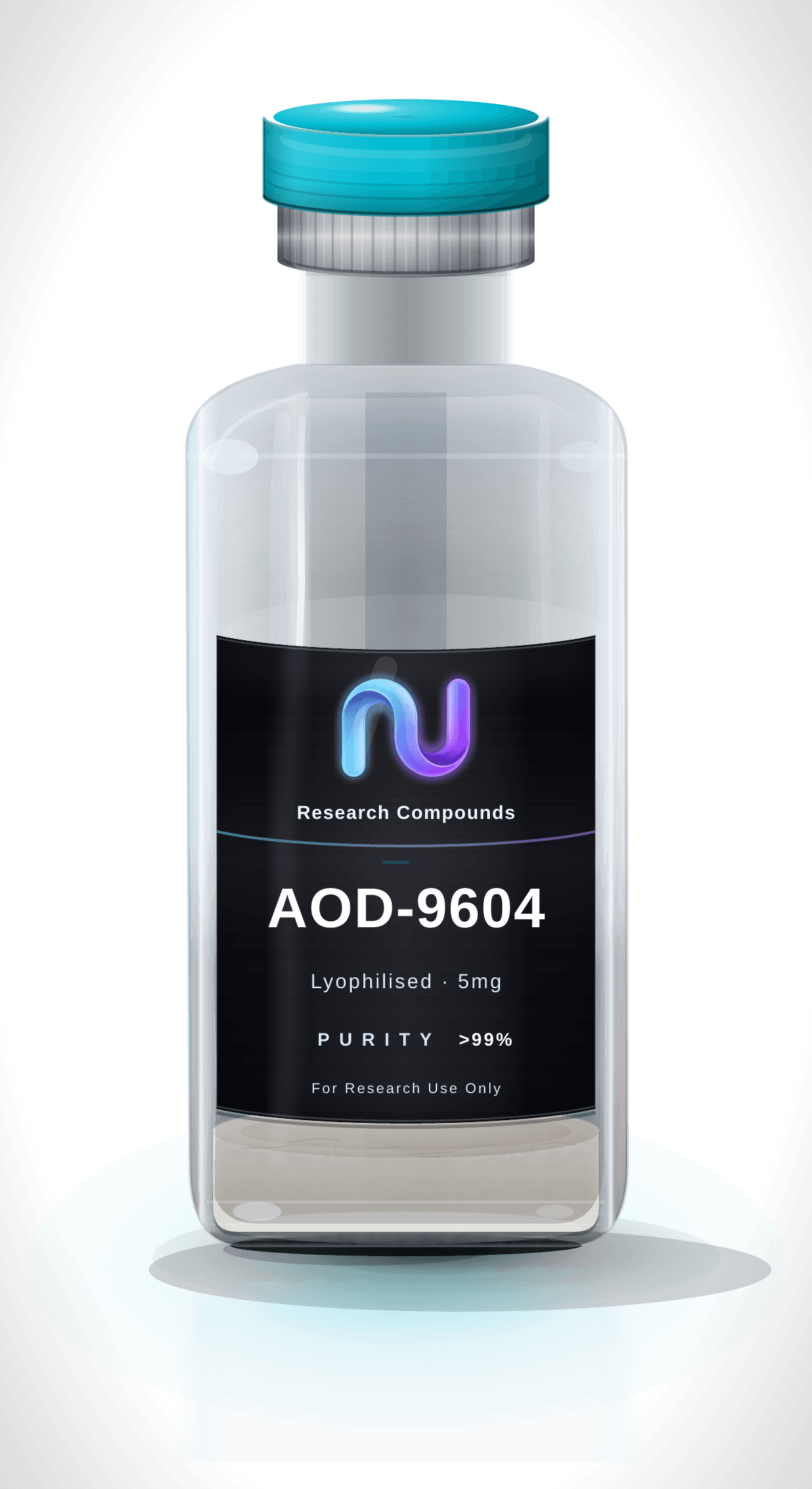
AOD-9604 (Tyr-hGH Fragment 177-191) is a synthetic 16-amino-acid peptide from the C-terminal region of human growth hormone, differing from HGH Fragment 176-191 by an N-terminal tyrosine. Preclinical studies link it to adipocyte lipolysis through cAMP/PKA signalling and the β3-adrenergic receptor, without growth hormone receptor binding or IGF-1 elevation. Its human obesity trials were mixed, and the larger 24-week phase IIb missed its primary endpoint. New-U supplies AOD-9604 as lyophilised research material; it is not an approved medicine and human efficacy is unproven.
AOD-9604 Peptide | Tyr-HGH Fragment 177-191
Tap a pack to select it
Buy the 10-pack - save 58%/mg. Single vials welcome — checkout needs 3+ vials or any 10-vial pack - build a custom vial pack
In plain terms, AOD-9604 is studied mainly as a fat-metabolism compound. Here is what that looks like across the research.
Studied for encouraging the breakdown of stored fat while slowing the making of new fat, the part of growth hormone linked to leanness.
In clinical research it was investigated for working on fat without disturbing blood sugar or insulin the way full growth hormone can.
Used in studies as a clean probe for fat-cell signalling because it does not raise growth-hormone-linked IGF-1 levels.
Human trials across roughly 900 participants built an unusually thorough safety record, leading to a GRAS safety designation.
In short: AOD-9604 is a tyrosine-modified version of the HGH 176-191 fat-loss fragment, originally developed at Monash University and taken through Phase 2b human obesity trials with full GRAS safety designation.
These points summarise lab themes, not human outcomes.
AOD-9604 is the synthetic research descendant of HGH Fragment 176-191. Professor Frank Ng at Monash University showed that replacing the N-terminal phenylalanine with a tyrosine improved stability and lipolytic potency without changing the core mechanism - the fragment still drives fat breakdown through β3-adrenergic receptor upregulation, and it still does not bind the growth hormone receptor or raise IGF-1.
Metabolic Pharmaceuticals took AOD-9604 through a formal clinical trial program spanning six randomised studies and roughly 900 participants. A 12-week Phase 2a trial showed significant weight loss versus placebo, though a larger 24-week Phase 2b missed its primary endpoint at low oral doses. The safety data was strong enough that the molecule received GRAS (Generally Recognized as Safe) designation for food and supplement applications.
AOD-9604 is supplied here as a research-grade lyophilised powder for in-vitro and preclinical study of lipolytic signalling and metabolic pharmacology.
AOD-9604 is a synthetic 16-amino acid peptide derived from the C-terminal lipolytic domain of human growth hormone (residues 177-191), distinguished from native HGH Fragment 176-191 by an N-terminal tyrosine substitution replacing phenylalanine. This modification confers enhanced stability and improved lipolytic potency while maintaining the Cys7-Cys14 disulfide bridge essential for bioactive cyclic conformation. Developed by Professor Frank Ng at Monash University, AOD-9604 activates adenylyl cyclase/cAMP/PKA signaling in adipocytes, stimulating hormone-sensitive lipase (HSL) and upregulating β3-adrenergic receptor (β3-AR) RNA expression, confirmed by Heffernan et al. (Endocrinology, 2001) who demonstrated that β3-AR knockout mice are completely unresponsive to AOD-9604, establishing pathway dependence. The peptide simultaneously inhibits lipogenesis via acetyl-CoA carboxylase (ACC) downregulation without binding GHR or elevating IGF-1. Six randomized clinical trials enrolled approximately 900 participants; a 12-week phase IIa trial showed significant weight loss (2.6 kg vs. 0.8 kg placebo), though the larger 24-week phase IIb failed to replicate at oral doses up to 1 mg/day. AOD-9604 received GRAS (Generally Recognized as Safe) designation for food/supplement applications.
AOD-9604 triggers fat breakdown through the cAMP/PKA pathway and β3-adrenergic receptor upregulation, with no activity at the growth hormone receptor.
| Pathway | Effect | Why it matters |
|---|---|---|
| β3-adrenergic receptor | Upregulates β3-AR mRNA in adipocytes | Knockout studies confirm this is the required pathway for lipolytic effects |
| Hormone-sensitive lipase | Activates HSL via cAMP / PKA | Breaks down stored triglycerides into free fatty acids |
| Acetyl-CoA carboxylase (ACC) | Downregulates ACC in liver and adipose | Reduces new fat synthesis while breakdown is increased |
| No GH receptor binding | Does not engage GHR / JAK2 / STAT5 | Preserves insulin sensitivity and keeps IGF-1 unchanged |
| N-terminal Tyr | Tyr substitution enhances stability vs native fragment | Gives improved lipolytic potency and shelf life over HGH Frag 176-191 |
Heffernan et al. (Endocrinology, 2001) demonstrated β3-AR dependence: β3-AR knockout mice were completely unresponsive to AOD-9604, nailing down the mechanism. Six clinical trials enrolled roughly 900 participants across Phase 1 and Phase 2 investigations. Serum t½ is ~3-4 min due to rapid N-terminal truncation, but metabolic effects persist beyond plasma clearance. Oral bioavailability is approximately 40% in animal models - unusual for a peptide and a deliberate design goal of the Monash program.
AOD-9604 is a synthetic, tyrosine-modified version of the C-terminal lipolytic fragment of human growth hormone (Tyr-hGH 177-191) - closely related to native HGH Fragment 176-191, with an added N-terminal tyrosine for stability and lipolytic potency. It was developed to target fat metabolism without the growth or IGF-1 effects of full HGH, and reached Phase 2b human obesity trials. Supplied as a lyophilised research-grade powder for laboratory use only.
In research models AOD-9604 stimulates lipolysis (fat breakdown) and inhibits lipogenesis via a β3-adrenergic-linked mechanism, reportedly without raising IGF-1 or affecting blood glucose the way full HGH does. These are findings in cell and animal models; New-U supplies it for laboratory research only and implies no human effect.
Early and animal research showed lipolytic activity, but the Phase 2b human obesity trial did not produce statistically significant weight loss versus placebo. So its real-world efficacy is unproven, and it is sold as a research compound only - not an approved weight-loss drug.
For laboratory preparation, dissolve the lyophilised powder in bacteriostatic water: concentration in mg/mL equals the vial mass in mg divided by the millilitres of diluent added. Keep the reconstituted vial refrigerated at 1–6 °C and protected from light. This is preparation math only; New-U provides no human-use dosing guidance.
AOD-9604 is the same lipolytic fragment with a tyrosine substituted for the N-terminal phenylalanine. The tyrosine substitution improves stability and lipolytic potency and was the design choice that enabled the molecule to progress through formal clinical trials as a distinct research entity.
No - and this was a deliberate design goal. AOD-9604 does not bind the growth hormone receptor, so it does not trigger hepatic IGF-1 synthesis and does not produce the counter-regulatory insulin-opposing effects of full-length HGH. Clinical trials confirmed unchanged glycemic parameters.
The Phase 2b was an oral-dosing study at 0.25-1 mg/day, and those doses were likely too low to produce meaningful weight loss in humans - the earlier Phase 2a at different dosing had shown ~2.6 kg loss versus 0.8 kg placebo. The failure ended commercial development but did not change the preclinical mechanism data.
Keep the lyophilised powder frozen at −20 °C. After reconstitution with bacteriostatic water, refrigerate at 1-6 °C and protect from light. The disulfide-containing cyclic structure is reasonably stable but plan usage within the normal peptide-handling window.
Right here - AOD-9604 is supplied directly by New-U Research Compounds on this page as lyophilised research-grade material, with an independent Freedom Diagnostics Certificate of Analysis published on this page, and shipped direct from source worldwide in discreet, tracked packaging.
AOD-9604 pricing is shown live on this page, per pack size - sealed 10-vial research packs, or single vials where listed (an order needs at least 3 single vials in total, or any 10-vial pack). Larger vial strengths lower the per-mg cost, the batch Certificate of Analysis is published on this page, and shipping is free on orders over $350.
Yes. AOD-9604 has an independent Freedom Diagnostics Certificate of Analysis, which reports 99.532% purity for the sample analysed. The report number and test date are on the certificate, published on this page and on our COA page rather than packed with orders. View the AOD-9604 Certificate of Analysis →
Add the AOD-9604 pack size you need to your cart and check out: enter your shipping details, then choose your payment method - cryptocurrency or card - on the next step. The batch Certificate of Analysis (COA) is published on this page, so you can check it before you order.
At checkout you can pay by card or crypto. New-U supports BTC and selected stablecoin and network-asset payments across Ethereum, Solana, TRON, Polygon, Base, BNB Chain and Linea. You choose your method after confirming your order.
Yes - we ship worldwide in discreet, unmarked, tracked packaging; lyophilised peptides are stable through the tracked transit window. Delivery typically takes 6–14 business days, and shipping is free on orders over $350.
In the United States, AOD-9604 is sold strictly for laboratory and research purposes only. It is not approved by the FDA for human consumption and is not sold for that purpose. Regulatory status varies by jurisdiction - buyers are responsible for compliance in their own region.
Research use only - all claims made on this site are for testing and research use only.
| Stability | Lyophilised powder: store in freezer (−20 °C). Reconstituted: refrigerate 1–6 °C, away from sunlight. Use within the validated stability window for the specific batch and formulation. |
|---|---|
| Notes | Serum t½ ≈ 3–4 min (rapid amino-terminal truncation cascade); primary metabolites (-2aa, -3aa) retain partial anti-lipogenic activity; ~40% oral bioavailability in pigs; clinical trial oral doses: 0.25–1 mg/day. Metabolic effects persist beyond peptide clearance. NOAEL: 100 mg/kg/day (rats), 50 mg/kg/day (cynomolgus monkeys). |
Overall: Mixed (human + animal)
AOD-9604 reached human obesity trials (six RCTs, ~900 participants): a 12-week phase 2a reported significant weight loss but the pivotal 24-week phase 2b was endpoint-negative, so human efficacy is unproven. The mechanism is well-supported preclinically, and the molecule holds a GRAS food/supplement designation but NO approved drug indication. Supplied as unapproved laboratory material for research use only.
Last reviewed: 16 June 2026 · New-U Research Compounds
| Molecular Formula | C78H123N23O23S2 |
|---|---|
| Molecular Weight | 1815.10 Da |
| Sequence | Tyr-Leu-Arg-Ile-Val-Gln-Cys-Arg-Ser-Val-Glu-Gly-Ser-Cys-Gly-Phe |
| Purity | >99% (HPLC) |
| Form | Lyophilised powder |
| Half-life | ~3-4 min serum |
| Oral bioavailability | ~40% (pig model) |
| Route | Subcutaneous injection (fasted) |
| Storage | Lyophilised: −20 °C freezer. Reconstituted: 1-6 °C, away from light. |
AOD-9604 came out of Monash University's search for a growth hormone derivative that would isolate the fat-burning activity of HGH without the growth, insulin, or IGF-1 effects. The insight was that the last 16 residues of the growth hormone molecule (positions 176-191) carried most of the lipolytic action, and adding a tyrosine at the N-terminus made the fragment more stable and more potent.
Metabolic Pharmaceuticals then ran the kind of clinical trial program that most research peptides never see: six randomised studies across roughly 900 participants, with formal safety, pharmacokinetic, and dose-response data. The Phase 2b trial at low oral doses failed to hit its primary endpoint, which ended commercial development, but the safety package was strong enough that AOD-9604 received GRAS designation for food and supplement use.
New-U Research Compounds supplies AOD-9604 as a research-grade lyophilised powder at >99% HPLC purity, verified by independent third-party labs. All material is strictly for in-vitro and preclinical research. AOD-9604 is not approved as a therapeutic drug, and nothing on this page constitutes medical advice.
No customer reviews yet - be the first to share your experience.
Purchased this? Write a reviewFrom our community
Facebook account deactivated