
Immune support
Research explores how it strengthens a worn-down immune system and helps mature the T-cells the body uses to fight infection.
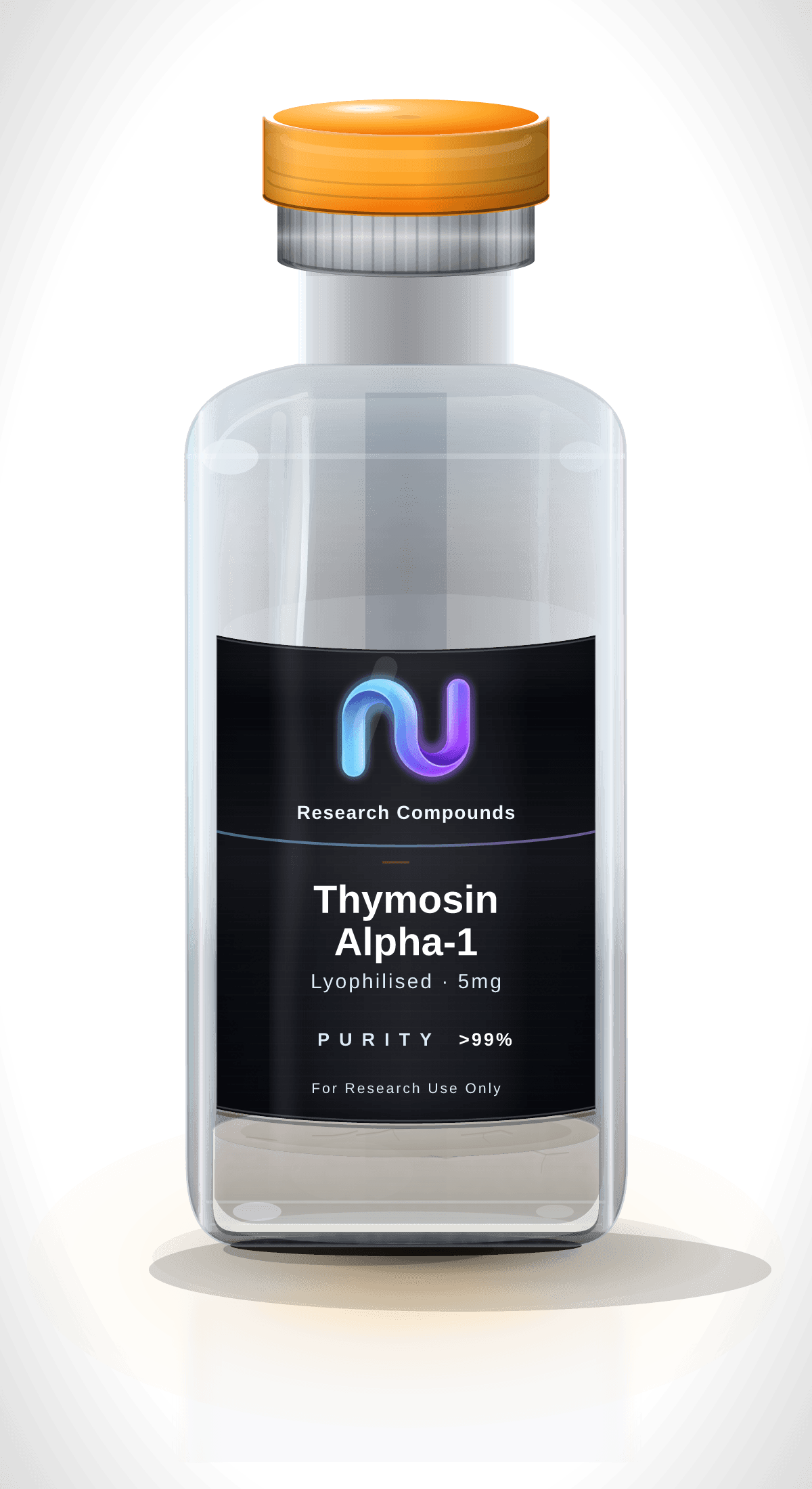
Thymosin Alpha-1 (thymalfasin, Tα1) is a 28-amino-acid N-terminally acetylated peptide derived from prothymosin alpha, studied for Toll-like receptor signalling and T-cell, NK-cell and dendritic-cell maturation. Its human record includes hepatitis B studies and a sepsis meta-analysis, but a phase 3 sepsis trial found no significant mortality benefit, so the efficacy picture is mixed. New-U supplies Thymosin Alpha-1 as lyophilised research material in selected vial strengths. It is not FDA-approved, and this material is for laboratory research only.
Thymosin Alpha-1 (Thymalfasin / Tα1) | Immune Peptide
Tap a pack to select it
Buy the 10-pack - save 54%/mg. Single vials welcome — checkout needs 3+ vials or any 10-vial pack - build a custom vial pack
In plain terms, Thymosin Alpha-1 is studied as an immune-balancing peptide that helps tune the body's defences up or down. Here is what that looks like across the research.
Research explores how it strengthens a worn-down immune system and helps mature the T-cells the body uses to fight infection.
In clinical research it is investigated for helping clear viral infections such as hepatitis B, and it is approved as Zadaxin in more than 30 countries.
Clinical studies look at its use in severe infection (sepsis), where the focus is rebalancing an overwhelmed immune system rather than just boosting it.
Studied for sharpening the front-line immune cells that target both viruses and abnormal cells.
In short: Thymosin Alpha-1 (Zadaxin) is a 28-amino-acid thymic peptide that activates multiple Toll-like receptors to rebalance both innate and adaptive immunity, approved as an immunomodulator in more than 30 countries.
These points summarise lab themes, not human outcomes.
Thymosin Alpha-1 (Tα1) is a small naturally occurring peptide produced from the prohormone prothymosin alpha in thymic tissue. The thymus is where T-cells mature, and Tα1 turns out to be one of the signals that tells immune cells how to differentiate and respond.
What makes Tα1 clinically interesting is its dual effect on the immune system. It activates Toll-like receptors 2, 3, 4, 7, and 9 - the innate-immunity sensors that detect viral and bacterial signatures - while also supporting T-cell maturation, NK cell cytotoxicity, and dendritic cell function on the adaptive side. In conditions where the immune system is either exhausted (like chronic hepatitis B) or overwhelmed (like sepsis), Tα1 acts as a rebalancer rather than a blunt stimulant or suppressant.
Marketed globally as Zadaxin, Thymosin Alpha-1 is approved in over 30 countries and holds FDA orphan drug designation for melanoma, hepatitis B, DiGeorge syndrome, and hepatocellular carcinoma. Supplied here as sterile lyophilised powder for in-vitro and preclinical research.
Thymosin Alpha-1 (thymalfasin) is a 28-amino-acid N-terminally acetylated peptide (MW 3108 Da) derived from proteolytic cleavage of prothymosin alpha by the lysosomal asparaginyl endopeptidase legumain. Tα1 activates innate and adaptive immunity through direct engagement of Toll-like receptors TLR2, TLR3, TLR4, TLR7, and TLR9, triggering downstream IRF3, NF-κB, p38MAPK, and MyD88 signaling cascades to promote T-cell differentiation, NK cell activation, and dendritic cell maturation (Romani et al., Molecules, 2023). Randomized controlled trials demonstrate HBV DNA clearance of 40.6% at 6 months versus 9.4% in untreated controls, and sepsis meta-analysis shows pooled mortality RR of 0.68 (95% CI 0.59-0.78, p<0.00001, 12 trials, n=1480) (Li et al., Critical Care Medicine, 2015). Marketed globally as Zadaxin in over 30 countries, with FDA orphan drug designation for melanoma and hepatitis B.
Thymosin Alpha-1 activates innate immune Toll-like receptors while supporting T-cell maturation, reshaping both arms of the immune system rather than just boosting or suppressing it.
| Pathway | Effect | Why it matters |
|---|---|---|
| TLR 2/3/4/7/9 activation | Engages multiple innate immune sensors | Triggers IRF3, NF-κB, p38MAPK and MyD88 downstream signalling |
| T-cell maturation | Supports CD4+ and CD8+ T-lymphocyte differentiation | Rebuilds functional T-cell populations in immune-exhausted states |
| NK cell cytotoxicity | Enhances natural killer cell activity | Improves first-line antiviral and antitumour immune defence |
| Dendritic cell function | Improves antigen presentation efficiency | Links innate recognition to adaptive T-cell responses |
| Cytokine balance | Modulates IL-2 and B-cell growth factor output | Produces immunomodulation rather than pure stimulation or suppression |
Romani et al. (Molecules, 2023) reviewed the mechanism and showed that Tα1 binds multiple TLRs directly - an unusual multi-receptor innate activity. Li et al. (Critical Care Medicine, 2015) published a meta-analysis of 12 sepsis RCTs (N = 1,480) showing a pooled mortality relative risk of 0.68 (p < 0.00001) versus placebo. In chronic hepatitis B, randomised studies reported 40.6% HBV DNA clearance at 6 months versus 9.4% in controls. Subcutaneous Tmax is ~2 hours, serum t½ ~2 hours, with return to baseline within 24 hours.
Thymosin Alpha-1 is a 28-amino-acid N-terminally acetylated thymic peptide derived from prothymosin alpha. It works by directly engaging multiple Toll-like receptors (TLR2/3/4/7/9) on innate immune cells, triggering IRF3, NF-κB, p38MAPK and MyD88 signalling, while also supporting maturation of CD4+/CD8+ T-cells, NK-cell cytotoxicity, and dendritic-cell antigen presentation. This dual innate-plus-adaptive action is why it is described as an immune rebalancer rather than a simple stimulant.
An immunostimulant broadly revs up immune activity; an immunosuppressant broadly shuts it down. An immunomodulator like Tα1 rebalances - it can amplify weak responses in immune-exhausted states like chronic viral infection, while helping calm overactivation in conditions like sepsis. The same molecule can do both because the immune system regulates itself differently in different states.
The evidence is genuinely mixed. Chronic hepatitis B studies reported higher HBV DNA clearance versus controls, and COVID-19 work suggested restoration of lymphocyte counts and reversal of T-cell exhaustion. But the rigorous multicentre phase-3 TESTS sepsis trial (2025) found no significant 28-day mortality benefit. So while the mechanism is well characterised, the clinical efficacy picture is not uniformly positive - and none of this is human-use guidance.
Published clinical trials describe a 1.6 mg dose (approximately 900 μg/m² of body surface area) administered subcutaneously twice weekly, the schedule used across most of the sepsis, hepatitis B, and immune-support studies. Subcutaneous Tmax is roughly 2 hours and serum half-life around 2 hours, with return toward baseline within 24 hours. These are descriptive research parameters only; Tα1 is supplied for laboratory research.
They are all thymic peptides but completely different molecules with different mechanisms. Tα1 is a 28-residue peptide derived from prothymosin alpha that binds TLRs and supports T-cell maturation. Thymulin is a nonapeptide that requires zinc for activity, and thymopoietin is a 49-residue polypeptide. They are sometimes grouped together as "thymic factors" but act distinctly.
Thymosin Alpha-1 is marketed as Zadaxin and approved as an immunomodulator in more than 30 countries, and it holds FDA orphan-drug designation for several indications - but it is not an FDA-approved drug for general therapeutic use in the United States. New-U supplies it strictly as a research-grade compound for in-vitro and preclinical laboratory research, not for human use; buyers are responsible for local compliance.
Keep the lyophilised powder frozen at −20 °C. After reconstitution with bacteriostatic water, refrigerate at 1–6 °C and protect from light. Tα1 is reasonably stable in solution within the normal peptide-handling window; avoid repeated freeze-thaw cycles. This is laboratory handling guidance only.
Right here - Thymosin Alpha-1 is supplied directly by New-U Research Compounds on this page as lyophilised research-grade material, with an independent Janoshik Analytical Certificate of Analysis published on this page, and shipped direct from source worldwide in discreet, tracked packaging.
Thymosin Alpha-1 pricing is shown live on this page, per pack size - sealed 10-vial research packs, or single vials where listed (an order needs at least 3 single vials in total, or any 10-vial pack). Larger vial strengths lower the per-mg cost, the batch Certificate of Analysis is published on this page, and shipping is free on orders over $350.
Yes. Thymosin Alpha-1 has an independent Janoshik Analytical Certificate of Analysis, which reports 99.748% purity for the sample analysed. The report number and test date are on the certificate, published on this page and on our COA page rather than packed with orders. View the Thymosin Alpha-1 Certificate of Analysis →
Add the Thymosin Alpha-1 pack size you need to your cart and check out: enter your shipping details, then choose your payment method - cryptocurrency or card - on the next step. The batch Certificate of Analysis (COA) is published on this page, so you can check it before you order.
At checkout you can pay by card or crypto. New-U supports BTC and selected stablecoin and network-asset payments across Ethereum, Solana, TRON, Polygon, Base, BNB Chain and Linea. You choose your method after confirming your order.
Yes - we ship worldwide in discreet, unmarked, tracked packaging; lyophilised peptides are stable through the tracked transit window. Delivery typically takes 6–14 business days, and shipping is free on orders over $350.
Research use only - all claims made on this site are for testing and research use only.
| Stability | Lyophilised powder: store in freezer (−20 °C). Reconstituted: refrigerate 1–6 °C, away from sunlight. Use within the validated stability window for the specific batch and formulation. |
|---|---|
| Notes | Subcutaneous Tmax ~2 hours. Serum t½ ~2 hours with return to baseline within 24 hours. Rapidly absorbed after SC injection. Amino acid sequence conserved across murine, bovine, and human species. Contraindicated in organ transplant recipients. Approved in 30+ countries as Zadaxin for hepatitis B/C and immune dysfunction. |
Overall: Tier 1: Human clinical
Thymosin Alpha-1 has the strongest human clinical dataset in this batch (multiple RCTs, a sepsis meta-analysis and hepatitis B trials) and is an approved immunomodulator in 30+ countries - but the efficacy picture is genuinely mixed, as the rigorous phase-3 TESTS sepsis trial was negative. It is NOT FDA-approved for general therapeutic use; the research-grade material supplied here is unapproved laboratory material in the US.
Last reviewed: 16 June 2026 · New-U Research Compounds
| Molecular Formula | C129H215N33O55 |
|---|---|
| Molecular Weight | 3108 Da |
| Sequence | Ac-Ser-Asp-Ala-Ala-Val-Asp-Thr-Ser-Ser-Glu-Ile-Thr-Thr-Lys-Asp-Leu-Lys-Glu-Lys-Lys-Glu-Val-Val-Glu-Glu-Ala-Glu-Asn |
| Purity | >99% (HPLC) |
| Form | Lyophilised powder |
| Half-life | ~2 h serum |
| Route | Subcutaneous injection, twice weekly |
| Solubility | Bacteriostatic water or sterile saline |
| Storage | Lyophilised: −20 °C freezer. Reconstituted: 1-6 °C, away from light. |
Thymosin Alpha-1 (Tα1, thymalfasin) was first purified from thymic tissue in the 1970s as part of a broader effort to identify the signals the thymus uses to orchestrate T-cell maturation. It turned out that a small 28-residue peptide, derived from the larger prothymosin alpha protein, carries much of that activity. That discovery launched decades of clinical development that ended with Zadaxin approved in more than 30 countries as an immunomodulator.
The clinical dataset is what makes Tα1 stand out among research peptides in the immune category. Earlier meta-analysis across twelve randomised sepsis trials (nearly 1,500 patients) reported a pooled mortality reduction, and Tα1 was studied for reversing T-cell exhaustion in severe COVID-19. More recent high-quality work tempers that picture: the multicentre phase-3 TESTS trial (2025) found no significant 28-day mortality difference versus placebo in sepsis, so the honest research position is mixed rather than settled. HBV DNA clearance data in chronic hepatitis B and FDA orphan-drug designations for melanoma and hepatocellular carcinoma round out an unusually deep but not uniformly positive profile.
New-U Research Compounds supplies Thymosin Alpha-1 as a research-grade lyophilised powder at >99% HPLC purity, verified by independent third-party labs. All material is strictly for in-vitro and preclinical research use. Note the clinical contraindication in organ transplant recipients, where Tα1's immunostimulatory effect is undesirable. Nothing on this page constitutes medical advice.
Was glad to see the order arrive complete and in good condition. Nothing to complain about.
Wasn't sure what to expect at first. The site was easier to use than I thought
Part of the Immune & anti-microbial research research area — explore related compounds, guides and sources.
From our community
Facebook account deactivated