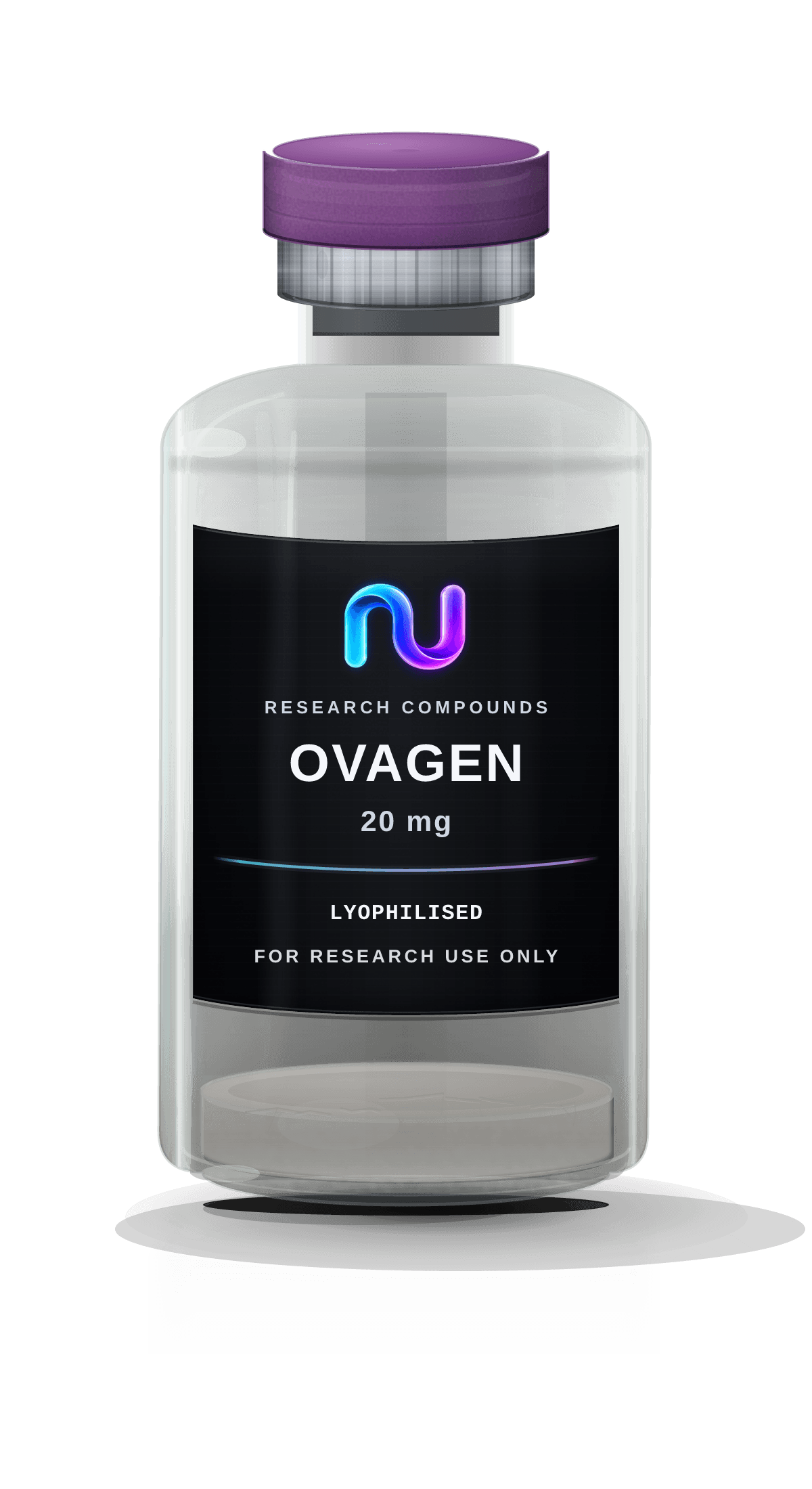
In short: Ovagen (Glu-Asp-Leu, "EDL") is a three-residue synthetic peptide from the Khavinson bioregulator family; the peer-reviewed experiments on it are all in kidney tissue and kidney cell cultures.
Key research facts
- Synthetic Glu-Asp-Leu (EDL) tripeptide from the Khavinson short-peptide lineage, lab code T-35
- Studied in rat kidney-injury models for diuresis, creatinine and antioxidant-enzyme markers
- Examined in kidney cell cultures for MMP-14, p16, p21, p53 and SIRT-6
- Tested side by side with Cartalax (Ala-Glu-Asp) in kidney cultures and aged-rat kidney
- Shares its Glu-Asp pair with Pinealon, Epitalon and Chonluten
These points summarise lab themes, not human outcomes.
EDL is Bronchogen (Ala-Glu-Asp-Leu) without its first residue. The Khavinson reviews list it as "Ovagen (EDL)", with a kidney role and a liver role. The papers themselves call it "EDL peptide" or "T-35" and never use the word Ovagen, and the patent behind it, which concerns liver regeneration, does not either. The name collides with an unrelated veterinary hormone product, so it should be searched by sequence.
The kidney work is the substance of the peer-reviewed record on EDL. In rat models of drug-induced and ischemia-related kidney injury, EDL was reported to normalise diuresis and creatinine markers and to preserve antioxidant-enzyme activity. In aged rats it was reported to raise diuresis and sodium excretion with no sign of nephrotoxicity in the tissue. In kidney cell cultures it was reported to raise proliferation, lower p16, p21 and p53 and raise SIRT-6, and to act on MMP-14 as a target.
It is supplied here as a lyophilised research powder for in-vitro and preclinical use. No analytical report for the supplied material has been published yet, so this page quotes no purity figure.
- Research class: Synthetic short-peptide bioregulator (Khavinson family)
- Sequence: Glu-Asp-Leu (EDL)
- Research focus: Kidney tissue, kidney explants and kidney cell cultures
- Evidence base: Rat and cell-culture studies, every one co-authored by the originating group; no human data
Ovagen is a synthetic tripeptide with the sequence Glu-Asp-Leu (EDL), carried in the Khavinson papers under the lab code T-35. The name suggests an ovarian peptide, but it is the trade-style name for EDL and not a tissue claim. All six peptide-specific peer-reviewed papers test kidney tissue and kidney cell cultures, in rat injury models, aged-rat kidney, kidney explants and cell cultures. The liver link comes from a patent. It is supplied as lyophilised powder strictly for in-vitro and preclinical research. Not for human or veterinary use.
At a glance
- Compound identity Synthetic short-peptide bioregulator (Khavinson family)
- Primary research focus Kidney tissue, kidney explants and kidney cell cultures
- Mechanism and receptors Ovagen is studied as a kidney-matched short peptide. The cell-culture data point to senescence markers (p16, p21, p53, SIRT-6) and an MMP-14 target; the animal data are functional kidney readouts.
- Experimental models Diuresis, creatinine, GFR and sodium handling in rat gentamicin, ischemia-reperfusion and cisplatin kidney-injury models; Diuresis, sodium excretion, antioxidant enzymes and morphology in old rat kidney.
- Molecular characteristics Molecular weight 375.38 Da; sequence Glu-Asp-Leu.
- Evidence maturity Tier 3: Limited / anecdotal — Ovagen has a substantial animal record for a short peptide, but all of it is in kidney and all of it comes from one network. The liver pairing rests on a patent, the gut pairing on retail copy, and the name itself appears in no primary paper. There are no human data and no independent replication. It is supplied as unapproved laboratory material.
- Research limitations Most published findings come from cell and animal models; they cannot be treated as evidence of human efficacy or safety.