
TREK-1 current inhibition in cells
In a human TREK-1 HEK cell line, PE 22-28 inhibited the channel current by about 55% at 100 nM against about 44% for spadin. The reported IC50 was about 0.12 nM for PE 22-28 and about 40 nM for spadin. [in vitro]
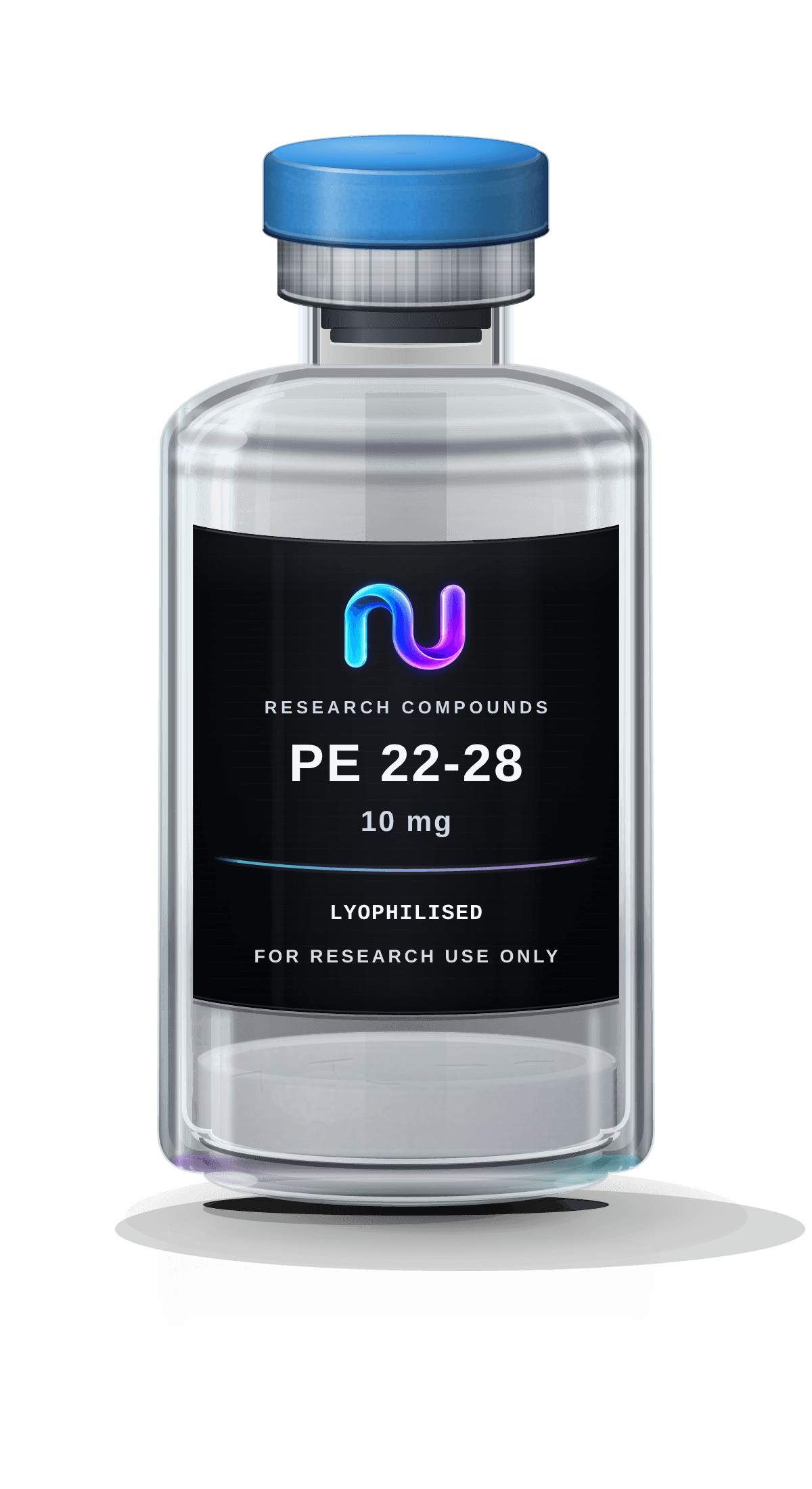
PE 22-28 is a seven-residue peptide covering positions 22 to 28 of the sortilin propeptide, designed by shortening spadin (PE 12-28), a blocker of the TREK-1 two-pore-domain potassium channel. Its literature comes from one research group: patch-clamp recordings in a human TREK-1 cell line and mouse studies of serum stability and behavioural models. New-U supplies PE 22-28 as lyophilised powder in 10 mg vials. The record contains no controlled human data, and the peptide is intended for laboratory research only.
Scientific Research Context
PE 22-28 Peptide | Spadin-Derived TREK-1 Channel Blocker
Tap a pack to select it
Buy the 10-pack - save 50%/mg. Single vials welcome — checkout needs 3+ vials or any 10-vial pack - build a custom vial pack
What the published literature on PE 22-28 and its parent peptide spadin examined in cells and rodents. Findings about the compound in these studies are not claims about the supplied material.
In a human TREK-1 HEK cell line, PE 22-28 inhibited the channel current by about 55% at 100 nM against about 44% for spadin. The reported IC50 was about 0.12 nM for PE 22-28 and about 40 nM for spadin. [in vitro]
The 2017 paper reported that the action of PE 22-28 and its analogues lasted up to about 23 hours in mice, compared with roughly 6 to 7 hours for spadin, and followed degradation of spadin in mouse serum. [animal]
In male C57Bl/6J mice, the authors reported shorter immobility in the forced swim test, shorter feeding latency in the novelty suppressed feeding test and shorter escape latency in a learned helplessness test after treatment with the peptides. Hippocampal BrdU labelling was also measured. These are mouse test readouts, not human outcomes. [animal]
The 2010 PLoS Biology paper described spadin, a sortilin-derived peptide, as targeting rodent TREK-1 channels and reported TREK-1-related behavioural readouts in mice. PE 22-28 was derived from it. [animal]
In short: PE 22-28 is a seven-residue peptide cut down from spadin, the sortilin-propeptide fragment studied as a TREK-1 potassium channel blocker in rodent research.
These points summarise lab themes, not human outcomes.
The name refers to positions 22 to 28 of the sortilin propeptide (PE). Spadin spans positions 12 to 28, so PE 22-28 keeps the C-terminal end and drops the first ten residues. The group behind it, Djillani, Pietri, Moreno, Heurteaux, Mazella and Borsotto, reported that the shorter peptide inhibited TREK-1 more potently than spadin in cell recordings.
The record is small and preclinical: patch-clamp work on a HEK cell line, serum-stability work, and a set of mouse behavioural tests, almost all from one research group. No controlled human data are cited on this page, and the mouse results are not claims about people or about the supplied material.
Residue-level sequence, molecular formula and molecular weight are not stated on this page because they could not be confirmed from the cited papers. No analytical report for the supplied material has been published yet, so no purity figure is quoted.
PE 22-28 is a seven-residue synthetic peptide covering positions 22 to 28 of the sortilin propeptide. It was designed by shortening spadin (PE 12-28), a propeptide fragment that blocks the TREK-1 two-pore-domain potassium channel in cells and mice. In the 2017 paper that introduced it, the short peptide inhibited human TREK-1 currents in a HEK cell line at a much lower concentration than spadin, and was reported to keep its activity longer in mouse serum and in mice. It is supplied as lyophilised powder in 10 mg vials, as a sealed 10-vial pack or a single-vial sample, strictly for in-vitro and preclinical research. No controlled human data are cited. Not for human or veterinary use.
PE 22-28 is studied as an inhibitor of TREK-1, a two-pore-domain potassium (K2P) channel. The mechanism is described from cell electrophysiology and mouse behavioural tests only.
| Pathway | Effect | Why it matters |
|---|---|---|
| TREK-1 current inhibition | Reduced human TREK-1 current in HEK cells, with a reported IC50 near 0.1 nM | The defining measurement for the peptide, made in a cell line |
| Relation to spadin | Derived from spadin (PE 12-28), which was reported to target rodent TREK-1 | Places the peptide in the spadin series studied by the same group |
| Persistence | Reported action of up to about 23 hours in mice against about 6 to 7 hours for spadin | The main reason the shorter peptide was characterised |
| Behavioural readouts | Forced swim, novelty suppressed feeding and learned helplessness results in mice | Rodent test readouts; they do not establish effects in humans |
The 2010 work proposed spadin as a modulator of TREK-1 in rodents, and the 2017 work asked whether a shorter fragment could keep that activity while lasting longer after administration. This page describes cellular and rodent findings only and draws no conclusion about use in people.
PE 22-28 is a seven-residue peptide derived from spadin, covering positions 22 to 28 of the sortilin propeptide. It was studied as a TREK-1 channel inhibitor in cells and mice. This page supplies it as laboratory research material only.
Spadin spans positions 12 to 28 of the propeptide; PE 22-28 is the shorter seven-residue fragment. In the 2017 paper it inhibited TREK-1 currents at a lower concentration than spadin and its action was reported to last longer in mice.
No controlled human data are cited on this page. The studies cited used a human TREK-1 cell line and mice, and their results do not establish effects in people.
The residue letters, formula and molecular weight could not be confirmed from the cited papers, so they are left out rather than guessed.
One 10 mg vial of the same lyophilised research material as the sealed 10-vial pack, for in-vitro and preclinical use only.
Right here - PE 22-28 is supplied directly by New-U Research Compounds on this page, as lyophilised research-grade material, and shipped direct from source worldwide in discreet, tracked packaging.
PE 22-28 pricing is shown live on this page, per pack size - sealed 10-vial research packs, or single vials where listed (an order needs at least 3 single vials in total, or any 10-vial pack). Shipping is free on orders over $350.
Add the PE 22-28 pack size you need to your cart and check out: enter your shipping details, then choose your payment method - cryptocurrency or card - on the next step.
At checkout you can pay by card or crypto. New-U supports BTC and selected stablecoin and network-asset payments across Ethereum, Solana, TRON, Polygon, Base, BNB Chain and Linea. You choose your method after confirming your order.
Yes - we ship worldwide in discreet, unmarked, tracked packaging; lyophilised peptides are stable through the tracked transit window. Delivery typically takes 6–14 business days, and shipping is free on orders over $350.
In the United States, PE 22-28 is sold strictly for laboratory and research purposes only. It is not approved by the FDA for human consumption and is not sold for that purpose. Regulatory status varies by jurisdiction - buyers are responsible for compliance in their own region.
Research use only - all claims made on this site are for testing and research use only.
| Stability | Lyophilised powder: store in freezer (−20 °C). Reconstituted: refrigerate 1–6 °C, away from sunlight. |
|---|---|
| Notes | Laboratory research material. No amount, schedule or administration guidance is published or recommended on this page. |
Overall: Tier 3: Limited / anecdotal
The tier describes the published literature, not the supplied material. The record consists of cell recordings and mouse studies from one research group, with no controlled human data cited. No analytical report for the supplied material has been published yet.
Last reviewed: 13 October 2026 · New-U Research Compounds
| Length | 7 residues (propeptide positions 22-28) |
|---|---|
| Parent peptide | Spadin (PE 12-28) |
| Supplier code | Y-53 |
| Form | Lyophilised powder |
| Strength | 10 mg per vial |
| Pack | 10 vials, or a single-vial sample |
| Analytical report | None published yet |
| Storage | Lyophilised: −20 °C freezer. Reconstituted: 1-6 °C, away from light. |
PE 22-28 came out of work on spadin, a fragment of the sortilin propeptide that the Mazella and Heurteaux laboratories described in 2010 as acting on rodent TREK-1 channels. The 2017 Frontiers in Pharmacology paper shortened it to seven residues and compared the new peptides with spadin in cell recordings, serum stability and mouse tests.
Every result cited here comes from cultured cells or mice. No controlled human data are cited, and the mouse findings do not establish effects, safety or intended use in people or for the research material New-U supplies.
New-U Research Compounds supplies PE 22-28 as a lyophilised research powder in 10 mg vials, as a sealed 10-vial pack or a single-vial sample. No analytical report for the supplied material has been published yet, so this page makes no purity or certificate claim. It is for in-vitro and preclinical research only, is not a medicine, and nothing here is medical advice.
No customer reviews yet - be the first to share your experience.
Purchased this? Write a reviewPart of the Cognitive & longevity research research area — explore related compounds, guides and sources.
From our community
Facebook account deactivated