
Lingda Laboratory
Current
Certificate of Analysis · Healing / Recovery
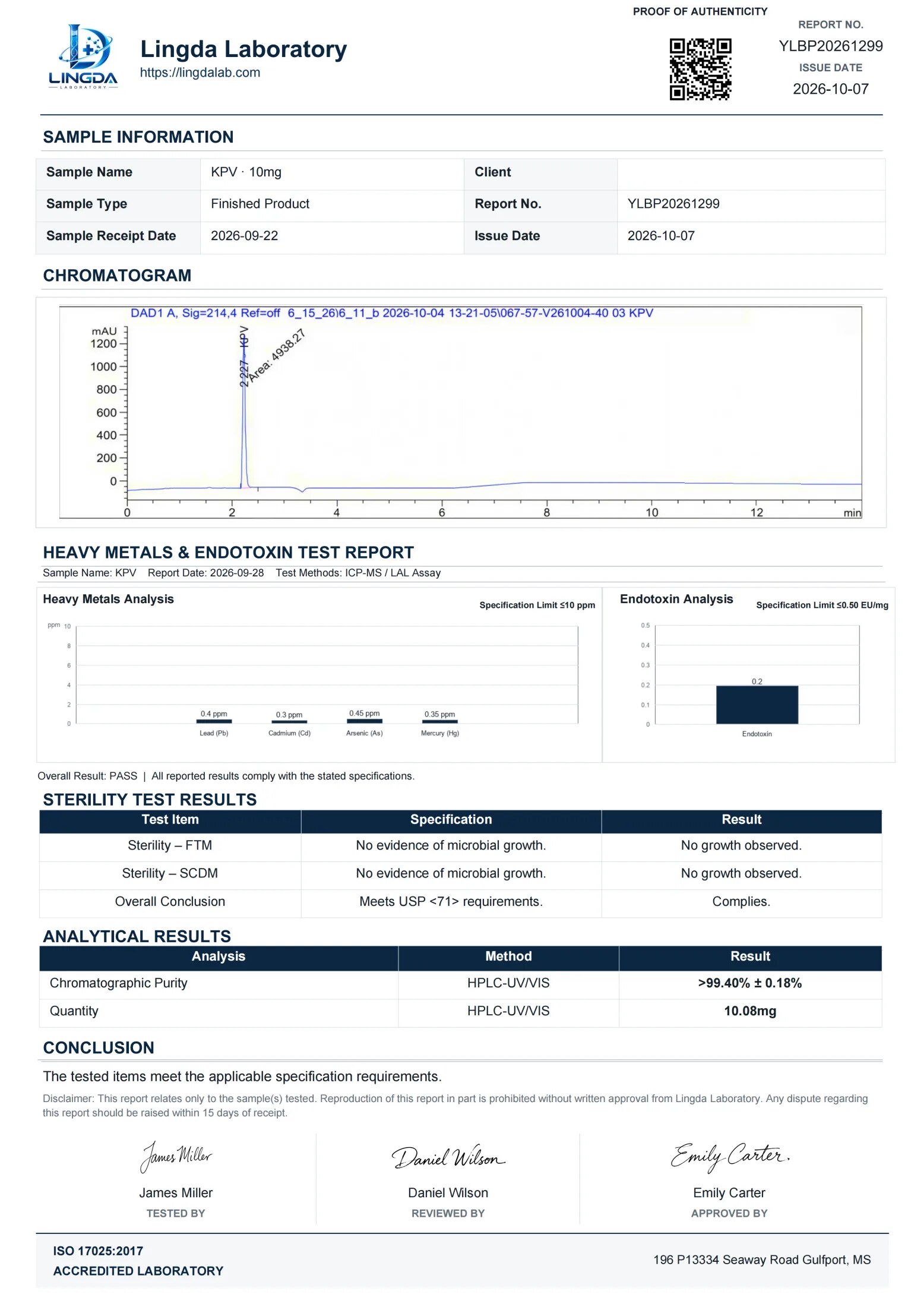
KPV
Independently verified
Third-party HPLC analysis · Lingda Laboratory
- Measured purity
- 99.40%
- Test date
- 7 Oct 2026
- Report no.
- #YLBP20261299
- Molecular weight
- 342.43 Da
Published certificate
What this certificate shows
Yes — a Certificate of Analysis is published for KPV. A Certificate of Analysis reports what one laboratory measured in one submitted sample on the test date shown on the report.
- Laboratory
- Lingda Laboratory
- Report number
- YLBP20261299
- Test date
- Measured result
- 99.4% purity (as reported)
- Sale lot
- Sale lot not stated
The public record does not state which sale lot that sample came from, so a certificate shows the measured result for the sample analysed, not the composition of a particular vial or order.
Where a report states a purity, the method and any identity result are on the report itself. A purity figure on its own does not confirm identity, sterility, endotoxin content or any biological property. See how to read a Certificate of Analysis and what a COA cannot tell you.
Certificates on this page are issued by independent third-party laboratories (the report names which). Questions about a certificate? Email hello@new-u.io with your order reference. For laboratory research use only; not for human consumption.
About KPV
The compound this certificate belongs to, its research guide, and how to read the analysis. Analytical testing describes the material in the vial; it does not validate any published research finding.
- Research guideKPV research guideKPV slips into cells through the PepT1 transporter, heads straight to the nucleus, and blocks the inflammatory master switch NF-κB - all…
- Related researchHow to read a Certificate of AnalysisWhat HPLC purity, identity and the report fields mean — and what a certificate does not tell you.
- Research areaTissue repair & recovery researchThe tissue-repair research area - cytoprotective and growth-factor peptides studied in wound healing, tendon, muscle and gut-lining…