

Janoshik & Freedom Diagnostics verified RP-HPLC + ESI-MS Published third-party COAs Lab-direct, shipped worldwide
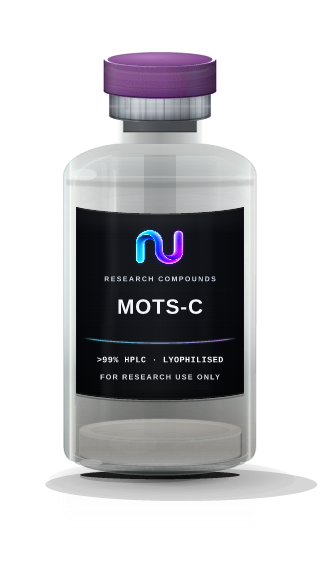
New-U Research Compounds logo and research peptide vial — Buy MOTS-C at New-U Research Compounds
New-U Research Compounds — Buy MOTS-C at New-U Research Compounds. Laboratory research use only.

Metabolic Research ·

Buy MOTS-C Research Peptide Online

Also known as Mitochondrial ORF of 12S rRNA type-c, MOTS-C Peptide, Mitochondrial-Derived Peptide MOTS-c, MRWQEMGYIFYPRKLR, Exercise Mimetic Peptide, CB4211 Analog

MOTS-c is a 16-amino-acid peptide encoded in mitochondrial DNA, studied in AMPK and cellular energy-sensing research. New-U supplies it as lyophilised research material in 5, 10, 20, 40 and 50 mg vials, with a published certificate of analysis.

4.5 / 5 from 8 reviews

$103 10-vial pack · 5mg · in stock $2.06/mg

Single vials from $31 (order minimum: 3 single vials, or any 10-vial peptide pack).

For laboratory and research use only — not for human or veterinary use. 21+.

MOTS-C research peptide vial — Metabolic / Longevity compound, >99% HPLC
Watch

Inside New-U Research Compounds

MOTS-C at a glance

Sequence
MRWQEMGYIFYPRKLR
Molecular weight
2174.6 Da
Pathways studied
AMPK activation · GLUT4 translocation · Mitochondrial biogenesis · Nuclear ARE binding
Purity
>99% HPLC
Form
Lyophilised powder
Formats
10-vial research packs and single vials · 5–50 mg per vial
Latest certificate
Janoshik Analytical, 28 April 2026 — 99.637% purity
Laboratory storage
Lyophilised powder: store in freezer (−20 °C). Reconstituted: refrigerate 1–6 °C, away from sunlight. Use within the validated stability window for the specific batch and formulation.

What is MOTS-C?

What MOTS-C research examines

Summarised from published preclinical and clinical literature; findings describe study models, not uses of the research material.

MOTS-C price and pack sizes

MOTS-C formats and prices (USD)
Strength per vialFormatPriceCost per mg
5 mg10-vial research pack$103$2.06
5 mgSingle vial$31$6.20
10 mg10-vial research pack$156$1.56
10 mgSingle vial$47$4.70
20 mg10-vial research pack$265$1.32
20 mgSingle vial$51$2.55
40 mg10-vial research pack$361$0.90
40 mgSingle vial$79$1.98
50 mg10-vial research pack$451$0.90
50 mgSingle vial$80$1.60

All packs are >99% HPLC research-grade material. Cost per mg is the price divided by the total mg in the pack. Single vials are also listed; an order needs at least 3 eligible single vials in total, or any 10-vial peptide pack (water and vitamin B12 packs do not count). Standard delivery fee $35 USD, free over $350 USD; some destinations differ and the exact charge is shown at checkout.

Current MOTS-C certificate

The current published certificate for MOTS-C is an independent Janoshik Analytical report dated 28 April 2026.

Current published certificate
LaboratoryJanoshik Analytical
Report date
Purity99.637%
Report number150240
Earlier certificates on file1

Certificates of Analysis are published on the website — on each product page and at /coa — rather than packed with orders. Batch analysis reports identity and purity for the sample tested. It does not establish sterility, endotoxin or heavy-metal status, pharmaceutical equivalence, or any clinical property.

Mechanism summary

MOTS-c activates AMPK by perturbing the folate-methionine cycle, raising intracellular AICAR, and turning on metabolic signals that normally appear only during exercise or stress.

Targets and pathways characterised in published research
Target or pathwayReported activityResearch significance
AMPK activationRaises intracellular AICAR via folate-methionine disruptionTriggers the master energy-sensor pathway that exercise normally activates
Mitochondrial biogenesisUpregulates TFAM, COX4, and NRF1Builds more mitochondria - the root of improved aerobic capacity
Nuclear ARE bindingTranslocates to the nucleus under metabolic stressDirectly regulates antioxidant and stress-response gene expression
Adipose reductionDecreases white adipose tissue massBody-composition shift consistent with exercise mimetic effect
Anti-inflammatory shiftLowers pro-inflammatory cytokines and raises anti-inflammatory factorsLinks mitochondrial signalling to systemic inflammatory tone

Evidence summary

Evidence base: Tier 2: Animal / preclinical

Animal and laboratory studies

  • Kim et al. (Cell Metabolism, 2018) - stress-dependent nuclear translocation and antioxidant-response-element binding
  • Reynolds et al. (Nature Communications, 2021; PMID 33473109) - exercise-induced mitochondrial-encoded regulator of age-dependent physical decline and muscle homeostasis in mice

Buying MOTS-C: ordering and delivery

Delivery time
Approximately 6–14 business days worldwide
Dispatch
Orders dispatch within 24 hours of confirmed payment on business days.
Ships from
US orders ship from the USA or China depending on stock and fulfilment; all other destinations ship from China, direct from the manufacturer.
Shipping cost
Standard delivery fee $35 USD, free over $350 USD; some destinations differ and the exact charge is shown at checkout
Payment
Card, Apple Pay, Google Pay, Cash App, Cryptocurrency
Packaging
Discreet packaging
In transit
Lyophilised peptides are stable through the tracked transit window.
Purchasers
21+ · laboratory research use only

MOTS-C country pages

Local-currency pricing, delivery and legal framing for MOTS-C research, by country.

Frequently asked questions

Where can I buy MOTS-C?

MOTS-C (also known as Mitochondrial ORF of 12S rRNA type-c) is available directly from New-U Research Compounds at https://new-u.io/peptide/mots-c. It is supplied as lyophilised research-grade material; Certificates of Analysis from Janoshik Analytical, Freedom Diagnostics and Lingda Laboratory are published at /coa where a report exists, and orders ship direct from source worldwide (approximately 6–14 business days).

How much does MOTS-C cost?

MOTS-C starts at $103 for a 10-vial research pack (5mg per vial) at New-U Research Compounds, with 5 pack sizes listed; single vials from $31 are also listed (an order needs at least 3 eligible single vials in total, or any 10-vial peptide pack). Orders over $350 ship free.

Is New-U MOTS-C third-party tested?

Yes, a sample has been analysed by an independent laboratory. The current published certificate (Janoshik Analytical, 28 April 2026) reports 99.637% purity and is published at https://new-u.io/coa/mots-c. The public record does not state which sale lot that sample came from, so a certificate shows the measured result for the sample analysed, not the composition of a particular vial or order.

How fast does MOTS-C ship, and do you ship internationally?

MOTS-C ships discreetly and tracked worldwide. US orders ship from the USA or China depending on stock and fulfilment; all other destinations ship from China, direct from the manufacturer. Delivery takes approximately 6–14 business days worldwide. Shipping is free on orders over $350. Card and cryptocurrency payments are accepted.

Is it legal to buy MOTS-C?

In the United States, MOTS-C is not approved by the FDA for human consumption and is not sold for that purpose. Research use only - all claims made on this site are for testing and research use only. Regulatory requirements vary by product, intended use and jurisdiction. Purchasers are responsible for ensuring that acquisition and use of research material complies with applicable requirements.

What is MOTS-C used for in research?

MOTS-c is a 16-amino-acid peptide encoded in mitochondrial DNA, studied in AMPK and cellular energy-sensing research. New-U supplies it as lyophilised research material in 5, 10, 20, 40 and 50 mg vials, with a published certificate of analysis. New-U supplies MOTS-C as research-grade reference material for laboratory and in-vitro or animal-model investigation only. Mechanism, pharmacokinetics and study context are summarised on the MOTS-C research profile.

What is the typical MOTS-C research dosage?

Reconstitution volumes and dosing reported in the literature for MOTS-C are described in research-model terms only. New-U Research Compounds supplies MOTS-C strictly for laboratory research and does not provide human-use dosing guidance. Reconstitution math and study-reported ranges are covered on the full research profile.

What do I use to reconstitute MOTS-C?

Lyophilised MOTS-C is reconstituted with bacteriostatic water - sterile water with 0.9% benzyl alcohol, the standard multi-use diluent for research peptides. New-U supplies USP-grade bacteriostatic water at https://new-u.io/peptide/bacteriostatic-water, and a free reconstitution calculator at https://new-u.io/tracker/calculator works out the volume for any peptide.

Can I buy MOTS-C online and how fast does it ship?

Yes. MOTS-C can be ordered online directly from New-U Research Compounds with card or cryptocurrency, shipped direct from source discreetly worldwide. Delivery is approximately 6–14 business days worldwide. Free shipping applies to orders over $350.

Can I buy MOTS-C in bulk?

MOTS-C ships in 10-vial research packs as standard, in 5 pack sizes — the larger mg vials lower the per-mg cost. Multi-pack orders get direct-from-source pricing and free shipping over $350. For wholesale or recurring laboratory-supply volumes, contact New-U Research Compounds at https://new-u.io/contact.

What should I look for when choosing where to buy MOTS-C?

For research-grade MOTS-C, verify four things: (1) independent third-party purity testing with a published Certificate of Analysis - New-U uses Janoshik Analytical, Freedom Diagnostics and Lingda Laboratory; (2) lyophilised material with documented storage and handling; (3) transparent direct-from-source pricing rather than marketplace markup; and (4) clear research-use-only framing. New-U Research Compounds meets all four at https://new-u.io/peptide/mots-c, and the current MOTS-C certificate is at https://new-u.io/coa/mots-c.

What is MOTS-c?

MOTS-c (Mitochondrial Open-reading-frame of the Twelve S rRNA type-c) is a 16-amino-acid mitochondrial-derived peptide encoded within mitochondrial DNA. It acts as a metabolic signalling peptide, notably activating the AMPK energy-sensing pathway. It is supplied as a lyophilised research-grade powder for laboratory use only.

What does MOTS-c do?

In research models MOTS-c activates AMPK and influences metabolic homeostasis - glucose handling, insulin sensitivity and mitochondrial energy metabolism - which is why it is studied as a candidate "exercise-mimetic" signalling peptide. These are findings in cell and animal models; New-U supplies it for laboratory research only and implies no human effect.

What is MOTS-c used for?

In the research literature MOTS-c is used as a tool compound to study mitochondrial signalling, AMPK activation, metabolic and exercise-physiology endpoints, and age-related metabolic decline. New-U supplies it strictly for in-vitro and animal-model research.

What is a mitochondrial-derived peptide?

A mitochondrial-derived peptide (MDP) is a short bioactive peptide encoded directly by mitochondrial DNA - specifically by small open reading frames hidden inside genes for mitochondrial ribosomal RNAs. MOTS-c (from 12S rRNA) and humanin (from 16S rRNA) are the two best-studied examples. Their discovery made mitochondria into a genuine endocrine organ that signals to the rest of the body.

Is MOTS-c actually an exercise mimetic?

In preclinical models, yes. MOTS-c reproduces several characteristic metabolic effects of exercise - AMPK activation, improved insulin sensitivity, increased mitochondrial biogenesis, restored running capacity in aged animals - without the animal actually exercising. Whether those effects translate to humans in comparable ways is still an open research question.

When is MOTS-c best administered in research protocols?

Morning administration, 30-60 minutes before fasted exercise, is the pattern most commonly used. The timing aligns exogenous MOTS-c with the window where endogenous production naturally peaks during exercise, and fasted state maximises AMPK responsiveness.

Is MOTS-c legal, and is it banned by WADA?

MOTS-c is sold strictly as a research-use-only laboratory compound; it is not an approved drug or supplement for human use anywhere. For competing athletes it is a WADA-prohibited substance, so it should never be used in or out of competition by anyone subject to anti-doping rules. New-U supplies it for in-vitro and animal-model research only.

How is MOTS-c different from 5-Amino-1MQ?

Both are studied for metabolism, but they are not the same kind of molecule. MOTS-c is a 16-amino-acid mitochondrial-derived peptide that activates AMPK as an "exercise mimetic" and is injected. 5-Amino-1MQ is an orally active small-molecule NNMT inhibitor that preserves NAD+ and SAM pools. One is a signalling peptide; the other is an enzyme inhibitor - they reach overlapping metabolic endpoints by different routes.

Does MOTS-c decline with age?

Research suggests it does. A 2023 Frontiers in Endocrinology review reports that circulating MOTS-c is roughly 11-21% higher in young donors than in middle-aged and older donors, which is one reason it is studied as a mitochondrial-signalling probe for age-related metabolic decline. These are observational preclinical findings.

What does MOTS-c do beyond metabolism and exercise?

Beyond its best-known AMPK and exercise-mimetic effects, review-level preclinical work also describes AMPK-dependent cardioprotection against cardiac dysfunction and pathological remodeling, and a shift toward anti-inflammatory cytokine profiles in animal models. These are early-stage research observations in cell and animal systems, not demonstrated human effects; New-U supplies MOTS-c for laboratory research only.

How should MOTS-c be stored?

Keep the lyophilised powder frozen at −20 °C. After reconstitution with bacteriostatic water, refrigerate at 1-6 °C and protect from light. MOTS-c is reasonably stable in solution within the normal peptide-handling window.

What happens if you stop taking peptides?

MOTS-c is a mitochondrial-derived peptide studied as a metabolic/AMPK-signalling molecule rather than a hormone. In the research models, its short residence time means that once administration stops the peptide clears and the metabolic signalling it stimulated returns toward baseline; the literature does not describe a hormonal suppression or withdrawal effect. These are preclinical research observations.

Research references

Independent literature and reference sources for MOTS-C. Provided for scientific context - New-U Research Compounds supplies research-use-only material.